



AD
4-[(2,4-Dichloro-5-methoxyphenyl)amino]-6-methoxy-7-[3-(4-methyl-1-piperazinyl)propoxy]-3-quinolinecarbonitrile(CAS: 380843-75-4)
![4-[(2,4-Dichloro-5-methoxyphenyl)amino]-6-methoxy-7-[3-(4-methyl-1-piperazinyl)propoxy]-3-quinolinecarbonitrile](https://static.chemtradehub.com/structs/380/380843-75-4-9c11.webp "4-[(2,4-Dichloro-5-methoxyphenyl)amino]-6-methoxy-7-[3-(4-methyl-1-piperazinyl)propoxy]-3-quinolinecarbonitrile")
CAS Number
Related Products
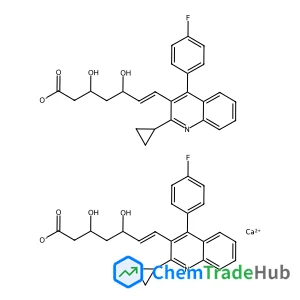
Pitavastatin Calcium
CAS Number: 147526-32-7
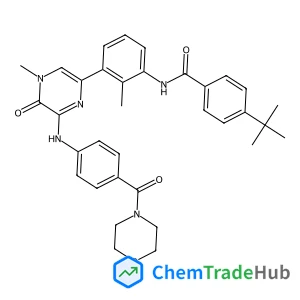
![2-Hydroxypropanoic acid - 4-amino-5-fluoro-3-[5-(4-methyl-1-piperazinyl)-1H-benzimidazol-2-yl]-2(1H)-quinolinone hydrate (1:1:1)](https://static.chemtradehub.com/structs/915/915769-50-5-4c04.webp)
![9-Methoxy-7H-furo[3,2-g]chromen-7-one](https://static.chemtradehub.com/structs/298/298-81-7-6887.webp)
9-Methoxy-7H-furo[3,2-g]chromen-7-one
CAS Number: 298-81-7
![3-(2-Amino-1,3-benzoxazol-5-yl)-1-isopropyl-1H-pyrazolo[3,4-d]pyrimidin-4-amine](https://static.chemtradehub.com/structs/122/1224844-38-5-7135.webp)
![N-(4-chlorophenyl)-4-[(pyridin-4-yl)methyl]phthalazin-1-amine](https://static.chemtradehub.com/structs/212/212141-54-3-18b3.webp)
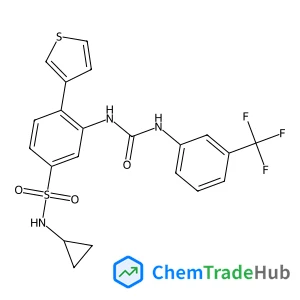
![2-[3-cyano-4-(2-methylpropoxy)phenyl]-4-methyl-1,3-thiazole-5-carboxylic acid](https://static.chemtradehub.com/structs/144/144060-53-7-2f9c.webp)
![2-[{1-[1-(4-Fluorobenzyl)-1H-benzimidazol-2-yl]-4-piperidinyl}(methyl)amino]-4(3H)-pyrimidinone](https://static.chemtradehub.com/structs/108/108612-45-9-bf4d.webp)
Other Suppliers for 4-[(2,4-Dichloro-5-methoxyphenyl)amino]-6-methoxy-7-[3-(4-methyl-1-piperazinyl)propoxy]-3-quinolinecarbonitrile
![4-[(2,4-Dichloro-5-methoxyphenyl)amino]-6-methoxy-7-[3-(4-methyl-1-piperazinyl)propoxy]-3-quinolinecarbonitrile — Shanghai Yinxin Laboratory Equipment Co., Ltd.](https://static.chemtradehub.com/suppliers/67cdd97a57537e5c8069adfb/67cdd97a57537e5c8069adfb-logo.webp)
![4-[(2,4-Dichloro-5-methoxyphenyl)amino]-6-methoxy-7-[3-(4-methyl-1-piperazinyl)propoxy]-3-quinolinecarbonitrile — Nanjing BaiXinDeNo Bio-tech Co., Ltd](https://static.chemtradehub.com/suppliers/67cec8dd2b2de6e8e95a5134/67cec8dd2b2de6e8e95a5134-logo.webp)
![4-[(2,4-Dichloro-5-methoxyphenyl)amino]-6-methoxy-7-[3-(4-methyl-1-piperazinyl)propoxy]-3-quinolinecarbonitrile — Shanghai Jixiang Biotechnology Co., Ltd.](https://static.chemtradehub.com/suppliers/67ce6f4d2b2de6e8e95a45bf/67ce6f4d2b2de6e8e95a45bf-logo.webp)
Basic Information
Molecular Formula
C26H29Cl2N5O3
Molecular Weight
530.4 g/mol
Physical State
No data available
Physical Properties
Melting Point
116-120 ºC
Boiling Point
649.7±55.0°C at 760 mmHg
Flash Point
346.7±31.5 °C
Chemical Identifiers
SMILES
CN1CCN(CC1)CCCOC2=C(C=C3C(=C2)N=CC(=C3NC4=CC(=C(C=C4Cl)Cl)OC)C#N)OC
InChIKey
UBPYILGKFZZVDX-UHFFFAOYSA-N
Database References
MDL Number
MFCD07367846
FAQ
4-[(2,4-Dichloro-5-methoxyphenyl)amino]-6-methoxy-7-[3-(4-methyl-1-piperazinyl)propoxy]-3-quinolinecarbonitrile (CAS: 380843-75-4) is a complex organic compound with a quinolinecarbonitrile core. It contains multiple functional groups, including methoxy, dichloro, and piperazinyl substituents, making it a potential candidate for pharmaceutical applications. The compound is known for its structural complexity and is often used in research for drug development and chemical synthesis.
This compound is primarily used in pharmaceutical research as a lead molecule for the development of new drugs, particularly in the treatment of neurological disorders. It may also find applications in chemical synthesis and as an intermediate in the production of various organic compounds. Its unique structure makes it valuable for studying molecular interactions and biological activity in drug discovery.
Safety data for this compound is limited, but as a chemical substance, it should be handled with care. It is important to follow standard laboratory safety protocols, including the use of protective equipment like gloves and goggles. Due to its potential reactivity and unknown long-term effects, it is recommended to use it in controlled environments and adhere to safety guidelines specific to its chemical properties.
This compound should be stored in a cool, dry, and dark place, ideally at temperatures below 25°C. It is recommended to keep it in a sealed container to prevent moisture exposure and maintain stability. Avoid prolonged exposure to light and air to minimize degradation. Proper storage ensures the compound remains chemically stable and safe for use in research settings.
Safety Notice
Please verify product specifications and safety data before use. Contact the supplier for detailed safety information.
Always follow proper handling procedures
Contact Information
junyichen2015@outlook.com