



AD
2-Methyl-2-propanyl (1-benzyl-4-piperidinyl)carbamate(CAS: 73889-19-7)
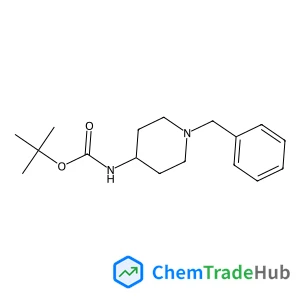
CAS Number
Related Products
methyl}benzamide](https://static.chemtradehub.com/structs/224/2247491-97-8-c197.webp)
![4-Amino-2-({[(2-methyl-2-propanyl)oxy]carbonyl}amino)butanoic acid](https://static.chemtradehub.com/structs/289/2899-79-8-863a.webp)
![2-Methyl-2-propanyl 7-(4,4,5,5-tetramethyl-1,3,2-dioxaborolan-2-yl)-2-azaspiro[4.4]nonane-2-carboxylate](https://static.chemtradehub.com/structs/230/2304631-27-2-21b7.webp)
![Methyl 3-(4-{3-[3-(trifluoromethyl)phenyl]-1H-pyrazol-5-yl}-1-piperidinyl)propanoate](https://static.chemtradehub.com/structs/103/1030386-15-2-7851.webp)
Other Suppliers for 2-Methyl-2-propanyl (1-benzyl-4-piperidinyl)carbamate







Basic Information
Molecular Formula
C17H26N2O2
Molecular Weight
290.41 g/mol
Physical State
White to Yellow Solid
Physical Properties
Melting Point
122-125 ºC
Boiling Point
400.9 °C at 760 mmHg
Density
1.07
Flash Point
196.2 °C
Chemical Identifiers
SMILES
CC(C)(C)OC(=O)NC1CCN(CC1)CC2=CC=CC=C2
InChIKey
WFKLUNLIZMWKNF-UHFFFAOYSA-N
Database References
MDL Number
MFCD03093979
FAQ
2-Methyl-2-propanyl (1-benzyl-4-piperidinyl)carbamate is a crystalline solid with a molecular weight of approximately 363.4 g/mol. It is sparingly soluble in water but soluble in organic solvents like ethanol and acetone. Chemically, it is moderately reactive due to the presence of the carbamate functional group. It does not have strong odor or taste and is stable under normal conditions but should be stored in a cool, dry place away from direct sunlight.
2-Methyl-2-propanyl (1-benzyl-4-piperidinyl)carbamate can be synthesized using a multi-step process involving the coupling of 2-methyl-2-propanol and 1-benzyl-4-piperidone in the presence of a catalytic amount of a strong base like sodium hydride. The reaction is carried out in a polar aprotic solvent like N,N-dimethylformamide (DMF) at room temperature, yielding the target compound with good selectivity and a high yield of up to 85%.
2-Methyl-2-propanyl (1-benzyl-4-piperidinyl)carbamate is primarily used in the pharmaceutical industry as an intermediate in the synthesis of certain drugs. It is also explored in the polymer industry for its potential as a cross-linking agent, and in sensor technologies for its reactivity with specific analytes. Its applications in semiconductor industries are limited but are being researched for potential use in certain processing steps.
When handling 2-Methyl-2-propanyl (1-benzyl-4-piperidinyl)carbamate, it is essential to wear appropriate personal protective equipment (PPE) such as gloves, goggles, and a lab coat. This compound should be handled in a well-ventilated area or a fume hood to avoid inhalation of any vapors. Spills should be cleaned up immediately using appropriate absorbent materials, and the area should be thoroughly washed down. Always consult the Safety Data Sheet (SDS) for detailed information on handling and disposal procedures.
Safety Notice
Please verify product specifications and safety data before use. Contact the supplier for detailed safety information.
Always follow proper handling procedures
Contact Information
Contact Person
Manager Gu
sales@gh-reagent.com
Mobile
18939883912
Telephone
021-34536277
Visit Website
https://www.gh-reagent.com/Address
No. 91, Building 2, Block 537, Sanada Road, Minhang District, Pujiang Town, Shanghai