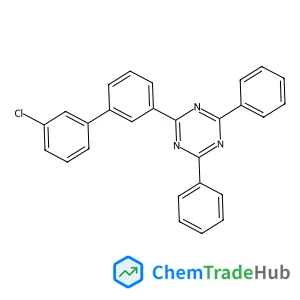
2-(3'-Chlorobiphenyl-3-yl)-4,6-diphenyl-1,3,5-triazine
CAS Number:
1443049-83-9
Molecular Formula:
C27H18ClN3
This Update spans all the abstracts listed in the 1995 issues of JAAS (95/1–95/4243). Developments in sample preparation/enrichment continued apace. Many of these involved FI and were usually coupled directly to the analytical instrument for on-line measurements. In our recent Updates, accelerator MS for investigations of A1 physiology has been featured; this year we saw the application of the technique to Ca and other elements. The ever-present interest in lead exposure among children has prompted construction of simple, semi-portable instruments with electrothermal atomizers, dedicated to measurement of Pb in blood. These emerged at Pittcon 1995 and were also shown at later conferences. Investigations of trace element nutrition and metabolism using stable isotopes and mass spectrometric methods have been reported in the past, but this year saw the publication of a comprehensive review of this important topic. A number of papers from the Fifth Nordic Symposium on Trace Elements in Human Health and Disease were published in The Analyst, including two which described endemic arsenic toxicity in West Bengal. As the source of exposure was naturally contaminated drinking water, this tragic situation must have been ongoing for many years, and it is surprising that information has only recently been forthcoming.
Z. M. Jendi, P. Servio, A. D. Rey
DOI: 10.1039/C5CP06530E
You Wang, Yun Wang, Wei Ren, Porun Liu, Huijun Zhao, Jun Chen, Jinxia Deng, Xianran Xing
DOI: 10.1039/C5CP03941J
Michael Vester, Andreas Grueter, Björn Finkler, Robert Becker, Gregor Jung
DOI: 10.1039/C6CP00718J
Shuqiong Xu, Hongjin Fu, Chengmao Zhang, Zonglei Gu, Danhui Zhang
DOI: 10.1039/C6CP00385K
Sijia Wang, Yinxing Shen, Junqi Zhang, Shouhong Xu, Honglai Liu
DOI: 10.1039/C6CP00378H
Zachary P. L. Laker, Jonathan P. Rourke, Neil R. Wilson
DOI: 10.1039/C5CP04070A
S. Soulé, J. Allouche, J.-C. Dupin, C. Courrèges, F. Plantier, W.-S. Ojo, Y. Coppel, C. Nayral, F. Delpech, H. Martinez
DOI: 10.1039/C5CP04491J
DOI: 10.1039/C6CP00579A
Hongping Li, Yonghui Chang, Wenshuai Zhu, Changwei Wang, Chao Wang, Sheng Yin, Ming Zhang
DOI: 10.1039/C5CP04172D
L. Shi, A. Xu, T. S. Zhao
DOI: 10.1039/C5CP03886C
(3.beta.)-3-Hydroxy-N,N-dimethyl-chol-5-en-24-amide (CAS: 79066-03-8) is primari...
5-(Aminomethyl)-2-methoxyphenol (CAS: 89702-89-6) is classified under GHS as a s...
Thieno[2,3-c]pyridin-7(6H)-one (CAS: 28981-13-7) is a heterocyclic organic compo...
1-[(6-Methoxy-3-pyridinyl)methyl]-4-piperidinamine dihydrochloride is generally ...
[(2E)-3-Phenyl-2-propen-1-yl]phosphonic acid (CAS: 146404-58-2) is regulated und...
6-Bromo-7-methoxyquinoline (CAS: 1620515-86-7) falls under the scope of the Glob...
This compound is primarily used in the pharmaceutical industry for the developme...
1-Ethyl-7-[2-methyl-6-(4H-1,2,4-triazol-3-yl)-3-pyridinyl]-3,5-dihydropyrazino[2...
Alternative reagents such as 2-[(dimethylamino)methyl]phenylboronic acid or rela...
3-(Piperidin-4-yloxy)pyridine (CAS: 310881-48-2) is an organic compound with the...

The Journal of Analytical Atomic Spectrometry (JAAS) is the central journal for publishing innovative research on fundamentals, instrumentation, and methods in the determination, speciation and isotopic analysis of (trace) elements within all fields of application. This includes, but is not restricted to, the most recent progress, developments and achievements in all forms of atomic and elemental detection, isotope ratio determination, molecular analysis, plasma-based analysis and X-ray techniques. The journal welcomes full papers, communications, technical notes, critical and tutorial review articles, editorials, and comments, in addition to the Atomic Spectrometry Updates (ASU) literature reviews that are prepared by an expert panel. Submissions are welcome in the following areas, but note this list reflects the current scope and authors are strongly encouraged to contact the Editorial team if they believe that their work offers potentially new and emerging research relevant to the journal remit: Fundamental studies in the following. New and existing sources for atomic emission, absorption, fluorescence and mass spectrometry and those that provide both atomic and molecular information Sample introduction techniques for solids, liquids, gases Improvements in sensitivity, selectivity, precision, accuracy and/or robustness Isotope ratio measurements, including techniques for improving precision and mass bias correction Single channel and multichannel simultaneous detection systems Chemometrics, statistics, calibration techniques and internal standardisation Theoretical and numerical modelling of fundamental processes related to all of the above methodologies Novel or improved methodologies in areas of application including, but not limited to the following. Biosciences, including elemental, speciation and isotopic analysis in biological systems, immunoassays based on metal-labeled antibodies, bio-imaging, and nanoparticle toxicology Geochemistry Environmental science Materials science, including engineered nanoparticles and quantum dots Metrology, including reference materials Forensic analysis Food and agricultural sciences Energy Archaeometry Molecular analysis. Molecular sources for elemental and isotopic analysis Atomic sources for molecular analysis Atomic and molecular techniques simultaneously used for complementary chemical information All contributions are judged on originality and quality of scientific content, and appropriateness of length to content of new science.