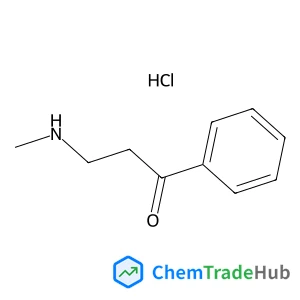
3-(Methylamino)-1-phenyl-1-propanone hydrochloride (1:1)
CAS Number:
2538-50-3
Molecular Formula:
C10H14ClNO
A graphical abstract is available for this content
Jaebeom Han, Perla B. Balbuena
DOI: 10.1039/C8CP02912A
Kevin G. Yager
DOI: 10.1039/C8CP02854K
Hendrik Böhnke, Rebecca A. Ingle, Hugo J. B. Marroux, Mats Bohnsack, Andrew J. Orr-Ewing, Friedrich Temps
DOI: 10.1039/C8CP02664E
Yu Matsuda, Itsuo Hanasaki, Ryo Iwao, Hiroki Yamaguchi, Tomohide Niimi
DOI: 10.1039/C8CP02566E
Sergei A. Chernyak, Anton S. Ivanov, Angelina M. Podgornova, Ekaterina A. Arkhipova, Stepan Yu. Kupreenko, Alexei V. Shumyantsev, Natalia E. Strokova, Konstantin I. Maslakov, Serguei V. Savilov, Valery V. Lunin
DOI: 10.1039/C8CP05149F
H. Fabio Busnengo
DOI: 10.1039/C8CP03515F
Ilia A. Vovk, Nikita V. Tepliakov, Anvar S. Baimuratov, Mikhail Yu. Leonov, Alexander V. Baranov, Anatoly V. Fedorov, Ivan D. Rukhlenko
DOI: 10.1039/C8CP04724C
When handling 4-(2-Furylmethyl)thiomorpholine 1,1-dioxide (CAS: 79206-94-3), it ...
When handling 4-Chloro-N-[2-(4-morpholinyl)ethyl]benzamide (CAS: 71320-77-9), it...
Waste containing this compound (CAS: 62921-74-8) should be handled according to ...
Waste containing (S)-Methyl 2-amino-3-cyclohexylpropanoate should be collected i...
This compound can be synthesized using a multi-step process involving the conjug...
There are several alternatives to (2E)-3-(3,4-Dichlorophenyl)acrylic acid in syn...
Ethyl 6-(2-nitrophenyl)imidazo[2,1-b][1,3]thiazole-3-carboxylate (CAS: 925437-84...
Waste containing 2-(1,3-Thiazol-2-yl)ethanamine (CAS: 18453-07-1) should be coll...
Methyl 5-iodo-2-methylbenzoate can be synthesized through the iodination of meth...
5-Chloro[1,2,4]triazolo[1,5-a]pyridine is commonly synthesized via the condensat...

NJC (New Journal of Chemistry) is a broad-based primary journal encompassing all branches of chemistry and its sub-disciplines. It contains full research articles, communications, perspectives and focus articles. This well-established journal, owned by the Centre National de la Recherche Scientifique (CNRS) of France, has been co-published with the Royal Society of Chemistry since January 1998. NJC is the forum for the publication of high-quality, original and significant work that opens new directions in chemistry or other scientific disciplines. In addition to having a significant chemical component, work published in NJC must demonstrate that it will have an impact on areas of research other than that of the reported work.