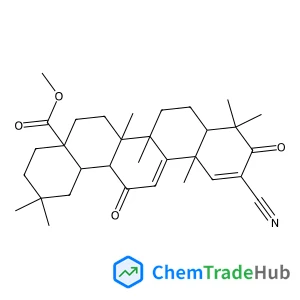
Methyl 2-cyano-3,12-dioxooleana-1,9(11)-dien-28-oate
CAS Number:
218600-53-4
Molecular Formula:
C32H43NO4
Jaebeom Han, Perla B. Balbuena
Oxidation potentials of electrolyte molecules in Li–sulfur (Li/S) batteries and their variations in various solvent environments are investigated using first-principles calculations in order to understand oxidative decomposition reactions of electrolytes for cathode passivation. Electrolyte solvents, Li salts, and various additives in Li/S batteries along with some Li-ion battery additives are studied. Oxidation potentials of isolated electrolyte molecules are found to be out of the operating range of typical Li/S batteries. The complexation of electrolyte molecules with Li+, salt anion, salt, S8, and pyrene alters oxidation potentials compared to those of the isolated systems. The salt anion lowers oxidation potentials of electrolyte molecules by at least 4.7% while the complexes with Li+ have higher oxidation potentials than the isolated molecules by at least 10.4%. S8 and pyrene, used as model compounds for sulfur and sulfur/carbon composite cathode materials, also affect oxidation potentials of electrolyte molecules, but their influence is negligible and the oxidation trends differ from those of the Li+ and salt anion. Although complexations change the oxidation potentials of electrolyte molecules, they are still higher than the operating voltage range of Li/S batteries, which indicates that oxidation of the studied electrolytes in Li/S batteries is not expected under ambient conditions.
Jonathan Sjögren, Fredrik Olsson, Alain Beck
DOI: 10.1039/C6AN00071A
Ishaan Maitra, Camilo L. M. Morais, Katherine M. Ashton, Ravindra S. Date, Francis L. Martin
DOI: 10.1039/C9AN01749F
Jennifer Wild, Meera Shanmuganathan, Mika Hayashi, Murray Potter
DOI: 10.1039/C9AN01642B
Wen Chen, Mei Yang, Na Luo, Fenglin Wang, Ru-Qin Yu, Jian-Hui Jiang
DOI: 10.1039/C9AN01778J
Elena Tsolaki, Louis Didierlaurent, Samuel Staubli, Robert Zboray, Antonia Neels, Dörthe Dietrich, Pius Manser, Lotus May Desbiolles, Sebastian Leschka, Simon Wildermuth, Sandro Lehner, Pascale Chavatte-Palmer, Wolfram Jochum, Peter Wick, Tina Bürki-Turnherr, Tina Fischer, René Hornung, Sergio Bertazzo
DOI: 10.1039/C9AN01312A
Xiao-xiao Niu, Qin-chao Xu, An-zhen Li, Yang-jie Li, Xiao-tai Zhang, Guo-wen Xing
DOI: 10.1039/C9AN01940E
Hui Hun Cho, Si Hyun Kim, Jun Hyuk Heo, Young Eel Moon, Young Hun Choi, Dong Cheol Lim, Kwon-Hoon Han
DOI: 10.1039/C6AN00744A
When handling 4-(2-Furylmethyl)thiomorpholine 1,1-dioxide (CAS: 79206-94-3), it ...
When handling 4-Chloro-N-[2-(4-morpholinyl)ethyl]benzamide (CAS: 71320-77-9), it...
Waste containing this compound (CAS: 62921-74-8) should be handled according to ...
Waste containing (S)-Methyl 2-amino-3-cyclohexylpropanoate should be collected i...
This compound can be synthesized using a multi-step process involving the conjug...
There are several alternatives to (2E)-3-(3,4-Dichlorophenyl)acrylic acid in syn...
Ethyl 6-(2-nitrophenyl)imidazo[2,1-b][1,3]thiazole-3-carboxylate (CAS: 925437-84...
Waste containing 2-(1,3-Thiazol-2-yl)ethanamine (CAS: 18453-07-1) should be coll...
Methyl 5-iodo-2-methylbenzoate can be synthesized through the iodination of meth...
5-Chloro[1,2,4]triazolo[1,5-a]pyridine is commonly synthesized via the condensat...

Physical Chemistry Chemical Physics (PCCP) is an international journal co-owned by 19 physical chemistry and physics societies from around the world. This journal publishes original, cutting-edge research in physical chemistry, chemical physics and biophysical chemistry. To be suitable for publication in PCCP, articles must include significant innovation and/or insight into physical chemistry; this is the most important criterion that reviewers and Editors will judge against when evaluating submissions. The journal has a broad scope and welcomes contributions spanning experiment, theory, computation and data science. Topical coverage includes spectroscopy, dynamics, kinetics, statistical mechanics, thermodynamics, electrochemistry, catalysis, surface science, quantum mechanics, quantum computing and machine learning. Interdisciplinary research areas such as polymers and soft matter, materials, nanoscience, energy, surfaces/interfaces, and biophysical chemistry are welcomed if they demonstrate significant innovation and/or insight into physical chemistry. Joined experimental/theoretical studies are particularly appreciated when complementary and based on up-to-date approaches.
![4-{2-[4-(2-Methyl-2-propanyl)phenyl]ethoxy}quinazoline structure](https://static.chemtradehub.com/structs/120/120928-09-8-d3db.webp "4-{2-[4-(2-Methyl-2-propanyl)phenyl]ethoxy}quinazoline structure")