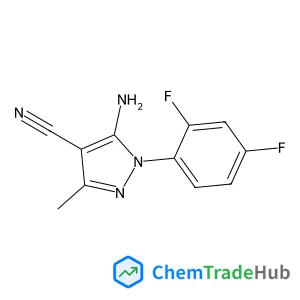
5-Amino-1-(2,4-difluorophenyl)-3-methyl-1H-pyrazole-4-carbonitrile
CAS Number:
1020057-92-4
Molecular Formula:
C11H8F2N4
B. Sivaraman, A. M. Mebel, N. J. Mason, D. Babikov
The formation of six ozone isotopomers and isotopologues, 16O16O16O, 18O18O18O, 16O16O18O, 18O18O16O, 16O18O16O, and 18O16O18O, has been studied in electron-irradiated solid oxygen 16O2 and 18O2 (1 ∶ 1) ices at 11 K. Significant isotope effects were found to exist which involved enrichment of 18O-bearing ozone molecules. The heavy 18O18O18O species is formed with a factor of about six higher than the corresponding 16O16O16O isotopologue. Likewise, the heavy 18O18O16O species is formed with abundances of a factor of three higher than the lighter 16O16O18O counterpart. No isotope effect was observed in the production of 16O18O16Oversus18O16O18O. Such studies on the formation of distinct ozone isotopomers and isotopologues involving non-thermal, non-equilibrium chemistry by irradiation of oxygen ices with high energy electrons, as present in the magnetosphere of the giant planets Jupiter and Saturn, may suggest that similar mechanisms may contribute to the 18O enrichment on the icy satellites of Jupiter and Saturn such as Ganymede, Rhea, and Dione. In such a Solar System environment, energetic particles from the magnetospheres of the giant planets may induce non-equilibrium reactions of suprathermal and/or electronically excited atoms under conditions, which are quite distinct from isotopic enrichments found in classical, thermal gas phase reactions.
Angela S. Carlson, Joseph J. Topczewski
DOI: 10.1039/C8OB03178A
Zhenzhen Zhan, Haojie Ma, Xinfeng Cui, Pengbo Jiang, Jinghong Pu, Yixin Zhang, Guosheng Huang
DOI: 10.1039/C9OB00531E
Zhenjie Su, Zengyang Xie, Shan Wang, Naili Luo, Cunde Wang
DOI: 10.1039/C9OB01308C
Kristýna Cagašová, Maryam Ghavami, Zhong-Ke Yao, Paul R. Carlier
DOI: 10.1039/C9OB01139K
Elena A. Zakharova, Olga I. Shmatova, Irina V. Kutovaya, Valentine G. Nenajdenko
DOI: 10.1039/C9OB00229D
Jian-Yun Lin, Juan-Juan Gao, Xin-Yan Wu
DOI: 10.1039/C9OB00736A
Riccardo Gava, Elena Fernández
DOI: 10.1039/C9OB00989B
1-(2,4,6-Trifluorophenyl)ethanol is an organic compound with the CAS number 1250...
1-(2,4-Dimethoxybenzyl)-4-(hydroxymethyl)-2-pyrrolidinone (CAS: 919111-34-5) is ...
(7S,15R)-6β,15-Diacetoxy-7α,20-epoxy-7-hydroxykaura-2,16-dien-1-one is a crystal...
The compound rac-ethyl (1r,4r)-4-hydroxycyclohexane-1-carboxylate, trans (CAS: 3...
The market for 2-(2,4-Difluorophenoxy)-3-nitropyridine (CAS: 175135-62-3) is cur...
The main uses of 6-Diazo-5-oxo-L-norleucine (CAS: 157-03-9) include research in ...
When handling 2-Aminoethyl-mono-amide-DOTA-tris(tBu ester) (CAS: 173308-19-5), i...
5-Methylimidazo[1,2-a]pyridine-3-carbaldehyde (CAS: 178488-37-4) can be synthesi...
There are alternative reagents that can be used in the synthesis of 2,4,6-Trihyd...
(2Z)-3-(5-Fluoro-1H-indol-3-yl)-2-sulfanylacrylic acid is a chemical compound wi...

Physical Chemistry Chemical Physics (PCCP) is an international journal co-owned by 19 physical chemistry and physics societies from around the world. This journal publishes original, cutting-edge research in physical chemistry, chemical physics and biophysical chemistry. To be suitable for publication in PCCP, articles must include significant innovation and/or insight into physical chemistry; this is the most important criterion that reviewers and Editors will judge against when evaluating submissions. The journal has a broad scope and welcomes contributions spanning experiment, theory, computation and data science. Topical coverage includes spectroscopy, dynamics, kinetics, statistical mechanics, thermodynamics, electrochemistry, catalysis, surface science, quantum mechanics, quantum computing and machine learning. Interdisciplinary research areas such as polymers and soft matter, materials, nanoscience, energy, surfaces/interfaces, and biophysical chemistry are welcomed if they demonstrate significant innovation and/or insight into physical chemistry. Joined experimental/theoretical studies are particularly appreciated when complementary and based on up-to-date approaches.