


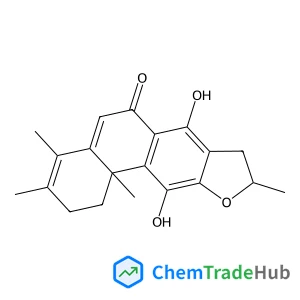
Phenanthro(3,2-b)furan-6(2H)-one, 1,8,9,11b-tetrahydro-7,11-dihydroxy-3,4,9,11b-tetramethyl-, cis-
CAS Number:
99624-92-7
Molecular Formula:
C20H22O4
Yanfang Sun, Han Wang, Amin Shavandi, Lei Nie, Khaydar E. Yunusov
An appropriate non-oral platform via transdermal delivery of drugs is highly recommended for the treatment of hyperuricemia. Herein, a core–shell structured microneedle patch with programmed drug release functions was designed to regulate serum uric acid (SUA) levels for prolonged hyperuricemia management. The patch was fabricated using a three-step casting method. Allopurinol (AP), an anti-hyperuricemic drug, was encapsulated within the carboxymethyl cellulose (CMC) layer, forming the “shell” of the MNs. The MN's inner core was composed of polyvinylpyrrolidone (PVP) loaded with urate oxidase-calcium peroxide nanoparticles (UOx-CaO2 NPs). When the as-fabricated core–shell structured microneedles were inserted into the skin, the loaded AP was first released immediately to effectively inhibit the production of SUA due to the water solubility of CMC. Subsequently, the internal SUA was further metabolized by UOx, leading to exposure of CaO2 NPs. The sustained release of UOx accompanied by the decomposition of CaO2 NPs contributed to maintaining a state of normal uric acid levels over an extended period. More attractively, uric acid could be oxidized due to the strong oxidant of CaO2, which was beneficial to the continuous consumption of uric acid. In vivo results showed that the as-fabricated MNs exhibited an excellent anti-hyperuricemia effect to reduce SUA levels to the normal state within 3 h and maintain the normouricemia state for 12 h. In addition, the levels of creatinine (Cr) and blood urea nitrogen (BUN) in the serum remained within the normal range, and the activities of adenosine deaminase (ADA) and xanthine oxidase (XOD) in the liver were effectively inhabited, mitigating the risk of liver and kidney damage for clinical anti-hyperuricemia management.

Organic Preparations and Procedures International

Kinetics and Catalysis

Journal of Organometallic Chemistry

Proceedings of the National Academy of Sciences of the United States of America

Journal of Heterocyclic Chemistry

Fibre Chemistry

Nature

Science

European Journal of Wood and Wood Products

Journal of Catalysis
Tao Cai, Wen Jing Yang
DOI: 10.1039/C2PY00609J
DOI: 10.1039/C2PY00588C
Hirofumi Tsuruta, Yoshihisa Fujii, Keiji Tanaka
DOI: 10.1039/C1PY00488C
Dong Wang, Yuzhen Zhao, Hong Gao, Yan Xing, Huai Yang
DOI: 10.1039/C2PY00593J
Akihito Hashidzume
DOI: 10.1039/C1PY00162K
Zhongmin Dong, Zhibin Ye
DOI: 10.1039/C1PY00368B
Mahadeo R. Halhalli, Carla S. A. Aureliano, Eric Schillinger, Claudia Sulitzky, M. Magdalena Titirici, Börje Sellergren
DOI: 10.1039/C2PY00544A
Qiang Fu, Jing. M. Ren, Greg. G. Qiao
DOI: 10.1039/C1PY00362C
4-(4-tert-Butylphenyl)-1H-pyrazol-3-amine finds applications in various industri...
H3TATAB is used in the pharmaceutical industry for the synthesis of certain orga...
1-Ethyl-3-fluorobenzene (CAS: 696-39-9) is primarily used as a precursor in the ...
1-(tert-Butoxycarbonyl)-4-(4-methoxyphenyl)pyrrolidine-3-carboxylic acid is prim...
1-Cyclobutyl-4-piperidinone (CAS: 359880-05-0) is a colorless or white crystalli...
Pyridine-2,6-dicarboxylic acid mono-tert-butyl ester (CAS: 575433-76-0) is a che...
The market for 2,3-Difluorophenylalanine (CAS: 236754-62-4) is growing with incr...
(2-Hydroxy-1-naphthyl)boronic acid can be synthesized through the reduction of 2...
This compound is a crystalline solid with a molecular weight of approximately 52...
While 5,7-Dihydroxy-4-oxo-2-(3,4,5-trihydroxyphenyl)-4H-chromen-3-yl beta-D-gluc...

Journal of Materials Chemistry A, B & C cover high quality studies across all fields of materials chemistry. The journals focus on those theoretical or experimental studies that report new understanding, applications, properties and synthesis of materials. The journals have a strong history of publishing quality reports of interest to interdisciplinary communities and providing an efficient and rigorous service through peer review and publication. The journals are led by an international team of Editors-in-Chief and Associate Editors who are all active researchers in their fields. Journal of Materials Chemistry A, B & C are separated by the intended application of the material studied. Broadly, applications in energy and sustainability are of interest to Journal of Materials Chemistry A, applications in biology and medicine are of interest to Journal of Materials Chemistry B, and applications in optical, magnetic and electronic devices are of interest to Journal of Materials Chemistry C. More than one Journal of Materials Chemistry journal may be suitable for certain fields and researchers are encouraged to submit their paper to the journal that they feel best fits for their particular article. Example topic areas within the scope of Journal of Materials Chemistry B are listed below. This list is neither exhaustive nor exclusive. Antifouling coatings Biocompatible materials Bioelectronics Bioimaging Biomimetics Biomineralisation Bionics Biosensors Diagnostics Drug delivery Gene delivery Immunobiology Nanomedicine Regenerative medicine & Tissue engineering Scaffolds Soft robotics Stem cells Therapeutic devices image block All articles published in Journal of Materials Chemistry B from 2019 onwards will be indexed in MEDLINE®. Articles that primarily focus on providing insight into the underlying science and performance of biomaterials within a biological environment are more suited to our companion journal, Biomaterials Science.
![6-Nitro-2-(4-nitrophenyl)imidazo[1,2-a]pyridine structure](https://static.chemtradehub.com/structs/118/118000-57-0-cb82.webp "6-Nitro-2-(4-nitrophenyl)imidazo[1,2-a]pyridine structure")
![4-[2-(3,4-Dihydro-2H-chromen-6-yl)-1,3-oxazol-5-yl]-1-(3-{[(2,5-dioxo-1-pyrrolidinyl)oxy]carbonyl}benzyl)pyridinium bromide structure](https://static.chemtradehub.com/structs/155/155863-03-9-8183.webp "4-[2-(3,4-Dihydro-2H-chromen-6-yl)-1,3-oxazol-5-yl]-1-(3-{[(2,5-dioxo-1-pyrrolidinyl)oxy]carbonyl}benzyl)pyridinium bromide structure")
![7-Amino-5-methyl-5,7-dihydro-6H-dibenzo[b,d]azepin-6-one hydrochloride (1:1) structure](https://static.chemtradehub.com/structs/209/209984-32-7-9912.webp "7-Amino-5-methyl-5,7-dihydro-6H-dibenzo[b,d]azepin-6-one hydrochloride (1:1) structure")




