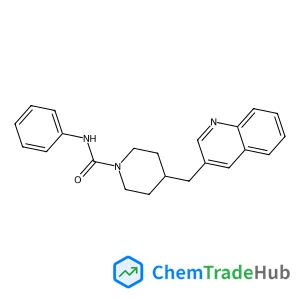
N-phenyl-4-(quinolin-3-ylmethyl)piperidine-1-carboxamide
CAS Number:
959151-50-9
Molecular Formula:
C22H23N3O
A graphical abstract is available for this content
Raita Goseki, Shogo Miyai, Satoshi Uchida, Takashi Ishizone
DOI: 10.1039/D1PY00500F
Tingyu He, Yanqiu Wang, Liang Xu, Xiangming Fu, Atsushi Narumi, Shin-ichiro Sato
DOI: 10.1039/D1PY00070E
Michihisa Toya
DOI: 10.1039/D1PY00144B
Huiqun Wang, Sebla Onbulak, Steven Weigand, Frank S. Bates, Marc A. Hillmyer
DOI: 10.1039/D0PY01728K
Zijuan Hai, Zhou Lu, Shuaikang Li, Zhong-Yan Cao, Shengyu Dai
DOI: 10.1039/D1PY00812A
Marc Schmutz
DOI: 10.1039/D1PY00139F
Huan-Huan Ding, Mu-Han Zhao, Le Zhai, Jian-Bin Zhen, Le-Yun Sun, Jia-Zhu Chigan, Cheng Chen, Jia-Qi Li, Han Gao, Ke-Wu Yang
DOI: 10.1039/D0PY01751E
Mariya Edeleva, Yoshi W. Marien, Paul H. M. Van Steenberge
DOI: 10.1039/D1PY00151E
Waste containing 2-Ethyl-4-Methyl-1H-Imidazole-5-Carbaldehyde (CAS: 88634-80-4) ...
Triethoxy(octyl)silane (CAS: 1385031-14-0) is widely used in the pharmaceuticals...
Several alternatives to 3-iodo-7-nitro-1H-indazole (CAS: 864724-64-1) exist in t...
Yes, there are alternatives to Benzene, bis[(trimethoxysilyl)ethyl] (CAS: 266317...
Isothiazole-3-carbonitrile (CAS: 1452-17-1) is generally considered safe when us...
(3-Chlorophenyl)methanol (CAS: 873-63-2) is considered low to moderately toxic. ...
(2S,3S)-2-Hydroxy-3-({[(2-methyl-2-propanyl)oxy]carbonyl}amino)-3-(2-naphthyl)pr...
Proper handling of methyl 2-(bromomethyl)-5-methoxybenzoate requires the use of ...
6,8-Dibromoimidazo[1,2-a]pyridine-2-carboxylic acid (CAS: 904805-36-3) is an aro...
3-Amino-5-bromo-2-pyridinecarbonitrile is considered safe when handled under pro...

Journal of Materials Chemistry A, B & C cover high quality studies across all fields of materials chemistry. The journals focus on those theoretical or experimental studies that report new understanding, applications, properties and synthesis of materials. The journals have a strong history of publishing quality reports of interest to interdisciplinary communities and providing an efficient and rigorous service through peer review and publication. The journals are led by an international team of Editors-in-Chief and Associate Editors who are all active researchers in their fields. Journal of Materials Chemistry A, B & C are separated by the intended application of the material studied. Broadly, applications in energy and sustainability are of interest to Journal of Materials Chemistry A, applications in biology and medicine are of interest to Journal of Materials Chemistry B, and applications in optical, magnetic and electronic devices are of interest to Journal of Materials Chemistry C. More than one Journal of Materials Chemistry journal may be suitable for certain fields and researchers are encouraged to submit their paper to the journal that they feel best fits for their particular article. Example topic areas within the scope of Journal of Materials Chemistry A are listed below. This list is neither exhaustive nor exclusive. Artificial photosynthesis Batteries Carbon dioxide conversion Catalysis Fuel cells Gas capture/separation/storage Green/sustainable materials Hydrogen generation Hydrogen storage Photocatalysis Photovoltaics Self-cleaning materials Self-healing materials Sensors Supercapacitors Thermoelectrics Water splitting Water treatment