












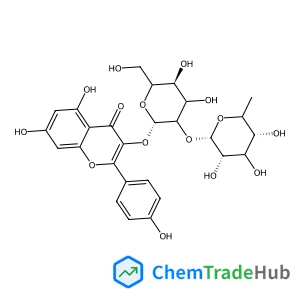
5,7-Dihydroxy-2-(4-hydroxyphenyl)-4-oxo-4H-chromen-3-yl 2-O-(6-deoxy-alpha-L-mannopyranosyl)-beta-D-glucopyranoside
CAS Number:
32602-81-6
Molecular Formula:
C27H30O15
Luca Torresi, Navid Haghmoradi, Serhiy Cherevko
Experimental catalyst optimization is plagued by slow and laborious efforts. Finding innovative materials is key to advancing research areas for sustainable energy conversion, such as electrocatalysis. Artificial intelligence (AI)-guided optimization bears great potential to autonomously learn from data and plan new experiments, identifying a global optimum significantly faster than traditional design of experiment approaches. Furthermore, it is vital to incorporate essential electrocatalyst features such as activity and stability into the optimization campaign to screen for a truly high-performing material. In this study, a multiobjective Bayesian optimization (MOBO) was used in conjunction with an experimental high-throughput (HT) pipeline to refine the composition of a non-noble Co–Mn–Sb–Sn–Ti oxide toward its activity and stability for the oxygen evolution reaction (OER) in acid. The viability of the MOBO algorithm was verified on a gathered data set, and an acceleration of 17x was achieved in subsequent experimental screening compared to a hypothetical grid search scenario. During the ML-driven assessment, Mn-rich compositions were critical to designing high-performing OER catalysts, while Ti incorporation into MnOx triggered an improved activity after short accelerated stress tests. To examine this finding further, an operando mass spectrometry technique was used to probe the evolution of activity, metal dissolution, and surface area over 3 h of operation. This work demonstrates the importance of respecting the multiobjective nature in electrocatalyst performance during HT campaigns. AI-based decision-making helps to bridge the gap between fast HT screening (limited property extraction) and slow fundamental research (rich property extraction) by avoiding less informative experiments.
Masaru Sakomura, Kazuyoshi Ueda, Masamichi Fujihira
DOI: 10.1039/B410262B
Gergely Juhász, Makoto Seto, Yoshitaka Yoda, Shinya Hayami, Yonezo Maeda
DOI: 10.1039/B409025J
Hideki Hayashi, Seiji Ogo, Shunichi Fukuzumi
DOI: 10.1039/B411633J
Koji Nakayama, Masayuki Endo, Tetsuro Majima
DOI: 10.1039/B409844G
Yasushi Nishihara, Hiroyuki Onodera, Kohtaro Osakada
DOI: 10.1039/B308741G
Anthony D'Aléo, Jean-Luc Pozzo, Frédéric Fages, Marc Schmutz, Gudrun Mieden-Gundert, Fritz Vögtle, Vesna Caplar, Mladen Zinic
DOI: 10.1039/B307846A
Snigdha Panda, Harkesh B. Singh, Ray J. Butcher
DOI: 10.1039/B312358H
Evgueni Gribov
DOI: 10.1039/B411053F
Connie K. Y. Lee, Andrew B. Holmes, Bushra Al-Duri, Gary A. Leeke, Regina C. D. Santos, Jonathan P. K. Seville
DOI: 10.1039/B411561A
Naoufel Haddour, Serge Cosnier, Chantal Gondran
DOI: 10.1039/B410727F
When handling 2-Chloro-1,2-bis(4-methylphenyl)ethanone (CAS: 71193-32-3), it is ...
4-Ethoxy-3-(5-methyl-4-oxo-7-propyl-1,4-dihydroimidazo[5,1-f][1,2,4]triazin-2-yl...
Methyl 3-Oxo-4-Androsten-17-Carboxylate (CAS: 2681-55-2) should be stored in a c...
(R)-3-Amino-4-(3-hexylphenylamino)-4-oxobutylphosphonic acid is primarily used i...
2-Methyl-2-propanyl 3-amino-3-carbamoyl-1-azetidinecarboxylate (CAS: 1254120-14-...
There are alternative reagents that can be used in synthesis instead of (E)-4-(t...
[2-(3-Chlorophenyl)-1,3-thiazol-4-yl]methanol (CAS: 121202-20-8) is a crystallin...
The market and research trends for Methyl (2S)-[(4S)-2,2-dimethyl-1,3-dioxolan-4...
The market for 1-Bromo-2-isocyanatoethane (CAS: 42865-19-0) is driven by its use...
4-Nitro-D-phenylalanine hydrochloride (CAS: 147065-06-3) is primarily used in re...

Journal of Materials Chemistry A, B & C cover high quality studies across all fields of materials chemistry. The journals focus on those theoretical or experimental studies that report new understanding, applications, properties and synthesis of materials. The journals have a strong history of publishing quality reports of interest to interdisciplinary communities and providing an efficient and rigorous service through peer review and publication. The journals are led by an international team of Editors-in-Chief and Associate Editors who are all active researchers in their fields. Journal of Materials Chemistry A, B & C are separated by the intended application of the material studied. Broadly, applications in energy and sustainability are of interest to Journal of Materials Chemistry A, applications in biology and medicine are of interest to Journal of Materials Chemistry B, and applications in optical, magnetic and electronic devices are of interest to Journal of Materials Chemistry C. More than one Journal of Materials Chemistry journal may be suitable for certain fields and researchers are encouraged to submit their paper to the journal that they feel best fits for their particular article. Example topic areas within the scope of Journal of Materials Chemistry A are listed below. This list is neither exhaustive nor exclusive. Artificial photosynthesis Batteries Carbon dioxide conversion Catalysis Fuel cells Gas capture/separation/storage Green/sustainable materials Hydrogen generation Hydrogen storage Photocatalysis Photovoltaics Self-cleaning materials Self-healing materials Sensors Supercapacitors Thermoelectrics Water splitting Water treatment


![4-[2-(Trichlorosilyl)ethyl]benzenesulfonyl chloride structure](https://static.chemtradehub.com/structs/797/79793-00-3-de16.webp "4-[2-(Trichlorosilyl)ethyl]benzenesulfonyl chloride structure")



