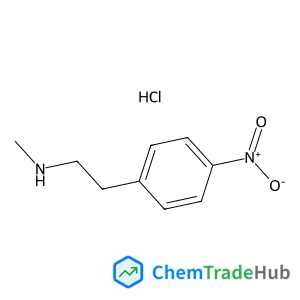
N-Methyl-2-(4-nitrophenyl)ethanamine hydrochloride (1:1)
CAS Number:
166943-39-1
Molecular Formula:
C9H13ClN2O2
Aleksandar Živković, Michael E. A. Warwick, Charles W. Dunnill
Materials with simultaneously excellent electrical conductivity (σ) and a high Seebeck coefficient (S) are important for thermoelectric applications. However, obtaining such materials is a challenging task as σ and S vary inversely with respect to each other. Here, a new fabrication process has been demonstrated that produces composite materials with desired properties. Electrically highly conducting copper sulphide (CuS) particles are encapsulated within a compound with a high Seebeck coefficient, i.e. copper iodide (CuI), to form core–shell type composites. The presented results show that the concept of producing such composites allows the optimisation of both σ and S to provide enhanced thermoelectric performance (measured using the figure of merit, zT) when compared to the individual starting materials. Quantum mechanical calculations are performed to elaborate on the Schottky barrier formed at the interface between copper iodide and copper sulphide and elucidate aspects of the improved transport mechanism. Furthermore, an optimized compositional ratio between the respective composite parts is identified, which at the same time exhibits a high power factor and reduced thermal conductivity. As a result, an improved value of 0.46 at room temperature has been observed, demonstrating that these simple, abundant, and non-toxic CuS/CuI composites are attractive candidates for thermoelectrics.
DOI: 10.1039/B901557D
Niklas Ottosson, Jan Heyda, Erik Wernersson, Wandared Pokapanich, Svante Svensson, Bernd Winter, Gunnar Öhrwall, Pavel Jungwirth, Olle Björneholm
DOI: 10.1039/C0CP00365D
A. V. Okotrub, I. P. Asanov, S. V. Larionov, T. G. Leonova, L. G. Bulusheva
DOI: 10.1039/C000189A
Nikita A. Kuznetsov, Alexandr D. Milov, Vladimir V. Koval, Rimma I. Samoilova, Yuri A. Grishin, Dmitry G. Knorre, Yuri D. Tsvetkov, Olga S. Fedorova, Sergei A. Dzuba
DOI: 10.1039/B904873A
Maria Waechtler, Martin Sellin, Annegret Stark, Dilek Akcakayiran, Gerhard Findenegg, Anna Gruenberg, Hergen Breitzke, Gerd Buntkowsky
DOI: 10.1039/B926836G
I. Mayer, E. Matito
DOI: 10.1039/C004427J
A. Bodsworth, B. Zobrist, A. K. Bertram
DOI: 10.1039/C0CP00572J
Takuya Shimomura, Kenta Fujii, Toshiyuki Takamuku
DOI: 10.1039/C0CP00614A
R. Azouani, S. Tieng, K. Chhor, J.-F. Bocquet, P. Eloy, E. M. Gaigneaux, K. Klementiev, A. V. Kanaev
DOI: 10.1039/B923548E
When handling 2-Chloro-1,2-bis(4-methylphenyl)ethanone (CAS: 71193-32-3), it is ...
4-Ethoxy-3-(5-methyl-4-oxo-7-propyl-1,4-dihydroimidazo[5,1-f][1,2,4]triazin-2-yl...
Methyl 3-Oxo-4-Androsten-17-Carboxylate (CAS: 2681-55-2) should be stored in a c...
(R)-3-Amino-4-(3-hexylphenylamino)-4-oxobutylphosphonic acid is primarily used i...
2-Methyl-2-propanyl 3-amino-3-carbamoyl-1-azetidinecarboxylate (CAS: 1254120-14-...
There are alternative reagents that can be used in synthesis instead of (E)-4-(t...
[2-(3-Chlorophenyl)-1,3-thiazol-4-yl]methanol (CAS: 121202-20-8) is a crystallin...
The market and research trends for Methyl (2S)-[(4S)-2,2-dimethyl-1,3-dioxolan-4...
The market for 1-Bromo-2-isocyanatoethane (CAS: 42865-19-0) is driven by its use...
4-Nitro-D-phenylalanine hydrochloride (CAS: 147065-06-3) is primarily used in re...

Journal of Materials Chemistry A, B & C cover high quality studies across all fields of materials chemistry. The journals focus on those theoretical or experimental studies that report new understanding, applications, properties and synthesis of materials. The journals have a strong history of publishing quality reports of interest to interdisciplinary communities and providing an efficient and rigorous service through peer review and publication. The journals are led by an international team of Editors-in-Chief and Associate Editors who are all active researchers in their fields. Journal of Materials Chemistry A, B & C are separated by the intended application of the material studied. Broadly, applications in energy and sustainability are of interest to Journal of Materials Chemistry A, applications in biology and medicine are of interest to Journal of Materials Chemistry B, and applications in optical, magnetic and electronic devices are of interest to Journal of Materials Chemistry C. More than one Journal of Materials Chemistry journal may be suitable for certain fields and researchers are encouraged to submit their paper to the journal that they feel best fits for their particular article. Example topic areas within the scope of Journal of Materials Chemistry A are listed below. This list is neither exhaustive nor exclusive. Artificial photosynthesis Batteries Carbon dioxide conversion Catalysis Fuel cells Gas capture/separation/storage Green/sustainable materials Hydrogen generation Hydrogen storage Photocatalysis Photovoltaics Self-cleaning materials Self-healing materials Sensors Supercapacitors Thermoelectrics Water splitting Water treatment