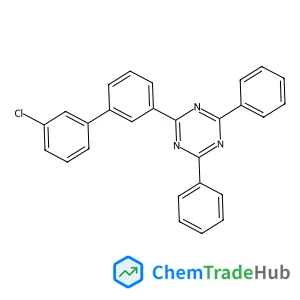
2-(3'-Chlorobiphenyl-3-yl)-4,6-diphenyl-1,3,5-triazine
CAS Number:
1443049-83-9
Molecular Formula:
C27H18ClN3
A. Bodsworth, B. Zobrist, A. K. Bertram
It is now well recognized that mixed organic–inorganic particles are abundant in the atmosphere. While there have been numerous studies of efflorescence of mixed organic–inorganic particles close to 293 K, there are only a few at temperatures less than 273 K. Understanding the efflorescence properties of these particles at temperatures less than 273 K could be especially important for predicting ice nucleation in the upper troposphere. We studied the efflorescence properties of mixed citric acid–ammonium sulfate particles as a function of temperature to better understand the efflorescence properties of mixed organic–inorganic particles in the middle and upper troposphere. Our data for 293 K illustrate that the addition of citric acid decreases the ERH of ammonium sulfate, which is consistent with the trends observed with other systems containing highly oxygenated organic compounds. At low temperatures the trend is qualitatively the same, but efflorescence can be inhibited by smaller concentrations of citric acid. For example at temperatures <250 K an organic mass/(organic mass + sulfate mass) of only 0.33 is needed to inhibit efflorescence of ammonium sulfate. In the upper troposphere the organic mass/(organic mass + sulfate mass) can often be larger than this value. As a result, particles in the upper troposphere may be more likely to remain in the liquid state than previously thought and solid ammonium sulfate may be less likely to participate in heterogeneous ice nucleation in the upper troposphere. Additional studies are required on other model organic systems.
Senbo Xiao, Shijun Xiao
DOI: 10.1039/C3CP00067B
Deepthi Jose, A. Nijamudheen
DOI: 10.1039/C3CP51028J
Marjo C. Mittelmeijer-Hazeleger, Miguel Angelo Granato, Vanessa F. Duarte Martins, Alírio E. Rodrigues, Gadi Rothenberg
DOI: 10.1039/C3CP44381G
Ling Chen, Wan Guo, Yuxin Yang, Ang Zhang, Shengqu Zhang, Yihang Guo, Yingna Guo
DOI: 10.1039/C3CP00084B
Seong K. Kim, Sergey Khodorov, Chien-Ting Chen, Sangtae Kim, Igor Lubomirsky
DOI: 10.1039/C3CP00145H
Ane K. di Gennaro, Leonid Gurevich, Esben Skovsen, Michael T. Overgaard, Peter Fojan
DOI: 10.1039/C3CP50742D
Z. Valy Vardeny
DOI: 10.1039/C3CP50639H
Jean-François Greisch, Michael E. Harding, Mattias Kordel
DOI: 10.1039/C3CP44362K
D. Fazzi, A. Milani, D. Brida, C. Manzoni, E. Cinquanta, M. Devetta, L. Ravagnan, P. Milani, F. Cataldo, L. Lüer, R. Wannemacher, J. Cabanillas-Gonzalez, M. Negro, S. Stagira, C. Vozzi
DOI: 10.1039/C3CP50508A
Jozef Bednarcik, Stefan Michalik, Vladimir Kolesar, Uta Rütt, Hermann Franz
DOI: 10.1039/C3CP44445G
When handling 2-Chloro-1,2-bis(4-methylphenyl)ethanone (CAS: 71193-32-3), it is ...
4-Ethoxy-3-(5-methyl-4-oxo-7-propyl-1,4-dihydroimidazo[5,1-f][1,2,4]triazin-2-yl...
Methyl 3-Oxo-4-Androsten-17-Carboxylate (CAS: 2681-55-2) should be stored in a c...
(R)-3-Amino-4-(3-hexylphenylamino)-4-oxobutylphosphonic acid is primarily used i...
2-Methyl-2-propanyl 3-amino-3-carbamoyl-1-azetidinecarboxylate (CAS: 1254120-14-...
There are alternative reagents that can be used in synthesis instead of (E)-4-(t...
[2-(3-Chlorophenyl)-1,3-thiazol-4-yl]methanol (CAS: 121202-20-8) is a crystallin...
The market and research trends for Methyl (2S)-[(4S)-2,2-dimethyl-1,3-dioxolan-4...
The market for 1-Bromo-2-isocyanatoethane (CAS: 42865-19-0) is driven by its use...
4-Nitro-D-phenylalanine hydrochloride (CAS: 147065-06-3) is primarily used in re...

Physical Chemistry Chemical Physics (PCCP) is an international journal co-owned by 19 physical chemistry and physics societies from around the world. This journal publishes original, cutting-edge research in physical chemistry, chemical physics and biophysical chemistry. To be suitable for publication in PCCP, articles must include significant innovation and/or insight into physical chemistry; this is the most important criterion that reviewers and Editors will judge against when evaluating submissions. The journal has a broad scope and welcomes contributions spanning experiment, theory, computation and data science. Topical coverage includes spectroscopy, dynamics, kinetics, statistical mechanics, thermodynamics, electrochemistry, catalysis, surface science, quantum mechanics, quantum computing and machine learning. Interdisciplinary research areas such as polymers and soft matter, materials, nanoscience, energy, surfaces/interfaces, and biophysical chemistry are welcomed if they demonstrate significant innovation and/or insight into physical chemistry. Joined experimental/theoretical studies are particularly appreciated when complementary and based on up-to-date approaches.