













Hexagonal 2D covalent organic frameworks from nonpolar and symmetric electron-accepting substituents for electron transport layers in near-infrared PeLEDs
Literature Information
Publication Date
2023-11-28
DOI
10.1039/D3TA05200A
Impact Factor
12.732
Authors
Lili Xu, Lei Zheng, Yu Jing, Xiangyu Guo, Xuemin Hu, Bo Xu, Shengli Zhang
View Original
Abstract
We conducted high-throughput calculations on the structure library of two-dimensional covalent organic frameworks (2D COFs), with the aim of finding new candidate materials as electron transport layers (ETLs) for the high-performance perovskite light-emitting diodes (PeLEDs). Starting with nearly 400 unique 2D COFs with hexagonal (hcb) topology, 23 candidates for β-ketoenamine linked 2D COFs composed of 1,3,5-triformylphloroglucinol (Tp) and linear diamines are identified by band structures. Interestingly, 2 β-ketoenamine linked 2D Tp-DAAQ and 2D Tp-DABDA with electron-accepting substituents, are the most promising candidates due to the optimal band edge and effective mass. Further, the nonpolarity of the Tp-DAAQ molecule makes it a more favorable choice for the ETL, as confirmed by nonadiabatic molecular dynamics that 2D Tp-DAAQ with anthraquinone diamine linker has a longer e–h nonradiative recombination time. This work provides a paradigm for the design of high-performance ETLs.
Recommended Journals
Related Literature
Chain transfer to aluminium in MAO-activated metallocene-catalyzed polymerization reactions
Esther Quintanilla, Fabio di Lena, Peter Chen
2006-09-04
Communication
DOI: 10.1039/B607248H
Diastereoselective Simmons–Smith cyclopropanations of allylic amines and carbamates
Stephen G. Davies, Kenneth B. Ling, Paul M. Roberts, Angela J. Russell, James E. Thomson
2007-08-24
Communication
DOI: 10.1039/B711358G
Aqueous preparation and physiological stability studies of Re(CO)3(tripodal) compounds
Richard S. Herrick, Tim J. Brunker, Caroline Maus, Kerianne Crandall, Anil Cetin, Christopher J. Ziegler
2006-08-23
Communication
DOI: 10.1039/B608683G
Constructing, deconstructing, and reconstructing ternary supermolecules‡
Christer B. Aakeröy, John Desper, Michelle M. Smith
2007-08-10
Communication
DOI: 10.1039/B707518A
A novel organic chromophore for dye-sensitized nanostructured solar cells
Daniel P. Hagberg, Tomas Edvinsson, Tannia Marinado, Gerrit Boschloo, Anders Hagfeldt, Licheng Sun
2006-04-13
Communication
DOI: 10.1039/B603002E
Control of ionic conductivity of ionic liquid/photoresponsive poly(amide acid) gels by photoirradiation
Masahiro Tamada, Toshiyuki Watanabe, Kazuyuki Horie, Hiroyuki Ohno
2007-07-25
Communication
DOI: 10.1039/B705060G
Self-assembling of nanoscopic molecular rectangles, extended helicates and porous-like materials based on macrocyclic dicopper building blocks under fine supramolecular control
Laura Gómez, Anna Company, Xavier Fontrodona, Xavi Ribas, Miquel Costas
2007-08-14
Communication
DOI: 10.1039/B707508A
Ru(ii)-cornered coordination cage that senses guest inclusion by color change
Ken-ichi Yamashita, Masaki Kawano, Makoto Fujita
2007-09-24
Communication
DOI: 10.1039/B712529A
Direct asymmetric catalytic 1,2-addition of RZnX to aldehydes promoted by AlMe3 and reversal of expected stereochemistry
Jonathan Shannon, David Bernier, Daniel Rawson, Simon Woodward
2007-08-15
Communication
DOI: 10.1039/B710681E
You might also like
Compound Q&A
How should waste containing 2-Ethyl-4-Methyl-1H-Imidazole-5-Carbaldehyde (CAS: 88634-80-4) be handled?
Waste containing 2-Ethyl-4-Methyl-1H-Imidazole-5-Carbaldehyde (CAS: 88634-80-4) ...
88634-80-42-Ethyl-4-Methyl-1H-...
Compound Q&A
What industries use Triethoxy(octyl)silane (CAS: 1385031-14-0)?
Triethoxy(octyl)silane (CAS: 1385031-14-0) is widely used in the pharmaceuticals...
1385031-14-0Triethoxy(octyl)sila...
Compound Q&A
Are there alternatives to 3-iodo-7-nitro-1H-indazole (CAS: 864724-64-1) in synthesis?
Several alternatives to 3-iodo-7-nitro-1H-indazole (CAS: 864724-64-1) exist in t...
864724-64-13-iodo-7-nitro-1H-in...
Compound Q&A
Are there alternatives to Benzene, bis[(trimethoxysilyl)ethyl] (CAS: 266317-71-9) in synthesis?
Yes, there are alternatives to Benzene, bis[(trimethoxysilyl)ethyl] (CAS: 266317...
266317-71-9Benzene, bis[(trimet...
Compound Q&A
Is Isothiazole-3-carbonitrile (CAS: 1452-17-1) safe?
Isothiazole-3-carbonitrile (CAS: 1452-17-1) is generally considered safe when us...
1452-17-1Isothiazole-3-carbon...
Compound Q&A
Is (3-Chlorophenyl)methanol (CAS: 873-63-2) safe?
(3-Chlorophenyl)methanol (CAS: 873-63-2) is considered low to moderately toxic. ...
873-63-2(3-Chlorophenyl)meth...
Compound Q&A
How is (2S,3S)-2-Hydroxy-3-({[(2-methyl-2-propanyl)oxy]carbonyl}amino)-3-(2-naphthyl)propanoic acid (CAS: 959583-98-3) typically synthesized?
(2S,3S)-2-Hydroxy-3-({[(2-methyl-2-propanyl)oxy]carbonyl}amino)-3-(2-naphthyl)pr...
959583-98-3(2S,3S)-2-Hydroxy-3-...
Compound Q&A
What precautions should be taken when handling Methyl 2-(bromomethyl)-5-methoxybenzoate (CAS: 788081-99-2)?
Proper handling of methyl 2-(bromomethyl)-5-methoxybenzoate requires the use of ...
788081-99-2Methyl 2-(bromomethy...
Compound Q&A
What is 6,8-Dibromoimidazo[1,2-a]pyridine-2-carboxylic acid (CAS: 904805-36-3)?
6,8-Dibromoimidazo[1,2-a]pyridine-2-carboxylic acid (CAS: 904805-36-3) is an aro...
904805-36-36,8-Dibromoimidazo[1...
Compound Q&A
Is 3-Amino-5-bromo-2-pyridinecarbonitrile (CAS: 573675-27-1) safe?
3-Amino-5-bromo-2-pyridinecarbonitrile is considered safe when handled under pro...
573675-27-13-Amino-5-bromo-2-py...
Source Journal
Journal of Materials Chemistry A

CiteScore:
19.5
Self-citation Rate:
4.7%
Articles per Year:
2211
Journal of Materials Chemistry A, B & C cover high quality studies across all fields of materials chemistry. The journals focus on those theoretical or experimental studies that report new understanding, applications, properties and synthesis of materials. The journals have a strong history of publishing quality reports of interest to interdisciplinary communities and providing an efficient and rigorous service through peer review and publication. The journals are led by an international team of Editors-in-Chief and Associate Editors who are all active researchers in their fields. Journal of Materials Chemistry A, B & C are separated by the intended application of the material studied. Broadly, applications in energy and sustainability are of interest to Journal of Materials Chemistry A, applications in biology and medicine are of interest to Journal of Materials Chemistry B, and applications in optical, magnetic and electronic devices are of interest to Journal of Materials Chemistry C. More than one Journal of Materials Chemistry journal may be suitable for certain fields and researchers are encouraged to submit their paper to the journal that they feel best fits for their particular article. Example topic areas within the scope of Journal of Materials Chemistry A are listed below. This list is neither exhaustive nor exclusive. Artificial photosynthesis Batteries Carbon dioxide conversion Catalysis Fuel cells Gas capture/separation/storage Green/sustainable materials Hydrogen generation Hydrogen storage Photocatalysis Photovoltaics Self-cleaning materials Self-healing materials Sensors Supercapacitors Thermoelectrics Water splitting Water treatment
Recommended Compounds


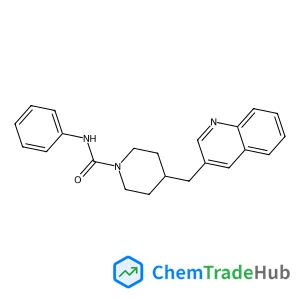
N-phenyl-4-(quinolin-3-ylmethyl)piperidine-1-carboxamide
CAS Number:
959151-50-9
Molecular Formula:
C22H23N3O
Recommended Suppliers







Disclaimer
This page provides academic journal information for reference and research purposes only. We are not affiliated with any journal publishers and do not handle publication submissions. For publication-related inquiries, please contact the respective journal publishers directly.
If you notice any inaccuracies in the information displayed, please contact us at support@chemtradehub.com. We will promptly review and address your concerns.