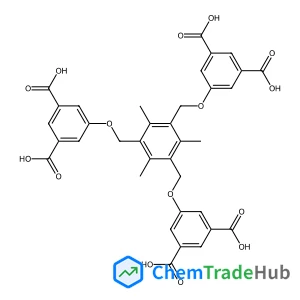
5,5',5''-(((2,4,6-Trimethylbenzene-1,3,5-triyl)tris(methylene))tris(oxy))triisophthalic acid
CAS Number:
1159974-70-5
Molecular Formula:
C36H30O15
Sundararajan Parani, Eun-young Choi, Jang-Kun Song
Carbon dots (CDs) are a rapidly emerging class of nanomaterials with remarkable physicochemical properties such as small size, high surface area-to-volume ratio, tunable optical properties and facile functionalization. These properties make CDs highly versatile and attractive for a wide range of applications such as biomedical imaging, drug delivery, photocatalysis, sensing etc. Recently, CDs have shown great potential for use in membrane separation applications, where their zero-dimensional structure, hydrophilicity, tunable surface chemistry, and antimicrobial characteristics are greatly useful. These properties allow for the design of advanced membranes with improved permeability, selectivity, and durability. This review presents a comprehensive overview of the fabrication techniques of CD engineered nanocomposite membranes and effect of CDs on the membrane formation, properties, and membrane separation since the inception of this research domain. An extensive collection of data of fabrication, properties, and application of the CD modified nanocomposite membranes from the reported research studies is provided in a tabular form for easy reference. Finally, the review concludes by discussing the current challenges and providing an outlook on future directions.

Medicinal Chemistry Research

Polycyclic Aromatic Compounds

Bioorganic & Medicinal Chemistry Letters

Acta Metallurgica Sinica-English Letters

Critical Reviews in Solid State and Materials Sciences

Chinese Journal of Chemistry

Electroanalysis

Main Group Chemistry

Heteroatom Chemistry

Bioorganic & Medicinal Chemistry
Shengzhi Dong, Wei Xu, Haoqing Guo, Wenfu Yan, Ming Zhang, Feng Li
DOI: 10.1039/C8CP01492B
Luke R. Anderson, Andrew M. Ediger
DOI: 10.1039/C8CP02829J
Sieghard Albert, Ziqiu Chen, Robert Prentner, Martin Quack
DOI: 10.1039/C8CP00133B
W. Siebrand, Z. Smedarchina, D. Ferro-Costas, E. Martínez-Núñez, A. Fernández-Ramos
DOI: 10.1039/C8CP00519B
P. Polzin, I. V. Eliani, J. Ströh, M. Braun, N. Ruser, P. Rönfeldt, F. Bertram, C. Näther, S. Wöhlbrandt, M. Suta, H. Terraschke
DOI: 10.1039/C7CP07142F
DOI: 10.1039/C7CP06621J
C. S. Trevisan, R. R. Lucchese, W. Iskandar, R. Moshammer, R. Strom, T. Severt, B. Jochim, D. Reedy, M. Weller, A. L. Landers, J. B. Williams, I. Ben-Itzhak, R. Dörner, D. Slaughter, Th. Weber, T. N. Rescigno
DOI: 10.1039/C8CP03637C
DOI: 10.1039/C8CP00261D
Papri Chakraborty, Ananya Baksi, Sathish Kumar Mudedla, Abhijit Nag, Ganesan Paramasivam, Venkatesan Subramanian, Thalappil Pradeep
DOI: 10.1039/C7CP08181B
Waste containing N-Methoxy-N-methyl-1,3-thiazole-5-carboxamide (CAS: 898825-89-3...
N-(4-Biphenylyl)dibenzo[b,d]furan-4-amine should be stored in a tightly sealed c...
The market for 3-Acetamido-5-amino-2,4,6-triiodobenzoic acid (CAS: 1713-07-1) is...
Benzyl 2-O-acetyl-3,4,6-tri-O-benzyl-beta-D-galactopyranoside (CAS: 61820-03-9) ...
2-Ethylpiperazine dihydrochloride (CAS: 438050-52-3) is regulated under the Glob...
1,1'-[1,3-Phenylenebis(methylene)]bis(3-methyl-1H-pyrrole-2,5-dione) (CAS: 11946...
Several alternatives can be used in the synthesis of 5-Fluoro-2-(1-pyrrolidinyl)...
Proper personal protective equipment (PPE) must be worn when handling this compo...
When handling 6-Bromoimidazo[1,2-a]pyridin-8-amine, it is important to wear appr...
Alternatives to (2S,4R)-4-(4-Nitrobenzyl)pyrrolidine-2-carboxylic acid hydrochlo...

Journal of Materials Chemistry A, B & C cover high quality studies across all fields of materials chemistry. The journals focus on those theoretical or experimental studies that report new understanding, applications, properties and synthesis of materials. The journals have a strong history of publishing quality reports of interest to interdisciplinary communities and providing an efficient and rigorous service through peer review and publication. The journals are led by an international team of Editors-in-Chief and Associate Editors who are all active researchers in their fields. Journal of Materials Chemistry A, B & C are separated by the intended application of the material studied. Broadly, applications in energy and sustainability are of interest to Journal of Materials Chemistry A, applications in biology and medicine are of interest to Journal of Materials Chemistry B, and applications in optical, magnetic and electronic devices are of interest to Journal of Materials Chemistry C. More than one Journal of Materials Chemistry journal may be suitable for certain fields and researchers are encouraged to submit their paper to the journal that they feel best fits for their particular article. Example topic areas within the scope of Journal of Materials Chemistry A are listed below. This list is neither exhaustive nor exclusive. Artificial photosynthesis Batteries Carbon dioxide conversion Catalysis Fuel cells Gas capture/separation/storage Green/sustainable materials Hydrogen generation Hydrogen storage Photocatalysis Photovoltaics Self-cleaning materials Self-healing materials Sensors Supercapacitors Thermoelectrics Water splitting Water treatment