











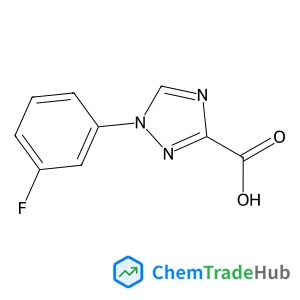
1-(3-Fluorophenyl)-1H-1,2,4-triazole-3-carboxylic acid
CAS Number:
1292369-51-7
Molecular Formula:
C9H6FN3O2
Shengzhi Dong, Wei Xu, Haoqing Guo, Wenfu Yan, Ming Zhang, Feng Li
A series of perchlorotriphenyl methyl (PTM) and tris(2,4,6-trichlorophenyl)methyl (TTM) radical derivatives were synthesized. The factors affecting the photoluminescence quantum yields (PLQYs) of π-radicals were studied systematically for the first time through comparing the photophysical properties of the synthesized PTM and TTM radicals. The room-temperature PLQY of a PTM radical derivative achieves to be 56.6%, which is the highest value among the organic near-infrared materials with peak wavelength over 650 nm. The photostabilities of the radicals was significantly enhanced via incorporation of substituent groups. The molecular rigidity, electron donating ability of the donor and dihedral angle between D–A system were found to be the potential factors to affect the luminescent efficiency of the open-shell molecules.
Yujie Wang, Siwei Zhao, Xu Liu, Wenqing Zhen, Gang Fu, Li Yang, Shaozeng Sun, Jiaxu Zhang
DOI: 10.1039/D0CP06516A
Konstantin Schutjajew, Tim Tichter, Jonathan Schneider, Markus Antonietti, Christina Roth, Martin Oschatz
DOI: 10.1039/D1CP00610J
Michael J. Van Stipdonk, Evan H. Perez, Luke J. Metzler, Amanda R. Bubas, Theodore Corcovilos, Arpad Somogyi
DOI: 10.1039/D1CP01520F
Niladri Sekhar Mondal, Subhadip Nath, Debnarayan Jana, Nanda Kumar Ghosh
DOI: 10.1039/D1CP01466H
Xia Xu, Jianxiong Dai, Xing Guo, Cheng Qian, Pei Zhang, Yixiang Duan, Yonghui Tian
DOI: 10.1039/D1CP00903F
Lilian K. Ellis-Gibbings, William G. Fortune, Bridgette Cooper, Jonathan Tennyson, Stephen D. Price
DOI: 10.1039/D1CP01328A
Ching H. Wu, Chi C. Hua, Chun I. Wang
DOI: 10.1039/D1CP00869B
Michael Busch, Elisabet Ahlberg, Kari Laasonen
DOI: 10.1039/D1CP00499A
Mariah L. Parker, Jiwen Jian, John K. Gibson
DOI: 10.1039/D1CP01362A
Asmida Herawati, Hui-Ching Lin, Shun-Hsiang Chan, Tsong-Shin Lim, Forest Shih-Sen Chien
DOI: 10.1039/D1CP00974E
Waste containing N-Methoxy-N-methyl-1,3-thiazole-5-carboxamide (CAS: 898825-89-3...
N-(4-Biphenylyl)dibenzo[b,d]furan-4-amine should be stored in a tightly sealed c...
The market for 3-Acetamido-5-amino-2,4,6-triiodobenzoic acid (CAS: 1713-07-1) is...
Benzyl 2-O-acetyl-3,4,6-tri-O-benzyl-beta-D-galactopyranoside (CAS: 61820-03-9) ...
2-Ethylpiperazine dihydrochloride (CAS: 438050-52-3) is regulated under the Glob...
1,1'-[1,3-Phenylenebis(methylene)]bis(3-methyl-1H-pyrrole-2,5-dione) (CAS: 11946...
Several alternatives can be used in the synthesis of 5-Fluoro-2-(1-pyrrolidinyl)...
Proper personal protective equipment (PPE) must be worn when handling this compo...
When handling 6-Bromoimidazo[1,2-a]pyridin-8-amine, it is important to wear appr...
Alternatives to (2S,4R)-4-(4-Nitrobenzyl)pyrrolidine-2-carboxylic acid hydrochlo...

Physical Chemistry Chemical Physics (PCCP) is an international journal co-owned by 19 physical chemistry and physics societies from around the world. This journal publishes original, cutting-edge research in physical chemistry, chemical physics and biophysical chemistry. To be suitable for publication in PCCP, articles must include significant innovation and/or insight into physical chemistry; this is the most important criterion that reviewers and Editors will judge against when evaluating submissions. The journal has a broad scope and welcomes contributions spanning experiment, theory, computation and data science. Topical coverage includes spectroscopy, dynamics, kinetics, statistical mechanics, thermodynamics, electrochemistry, catalysis, surface science, quantum mechanics, quantum computing and machine learning. Interdisciplinary research areas such as polymers and soft matter, materials, nanoscience, energy, surfaces/interfaces, and biophysical chemistry are welcomed if they demonstrate significant innovation and/or insight into physical chemistry. Joined experimental/theoretical studies are particularly appreciated when complementary and based on up-to-date approaches.
![2-Methyl-2-propanyl {3-[4-(4,4,5,5-tetramethyl-1,3,2-dioxaborolan-2-yl)phenyl]-3-oxetanyl}carbamate structure](https://static.chemtradehub.com/structs/127/1279090-25-3-1b84.webp "2-Methyl-2-propanyl {3-[4-(4,4,5,5-tetramethyl-1,3,2-dioxaborolan-2-yl)phenyl]-3-oxetanyl}carbamate structure")

![2-Methylbenzo[h]quinoline structure](https://static.chemtradehub.com/structs/605/605-88-9-ac43.webp "2-Methylbenzo[h]quinoline structure")






