



Cu-catalysed Chan–Evans–Lam reaction meets deep eutectic solvents: efficient and selective C–N bond formation under aerobic conditions at room temperature‡
Literature Information
Publication Date
2023-05-30
DOI
10.1039/D3SU00093A
Impact Factor
0
Authors
Luciana Cicco, Paola Vitale, Filippo Maria Perna, Joaquín García-Álvarez
View Original
Abstract
An unprecedented, simple and general protocol for the selective formation of C–N bonds was developed by using cheap and easily available Cu(OAc)2 as catalyst for the Cu(II)-catalysed Chan–Evans–Lam reaction in Deep Eutectic Solvents (DESs) as sustainable reaction media. The meticulous selection of both components of DES for this transformation (1ChOAc/2Urea) allows C–N coupling reactions under bench-type conditions (room temperature/under air), and in the absence of external ligands. The use of DES also permits to: (i) recycle the catalytic system for up to four consecutive runs; (ii) scale-up the C–N coupling reaction (without erosion of the yield); and (iii) apply this methodology to the synthesis of the anti-inflammatory drug Flufenamic acid (E-factor: 10).
Recommended Journals

Current Opinion in Colloid & Interface Science

Russian Journal of Applied Chemistry

Crystallography Reports

Acta Materialia

Current Opinion in Solid State & Materials Science

Russian Journal of General Chemistry

Russian Journal of Coordination Chemistry

Russian Journal of Bioorganic Chemistry

Journal of Natural Medicines

Organic Process Research & Development
Related Literature
The soft X-ray absorption spectrum of the allyl free radical
M. Alagia, E. Bodo, S. Falcinelli, R. Richter
2012-11-22
Paper
DOI: 10.1039/C2CP43466K
The trehalose coating effect on the internal protein dynamics
Christiane Hackel, Tatyana Zinkevich, Peter Belton, Anja Achilles, Detlef Reichert
2012-01-19
Paper
DOI: 10.1039/C2CP23098D
Operando surface spectroscopy—placing catalytic solids at work under the spotlight
B. M. Weckhuysen, A. Zecchina
2012-01-20
Editorial
DOI: 10.1039/C2CP90005J
Fully relativistic coupled cluster and DFT study of electric field gradients at Hg in 199Hg compounds
Vaida Arcisauskaite, Stefan Knecht, Stephan P. A. Sauer, Lars Hemmingsen
2012-01-19
Paper
DOI: 10.1039/C2CP23080A
Improvement in the assessment of direct and facilitated ion transfers by electrochemically induced redox transformations of common molecular probes
Min Zhou, Lijie Zhong, Xiandui Dong, Jens Ulstrup, Dongxue Han
2011-12-15
Paper
DOI: 10.1039/C2CP23184K
HERFD XAS/ATR-FTIR batch reactor cell
Martin Makosch, Christiane Kartusch, Jacinto Sá, Renata Bessa Duarte, Kristina Kvashnina, Pieter Glatzel, Daniel L. A. Fernandes, Maarten Nachtegaal, Jakub Szlachetko, Bobby Neuhold, Konrad Hungerbühler
2011-09-12
Paper
DOI: 10.1039/C1CP21933B
The intrinsic conformational features of amino acids from a protein coil library and their applications in force field development
Fan Jiang, Wei Han
2012-12-12
Perspective
DOI: 10.1039/C2CP43633G
Efficient reduction of graphene oxide catalyzed by copper
Keng-Ku Liu, Chih-Yu Wu, Chih-Wei Chu, Jacob Tse-Wei Wang, Chi-Te Liang
2011-12-21
Paper
DOI: 10.1039/C2CP23187E
You might also like
Compound Q&A
How should 2-Methylbenzene-1,4-diamine dihydrochloride (CAS: 615-45-2) be stored?
2-Methylbenzene-1,4-diamine dihydrochloride (CAS: 615-45-2) should be stored in ...
615-45-22-Methylbenzene-1,4-...
Compound Q&A
Is (1S,4S)-2,5-Diazabicyclo[2.2.1]heptane dihydrobromide (CAS: 132747-20-7) safe?
(1S,4S)-2,5-Diazabicyclo[2.2.1]heptane dihydrobromide is generally considered sa...
132747-20-7(1S,4S)-2,5-Diazabic...
Compound Q&A
What industries use (6-Chloropyridazin-3-YL)methanamine (CAS: 871826-15-2)?
(6-Chloropyridazin-3-YL)methanamine finds applications in the pharmaceutical ind...
871826-15-2(6-Chloropyridazin-3...
Compound Q&A
What are the main uses of 2-Fluoro-3-methylphenol (CAS: 77772-72-6)?
2-Fluoro-3-methylphenol is primarily used in the synthesis of pharmaceuticals, p...
77772-72-62-Fluoro-3-methylphe...
Compound Q&A
What precautions should be taken when handling 3-Methoxy-4-nitrobenzonitrile (CAS: 177476-75-4)?
When handling 3-Methoxy-4-nitrobenzonitrile, it is important to wear appropriate...
177476-75-43-Methoxy-4-nitroben...
Compound Q&A
What precautions should be taken when handling 1,3-Oxazolo[4,5-b]pyridine-2(3H)-thione (CAS: 211949-57-4)?
When handling 1,3-Oxazolo[4,5-b]pyridine-2(3H)-thione (CAS: 211949-57-4), it is ...
211949-57-4[1,3]Oxazolo[4,5-b]p...
Compound Q&A
What regulatory guidelines apply to 4-Ethynylbenzamide (CAS: 90347-86-7)?
4-Ethynylbenzamide (CAS: 90347-86-7) falls under various regulatory guidelines i...
90347-86-74-Ethynylbenzamide
Compound Q&A
What are the main uses of 3-(2-Ethylphenyl)-2-thioxo-4-imidazolidinone (CAS: 186822-57-1)?
3-(2-Ethylphenyl)-2-thioxo-4-imidazolidinone is primarily used as an intermediat...
186822-57-13-(2-Ethylphenyl)-2-...
Compound Q&A
What is (2-Fluoro-6-methoxyphenyl)acetic acid (CAS: 500912-19-6)?
(2-Fluoro-6-methoxyphenyl)acetic acid, also known as 4-fluoro-3-methoxybenzoic a...
500912-19-6(2-Fluoro-6-methoxyp...
Compound Q&A
What is the market or research trend for 2-[4-(Hydroxymethyl)phenoxy]ethanol (CAS: 102196-18-9)?
Market trends for 2-[4-(Hydroxymethyl)phenoxy]ethanol (CAS: 102196-18-9) indicat...
102196-18-92-[4-(Hydroxymethyl)...
Source Journal
Recommended Compounds

2,3,6-Tri-O-acetyl-4-O-(2,3,4,6-tetra-O-acetyl-beta-D-galactopyranosyl)-alpha-D-glucopyranosyl bromide
CAS Number:
4753-07-5
Molecular Formula:
C26H35BrO17
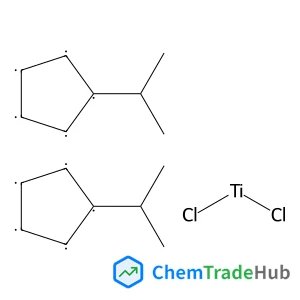
BIS(I-PROPYLCYCLOPENTADIENYL)TITANIUM DICHLORIDE
CAS Number:
12130-65-3
Molecular Formula:
C16H22Cl2Ti
Recommended Suppliers






Disclaimer
This page provides academic journal information for reference and research purposes only. We are not affiliated with any journal publishers and do not handle publication submissions. For publication-related inquiries, please contact the respective journal publishers directly.
If you notice any inaccuracies in the information displayed, please contact us at support@chemtradehub.com. We will promptly review and address your concerns.