



Improved 2-pyridyl reductive homocoupling reaction using biorenewable solvent Cyrene™ (dihydrolevoglucosenone)
Literature Information
Publication Date
2023-07-17
DOI
10.1039/D3SU00005B
Impact Factor
0
Authors
Daniel A. Webb, Zeid Alsudani, Guolin Xu, Peng Gao, Leggy A. Arnold
View Original
Abstract
The synthesis of 5,5′-bis(trifluoromethyl)-2,2′-bipyridine using 2-bromo-5-(trifluoromethyl) pyridine was achieved at 50 °C using palladium acetate, tetrabutylammonium iodide (TBAI), potassium carbonate, and isopropanol in Cyrene™ (dihydrolevoglucosenone), a bio-renewable “green” solvent formed by a two-step process from cellulose. Improvements were achieved with 50% of γ-valerolactone (GVL) in Cyrene™ resulting in a 95% yield and 99% product purity without the use of column chromatography or recrystallization. At 80 °C, the reaction was completed within 1 h. Full conversion with 1 mol% instead of 15 mol% of palladium acetate was observed within 10 h. We showed that the formed 2,2′-bipyridine product significantly accelerated the reaction probably due to the stabilization of the catalytic species. The addition of TBAI was essential for the rapid homocoupling, however, 20 mol% of TBAI was sufficient to reach full conversion of 2-bromo-5-(trifluoromethyl) pyridine within 6 h at 80 °C. Another improvement was observed with the substitution of isopropanol by 1,4-butanediol achieving full conversion within 6 h. 2-Bromopyridines with electron withdrawing substituents in the 6, 5, 4 ring position reacted under these conditions. 2-Bromopyridines with an electron donating substituent reacted slower. Overall, we demonstrated that the 50% GVL in Cyrene™ blend is a superior “green” and less toxic alternative to dimethylformamide for the reductive homocoupling reaction. Using a quantitative scoring for twelve principles of green chemistry (DOZN™), we found significant improvements that were mediated by higher yield (atom economy), shorter heating time and lower reaction temperature (energy efficiency), safer solvent (hazardous chemical synthesis), and safer chemistry (accident prevention).
Recommended Journals

Proceedings of the National Academy of Sciences of the United States of America

Fibre Chemistry

Planta Medica

European Journal of Wood and Wood Products

Journal of Catalysis

Journal of Organometallic Chemistry

Journal of Medicinal Chemistry

Israel Journal of Chemistry

Journal of Physics and Chemistry of Solids

Science Progress
Related Literature
Enhanced planar perovskite solar cells with efficiency exceeding 16% via reducing the oxygen vacancy defect state in titanium oxide electrode
Yangyang Du, Hongkun Cai, Yunhao Wu, Zhixue Xing, Zhenglong Li, Jian Xu, Like Huang, Jian Ni, Juan Li, Jianjun Zhang
2017-04-28
Paper
DOI: 10.1039/C7CP01936J
Thermodynamic and morphological characterization of Turing patterns in non-isothermal reaction–diffusion systems
Horacio Serna, Alberto P. Muñuzuri, Daniel Barragán
2017-04-11
Paper
DOI: 10.1039/C7CP00543A
H2 binding to the active site of [NiFe] hydrogenase studied by multiconfigurational and coupled-cluster methods
Geng Dong, Quan Manh Phung, Simon D. Hallaert, Kristine Pierloot, Ulf Ryde
2017-03-31
Paper
DOI: 10.1039/C7CP01331K
A kinetic model of water adsorption, clustering and dissociation on the Fe3S4{001} surface
Alberto Roldan
2017-04-06
Paper
DOI: 10.1039/C6CP07371A
Microstructure degradation of Ni/CGO anodes for solid oxide fuel cells after long operation time using 3D reconstructions by FIB tomography
Atef Zekri, Martin Knipper, Jürgen Parisi, Thorsten Plaggenborg
2017-05-09
Paper
DOI: 10.1039/C7CP02186K
Theoretical investigation of energy gap bowing in CdSxSe1−x alloy quantum dots
Laxman Tatikondewar
2017-05-23
Paper
DOI: 10.1039/C7CP01180F
On the validity of linear response approximations regarding the solvation dynamics of polyatomic solutes
Esther Heid, Wanda Moser, Christian Schröder
2017-04-04
Paper
DOI: 10.1039/C6CP08575J
Sodium–carboxylate contact ion pair formation induces stabilization of palmitic acid monolayers at high pH
Ellen M. Adams, Bethany A. Wellen, Raphael Thiraux, Sandeep K. Reddy, Andrew S. Vidalis, Francesco Paesani, Heather C. Allen
2017-03-28
Paper
DOI: 10.1039/C7CP00167C
Vapour–liquid interfacial properties of square-well chains from density functional theory and Monte Carlo simulation
Francisco José Martínez-Ruiz, Felipe J. Blas, A. Ignacio Moreno-Ventas Bravo, José Manuel Míguez, Luis G. MacDowell
2017-04-19
Paper
DOI: 10.1039/C7CP01182B
You might also like
Compound Q&A
How should 2-Methylbenzene-1,4-diamine dihydrochloride (CAS: 615-45-2) be stored?
2-Methylbenzene-1,4-diamine dihydrochloride (CAS: 615-45-2) should be stored in ...
615-45-22-Methylbenzene-1,4-...
Compound Q&A
Is (1S,4S)-2,5-Diazabicyclo[2.2.1]heptane dihydrobromide (CAS: 132747-20-7) safe?
(1S,4S)-2,5-Diazabicyclo[2.2.1]heptane dihydrobromide is generally considered sa...
132747-20-7(1S,4S)-2,5-Diazabic...
Compound Q&A
What industries use (6-Chloropyridazin-3-YL)methanamine (CAS: 871826-15-2)?
(6-Chloropyridazin-3-YL)methanamine finds applications in the pharmaceutical ind...
871826-15-2(6-Chloropyridazin-3...
Compound Q&A
What are the main uses of 2-Fluoro-3-methylphenol (CAS: 77772-72-6)?
2-Fluoro-3-methylphenol is primarily used in the synthesis of pharmaceuticals, p...
77772-72-62-Fluoro-3-methylphe...
Compound Q&A
What precautions should be taken when handling 3-Methoxy-4-nitrobenzonitrile (CAS: 177476-75-4)?
When handling 3-Methoxy-4-nitrobenzonitrile, it is important to wear appropriate...
177476-75-43-Methoxy-4-nitroben...
Compound Q&A
What precautions should be taken when handling 1,3-Oxazolo[4,5-b]pyridine-2(3H)-thione (CAS: 211949-57-4)?
When handling 1,3-Oxazolo[4,5-b]pyridine-2(3H)-thione (CAS: 211949-57-4), it is ...
211949-57-4[1,3]Oxazolo[4,5-b]p...
Compound Q&A
What regulatory guidelines apply to 4-Ethynylbenzamide (CAS: 90347-86-7)?
4-Ethynylbenzamide (CAS: 90347-86-7) falls under various regulatory guidelines i...
90347-86-74-Ethynylbenzamide
Compound Q&A
What are the main uses of 3-(2-Ethylphenyl)-2-thioxo-4-imidazolidinone (CAS: 186822-57-1)?
3-(2-Ethylphenyl)-2-thioxo-4-imidazolidinone is primarily used as an intermediat...
186822-57-13-(2-Ethylphenyl)-2-...
Compound Q&A
What is (2-Fluoro-6-methoxyphenyl)acetic acid (CAS: 500912-19-6)?
(2-Fluoro-6-methoxyphenyl)acetic acid, also known as 4-fluoro-3-methoxybenzoic a...
500912-19-6(2-Fluoro-6-methoxyp...
Compound Q&A
What is the market or research trend for 2-[4-(Hydroxymethyl)phenoxy]ethanol (CAS: 102196-18-9)?
Market trends for 2-[4-(Hydroxymethyl)phenoxy]ethanol (CAS: 102196-18-9) indicat...
102196-18-92-[4-(Hydroxymethyl)...
Source Journal
Recommended Compounds
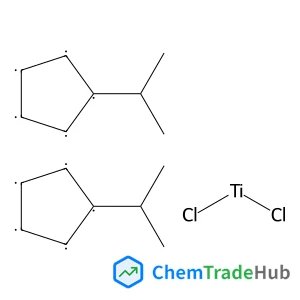
BIS(I-PROPYLCYCLOPENTADIENYL)TITANIUM DICHLORIDE
CAS Number:
12130-65-3
Molecular Formula:
C16H22Cl2Ti
![3-[(3R,4R)-3-[(6-aminopyrimidin-4-yl)-methyl-amino]-4-methyl-1-piperidyl]-3-oxo-propanenitrile structure](https://static.chemtradehub.com/structs/164/1640971-60-3-83a4.webp "3-[(3R,4R)-3-[(6-aminopyrimidin-4-yl)-methyl-amino]-4-methyl-1-piperidyl]-3-oxo-propanenitrile structure")
3-[(3R,4R)-3-[(6-aminopyrimidin-4-yl)-methyl-amino]-4-methyl-1-piperidyl]-3-oxo-propanenitrile
CAS Number:
1640971-60-3
Molecular Formula:
C14H20N6O
Recommended Suppliers



Disclaimer
This page provides academic journal information for reference and research purposes only. We are not affiliated with any journal publishers and do not handle publication submissions. For publication-related inquiries, please contact the respective journal publishers directly.
If you notice any inaccuracies in the information displayed, please contact us at support@chemtradehub.com. We will promptly review and address your concerns.