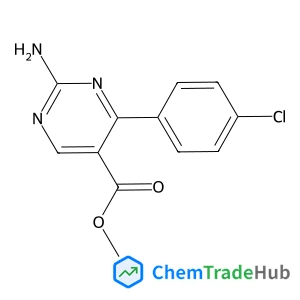
Methyl 2-amino-4-(4-chlorophenyl)-5-pyrimidinecarboxylate
CAS Number:
1133115-56-6
Molecular Formula:
C12H10ClN3O2
Horacio Serna, Alberto P. Muñuzuri, Daniel Barragán
The effect of temperature on the bifurcation diagram and Turing instability domain under non isothermal conditions is studied in the reversible Gray–Scott model. After adding the energy balance to the cubic autocatalytic model, the thermostat temperature and heat transfer coefficient are used as control parameters in the Turing pattern formation. The patterns obtained in the domain of the thermal parameter are characterized by quantifying the overall entropy generation rate and two topological indices; Shannon entropy and Minkowski functionals. The results show that it is possible to induce transitions between Turing patterns of different morphologies by regulating the temperature, and that these transitions take place at a lower entropy generation value compared to other parameters, such as kinetic constants and reactant fluxes. Finally, a correlation between entropy generation and topological indices shows that a difference between direct and inverse patterns is mainly morphological and not energetic.

Drug Discovery Today

Chemistry Education Research and Practice

Russian Journal of Applied Chemistry

Russian Chemical Bulletin

Saudi Pharmaceutical Journal

Chemical Communications

Current Opinion in Solid State & Materials Science

Journal of Natural Medicines

Russian Journal of Coordination Chemistry

Current Opinion in Colloid & Interface Science
S. G. Moussa, A. C. Stern, J. D. Raff, C. W. Dilbeck, D. J. Tobias, B. J. Finlayson-Pitts
DOI: 10.1039/C2CP42405C
Lesley R. Rutledge, Stacey D. Wetmore
DOI: 10.1039/C2CP23600A
Andrew S. Powell, Zlatka Stoeva, James S. Lord, Ronald I. Smith, Duncan H. Gregory, Jeremy J. Titman
DOI: 10.1039/C2CP43318D
Stanislav Pařez, Milan Předota
DOI: 10.1039/C2CP22136E
Satyananda Kishore Pilli, Todd G. Deutsch, Thomas E. Furtak, Logan D. Brown, John A. Turner, Andrew M. Herring
DOI: 10.1039/C2CP44577H
Paul C. Jennings, Bruno G. Pollet, Roy L. Johnston
DOI: 10.1039/C2CP23430K
2-Methylbenzene-1,4-diamine dihydrochloride (CAS: 615-45-2) should be stored in ...
(1S,4S)-2,5-Diazabicyclo[2.2.1]heptane dihydrobromide is generally considered sa...
(6-Chloropyridazin-3-YL)methanamine finds applications in the pharmaceutical ind...
2-Fluoro-3-methylphenol is primarily used in the synthesis of pharmaceuticals, p...
When handling 3-Methoxy-4-nitrobenzonitrile, it is important to wear appropriate...
When handling 1,3-Oxazolo[4,5-b]pyridine-2(3H)-thione (CAS: 211949-57-4), it is ...
4-Ethynylbenzamide (CAS: 90347-86-7) falls under various regulatory guidelines i...
3-(2-Ethylphenyl)-2-thioxo-4-imidazolidinone is primarily used as an intermediat...
(2-Fluoro-6-methoxyphenyl)acetic acid, also known as 4-fluoro-3-methoxybenzoic a...
Market trends for 2-[4-(Hydroxymethyl)phenoxy]ethanol (CAS: 102196-18-9) indicat...

Physical Chemistry Chemical Physics (PCCP) is an international journal co-owned by 19 physical chemistry and physics societies from around the world. This journal publishes original, cutting-edge research in physical chemistry, chemical physics and biophysical chemistry. To be suitable for publication in PCCP, articles must include significant innovation and/or insight into physical chemistry; this is the most important criterion that reviewers and Editors will judge against when evaluating submissions. The journal has a broad scope and welcomes contributions spanning experiment, theory, computation and data science. Topical coverage includes spectroscopy, dynamics, kinetics, statistical mechanics, thermodynamics, electrochemistry, catalysis, surface science, quantum mechanics, quantum computing and machine learning. Interdisciplinary research areas such as polymers and soft matter, materials, nanoscience, energy, surfaces/interfaces, and biophysical chemistry are welcomed if they demonstrate significant innovation and/or insight into physical chemistry. Joined experimental/theoretical studies are particularly appreciated when complementary and based on up-to-date approaches.