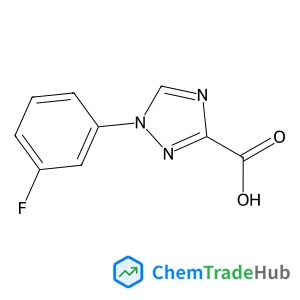
1-(3-Fluorophenyl)-1H-1,2,4-triazole-3-carboxylic acid
CAS Number:
1292369-51-7
Molecular Formula:
C9H6FN3O2
Chao-Shen Zhang, Chang-Zhen Fang, Liang Yi, Chen Zhu, Magnus Rueping
Visible light photoredox-catalyzed reactions have become essential tools in organic synthesis. However, these transformations often rely on high-cost photocatalysts that require multistep synthesis and chromophore design. In recent years, charge transfer complex (CTC) photochemistry has emerged as an alternative to photoredox catalysis, but this method requires substrates to form the CTC. To overcome these limitations, we developed a new catalytic paradigm using easily available N-heterocyclic nitreniums (NHNs) as photocatalysts. Our method uses incident light absorbed by the in situ-formed CTC between NHN and its counteranion or a sacrificial donor, extending CTC photochemistry to a general catalytic mode without relying on substrates. Here, we demonstrate NHN catalysis for the photoreduction of C–Cl bonds in chloroform and activated alkyl chlorides. This approach is characterized by easily available NHNs (one-step synthesis without column purification), operational simplicity, and diverse transformations. Mechanistic studies reveal that the generated NHN aminyl radical could undergo inner-sphere single-electron transfer in concert with halogen-atom dissociation.

Russian Journal of Coordination Chemistry

Crystallography Reports

Journal of Saudi Chemical Society

Journal of Peptide Science

Organic Process Research & Development

Journal of Natural Medicines

Russian Journal of Bioorganic Chemistry

Drug Discovery Today

Current Opinion in Colloid & Interface Science

Russian Journal of Organic Chemistry
Maria Rosa Antognazza, Francesco Scotognella, Karol Miszta, Dirk Dorfs, Marco Zanella, Margherita Zavelani-Rossi, Liberato Manna, Francesco Tassone
DOI: 10.1039/C1CP21402K
Shinobu Gonsui, Tetsuya Tsuda, Ken-ichi Fukui
DOI: 10.1039/C1CP20643E
Princia Salvatore, Allan Glargaard Hansen, Thomas Bjørnholm, Richard John Nichols, Jens Ulstrup
DOI: 10.1039/C1CP21197H
Jonathan Romero, Andres Reyes, Jorge David, Albeiro Restrepo
DOI: 10.1039/C1CP20903E
Tomoya Uruga, Hajime Tanida, Yasuko Terada, Yasuhiro Iwasawa, Shin-ichi Ohkoshi
DOI: 10.1039/C1CP20895K
Yufang Liu, Kai Jiang, Deheng Shi, Jinfeng Sun
DOI: 10.1039/C1CP20729F
S. Ghanta, V. Sivaranjana Reddy, S. Mahapatra
DOI: 10.1039/C1CP21083A
Pedro B. Coto, Luis Serrano-Andrés, Thomas Gustavsson, Takashige Fujiwara, Edward C. Lim
DOI: 10.1039/C1CP21089K
Stefanie A. Sherrill, Jonathon Duay, Zhe Gui, Parag Banerjee, Gary W. Rubloff
DOI: 10.1039/C1CP21815H
2-Methylbenzene-1,4-diamine dihydrochloride (CAS: 615-45-2) should be stored in ...
(1S,4S)-2,5-Diazabicyclo[2.2.1]heptane dihydrobromide is generally considered sa...
(6-Chloropyridazin-3-YL)methanamine finds applications in the pharmaceutical ind...
2-Fluoro-3-methylphenol is primarily used in the synthesis of pharmaceuticals, p...
When handling 3-Methoxy-4-nitrobenzonitrile, it is important to wear appropriate...
When handling 1,3-Oxazolo[4,5-b]pyridine-2(3H)-thione (CAS: 211949-57-4), it is ...
4-Ethynylbenzamide (CAS: 90347-86-7) falls under various regulatory guidelines i...
3-(2-Ethylphenyl)-2-thioxo-4-imidazolidinone is primarily used as an intermediat...
(2-Fluoro-6-methoxyphenyl)acetic acid, also known as 4-fluoro-3-methoxybenzoic a...
Market trends for 2-[4-(Hydroxymethyl)phenoxy]ethanol (CAS: 102196-18-9) indicat...

Organic Chemistry Frontiers publishes high-quality research from across organic chemistry. Emphases are placed on studies that make significant contributions to the field of organic chemistry by reporting either new or significantly improved protocols or methodologies. Topics include, but are not limited to the following: Organic synthesis Development of synthetic methodologies Catalysis Natural products Functional organic materials Supramolecular and macromolecular chemistry Physical and computational organic chemistry
![4-[(2-{2-[2-(2-Aminoethoxy)ethoxy]ethoxy}ethyl)amino]-2-(2,6-dioxo-3-piperidinyl)-1H-isoindole-1,3(2H)-dione structure](https://static.chemtradehub.com/structs/209/2093416-31-8-3162.webp "4-[(2-{2-[2-(2-Aminoethoxy)ethoxy]ethoxy}ethyl)amino]-2-(2,6-dioxo-3-piperidinyl)-1H-isoindole-1,3(2H)-dione structure")