












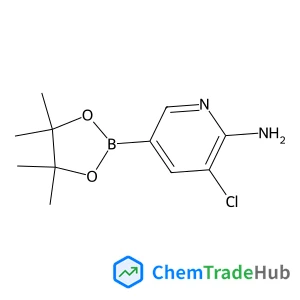
3-Chloro-5-(4,4,5,5-tetramethyl-1,3,2-dioxaborolan-2-yl)-2-pyridinamine
CAS Number:
1032758-99-8
Molecular Formula:
C11H16BClN2O2
S. Ghanta, V. Sivaranjana Reddy, S. Mahapatra
Motivated by the recent discovery of new diffuse interstellar bands and results from laboratory experiments, ab initio quantum chemistry calculations are carried out for the lowest six electronic states of naphthalene and anthracene radical cations. The calculated adiabatic electronic energies are utilized to construct suitable diabatic electronic Hamiltonians in order to perform nuclear dynamics studies in Part II. Complex entanglement of the electronic states is established for both the radical cations and the coupling surfaces among them are also derived in accordance with the symmetry selection rules. Critical examination of the coupling parameters of the Hamiltonian suggests that 29 (out of 48) and 31 (out of 66) vibrational modes are relevant in the nuclear dynamics in the six lowest electronic states of naphthalene and anthracene radical cations, respectively.
João Paulo B. Lopes, Luana Silva, Diogo S. Lüdtke
DOI: 10.1039/D1MD00217A
Efrat Finkin-Groner, Yoshiyuki Fukase, Qingfei Zheng, Shan Sun, Mayako Michino, Robert W. Myers
DOI: 10.1039/D1MD00062D
Alexander W. Weig, Samantha L. Barlock, Patrick M. O'Connor, Orry M. Marciano, Richard Smith, Robert K. Ernst, Roberta J. Melander, Christian Melander
DOI: 10.1039/D0MD00238K
Víctor Tena Pérez, Andreea Madalina Serban, Javier Acero Gómez, Ángel Rumbero Sánchez
DOI: 10.1039/D0MD00208A
Yan Yin, Yuxing Sun, Lianhua Zhao, Jinpeng Pan
DOI: 10.1039/C9MD00537D
Mabel Catalán, Vicente Castro-Castillo, Javier Gajardo-de la Fuente, Jocelyn Aguilera, Jorge Ferreira, Ricardo Ramires-Fernandez, Ivonne Olmedo, Alfredo Molina-Berríos, Charlotte Palominos, Marcelo Valencia, Marta Domínguez, José A. Souto, José A. Jara
DOI: 10.1039/D0MD00153H
Alex D. Johnson, Joseph A. Buhagiar, David C. Magri
DOI: 10.1039/D1MD00246E
Nikolai Makukhin, Alessio Ciulli
DOI: 10.1039/D0MD00272K
Virender Kumar Sharma, Ankur Biswas, Mayurika Lahiri, Sudipta Basu
DOI: 10.1039/D1MD00095K
Yuichiro Akao, Stacie Canan, Yafeng Cao, Kevin Condroski, Ola Engkvist, Sachiko Itono, Rina Kaki, Chiaki Kimura, Thierry Kogej, Kazuya Nagaoka, Akira Naito, Hiromi Nakai, Garry Pairaudeau, Constantin Radu, Ieuan Roberts, Mitsuyuki Shimada, David Shum, Nao-aki Watanabe, Huanxu Xie, Shuji Yonezawa, Osamu Yoshida, Ryu Yoshida, Charles Mowbray, Benjamin Perry
DOI: 10.1039/D0MD00353K
This compound is mainly used as an intermediate in the synthesis of antipsychoti...
Waste containing 1-(D-Ribofuranosyl)-1,4-dihydro-3-pyridinecarboxamide (CAS: 191...
2-Methyl-2-propanyl 3-bromo-3-(hydroxymethyl)-1-azetidinecarboxylate (CAS: 20079...
N-(4-Chloro-2-pyridinyl)acetamide (CAS: 245056-66-0) is a chemical compound with...
5-Chloro-2-hydroxybenzoic acid, also known as 5-chlorosalicylic acid, is an arom...
When handling 1,1-Dichloro-1-fluoroethane (CAS: 1717-00-6), it is important to u...
Fmoc-(2S,3R)-3-phenylpyrrolidine-2-carboxylic acid is a white crystalline solid ...
4-Amino-5-bromo-2-pyridinecarboxylic acid is primarily used as a precursor in th...
Handling this compound should be done with personal protective equipment (PPE) i...
When handling 8-bromo-2,2-dimethyl-3,4-dihydro-2H-1,4-benzoxazin-3-one, use prop...

Physical Chemistry Chemical Physics (PCCP) is an international journal co-owned by 19 physical chemistry and physics societies from around the world. This journal publishes original, cutting-edge research in physical chemistry, chemical physics and biophysical chemistry. To be suitable for publication in PCCP, articles must include significant innovation and/or insight into physical chemistry; this is the most important criterion that reviewers and Editors will judge against when evaluating submissions. The journal has a broad scope and welcomes contributions spanning experiment, theory, computation and data science. Topical coverage includes spectroscopy, dynamics, kinetics, statistical mechanics, thermodynamics, electrochemistry, catalysis, surface science, quantum mechanics, quantum computing and machine learning. Interdisciplinary research areas such as polymers and soft matter, materials, nanoscience, energy, surfaces/interfaces, and biophysical chemistry are welcomed if they demonstrate significant innovation and/or insight into physical chemistry. Joined experimental/theoretical studies are particularly appreciated when complementary and based on up-to-date approaches.
![1-[3-(4-Morpholinylsulfonyl)phenyl]methanamine structure](https://static.chemtradehub.com/structs/933/933989-32-3-51af.webp "1-[3-(4-Morpholinylsulfonyl)phenyl]methanamine structure")




