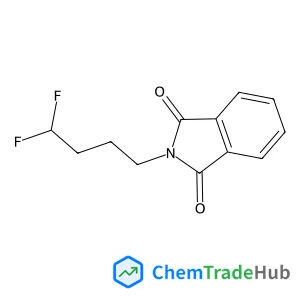
2-(4,4-Difluorobutyl)-1H-isoindole-1,3(2H)-dione
CAS Number:
1265341-14-7
Molecular Formula:
C12H11F2NO2
Organoboron compounds now known as versatile building blocks are broadly used in a variety of transformations in the fields of organic synthesis, drug synthesis, and materials science. The practical and convenient synthesis methodology of organoboron compounds has been well developed. Generally, organoboron compounds are prepared through transmetalation reactions using organolithium or organomagnesium reagents, hydroboration of C–C unsaturated bonds, borylation of CX double bonds, or borylation of C–H/C–X bonds. Among these methods, bis(pinacolato)diboron (B2pin2) and pinacol borane (HBpin) are used extensively. Recently, borylation mediated by BX3 for the efficient synthesis of organoborons has been well developed. In this review, we summarize the research on borylation driven by BX3 in the fields of organic synthesis and drug synthesis, including (1) borylative difunctionalization of C–C unsaturated bonds and (2) C–H bond borylation. The strategies of borylation processes as well as the scopes, limits, and mechanisms of these approaches are addressed.

CrystEngComm

Journal of Medical Biochemistry

Foundations of Chemistry

Advanced Engineering Materials

Environmental Toxicology and Pharmacology

Contact Lens & Anterior Eye

Current Pharmaceutical Biotechnology

Photochemical & Photobiological Sciences

Coloration Technology

Journal of Enzyme inhibition and Medicinal Chemistry
David Ruzafa, Lorena Varela, Ana I. Azuaga, Francisco Conejero-Lara, Bertrand Morel
DOI: 10.1039/C3CP54383H
Fengqiao Zhang, Dong Zhu, Xi'an Chen, Xin Xu, Zhi Yang, Chao Zou, Keqin Yang, Shaoming Huang
DOI: 10.1039/C3CP54334J
Yuqi Wu, Gongxuan Lu
DOI: 10.1039/C3CP54461C
Yanjiao Ma, Rongfang Wang, Hui Wang, Vladimir Linkov, Shan Ji
DOI: 10.1039/C3CP54600D
Henrike M. Müller-Werkmeister, Jens Bredenbeck
DOI: 10.1039/C3CP54760D
DOI: 10.1039/C3CP54041C
Chao Wang, Yuanxu Wang, Guangbiao Zhang, Chengxiao Peng, Gui Yang
DOI: 10.1039/C3CP54289K
Hong-Guang Xu, Wei-Jun Zheng, Jun Li
DOI: 10.1039/C3CP54478H
N-(4-Methoxybenzyl)-2-pyridinamine (CAS: 52818-63-0) is increasingly being used ...
When handling Ethyl 4-(2-chlorophenyl)-1,3-thiazole-2-carboxylate, appropriate p...
Diethyldiselane (CAS: 628-39-7) is classified under the Globally Harmonized Syst...
The market for oxocopper (CAS: 12053-18-8) is primarily driven by its use in cat...
The market for 5-{[(2-Methyl-2-propanyl)oxy]carbonyl}-5-azaspiro[2.4]heptane-7-c...
2-(1-Pyrrolidinyl)-4-pyridinamine is a chemical compound with the CAS number 359...
2-(3-Pyridinyl)-1-azabicyclo[2.2.2]octane (CAS: 91556-75-1) is a crystalline sol...
(S)-Alpha-allyl-proline hydrochloride is usually synthesized via a Wittig reacti...
3-Methyl-1,2-oxazole-5-carboxylic acid (CAS: 4857-42-5) is an organic compound w...
Lys-SMCC-DM1 is synthesized via a multi-step process involving the coupling of S...

Organic Chemistry Frontiers publishes high-quality research from across organic chemistry. Emphases are placed on studies that make significant contributions to the field of organic chemistry by reporting either new or significantly improved protocols or methodologies. Topics include, but are not limited to the following: Organic synthesis Development of synthetic methodologies Catalysis Natural products Functional organic materials Supramolecular and macromolecular chemistry Physical and computational organic chemistry