














Macroscopic alignment of metal–organic framework crystals in specific crystallographic orientations
Literature Information
Publication Date
2023-08-22
DOI
10.1039/D3QM00678F
Impact Factor
6.482
Authors
Jonghoon Park, Hoi Ri Moon, Jin Yeong Kim
View Original
Abstract
With the growing interest in metal–organic frameworks (MOFs) and their potential applications, it has become crucial to discover novel MOFs and modify their constituent components. One promising strategy for enhancing the properties of MOFs is the alignment of crystals in specific orientations, which induce anisotropic properties in particular facets. The integration of oriented MOFs at the macroscopic level can be achieved through two main approaches: the direct growth in an oriented manner and the alignment of pre-formed crystals. Direct growth methods involve the adsorption of precursor molecules on substrates, initiating the guided growth based on factors like lattice parameters, surface interactions, and differential growth rates of crystal facets. Integrating MOFs with other substrates in an oriented manner generates novel architectures with unique properties. Another approach is to create alignment using pre-formed MOF crystals, which mainly involves external forces, interfaces of synthetic media, and their assembly. This strategy offers greater flexibility in material selection because of the wide range of pre-existing MOF structures of different compositions. Furthermore, it enables the fabrication of highly ordered alignment over large areas. Ideally, perfectly aligned MOF crystals can mutually synchronize with each other to act like a large single-crystal, ultimately facilitating the full utilization of the directional anisotropic properties over a large area. This review focuses on the preparation strategies and examples of macroscopically oriented MOFs.
Related Literature
Role of sterics in phosphine-ligated gold clusters
Katherine A. Parrish, Mary King, Marshall R. Ligare, Grant E. Johnson, Heriberto Hernández
2018-09-20
Paper
DOI: 10.1039/C8CP04961K
Doping effect of transition metals (Zr, Mn, Ti and Ni) on well-shaped CuO/CeO2(rods): nano/micro structure and catalytic performance for selective oxidation of CO in excess H2
Xiaolin Guo, Zhihuan Qiu, Jianxin Mao, Renxian Zhou
2018-09-26
Paper
DOI: 10.1039/C8CP03696A
Evolution of optical properties and electronic structures: band gaps and critical points in MgxZn1−xO (0 ≤ x ≤ 0.2) thin films
Yue-Jie Shi, Rong-Jun Zhang, Xin Chen, Lei Wang, Lei Chen, Qing-Hua Huang, Da-Hai Li, Yu-Xiang Zheng, Song-You Wang, Ning Dai, Liang-Yao Chen
2018-09-21
Paper
DOI: 10.1039/C8CP04942D
Achieving a direct band gap and high power conversion efficiency in an SbI3/BiI3 type-II vdW heterostructure via interlayer compression and electric field application
Jiayu Dai
2019-01-03
Paper
DOI: 10.1039/C8CP07298A
Theoretical study of the bandgap regulation of a two-dimensional GeSn alloy under biaxial strain and uniaxial strain along the armchair direction
Wenqi Huang, Hong Yang, Buwen Cheng, Chunlai Xue
2018-08-20
Paper
DOI: 10.1039/C8CP03570A
Exposing catalytic versatility of GTPases: taking reaction detours in mutants of hGBP1 enzyme without additional energetic cost
Ravi Tripathi, Jan Noetzel, Dominik Marx
2018-12-07
Paper
DOI: 10.1039/C8CP06343E
In proteins, the structural responses of a position to mutation rely on the Goldilocks principle: not too many links, not too few
Laëtitia Bourgeat, Laurent Vuillon
2018-09-27
Paper
DOI: 10.1039/C8CP04530E
Nuclear spin singlet states as magnetic on/off probes in self-assembling systems
2018-08-14
Paper
DOI: 10.1039/C8CP04448A
You might also like
Compound Q&A
Are there alternatives to 1-(4-Chlorophenyl)-N-hydroxymethanimine (CAS: 3848-36-0) in synthesis?
When considering alternatives to 1-(4-Chlorophenyl)-N-hydroxymethanimine (CAS: 3...
3848-36-01-(4-Chlorophenyl)-N...
Compound Q&A
How should (1R,9S,10S,12S,14E,16S,19R,20R,21S,22R)-3,9,21-Trihydroxy-5,10,12,14,16,20,22-heptamethyl-23,24-dioxatetracyclo[17.3.1.1~6,9~.0~2,7~]tetracosa-2,5,7,14-tetraen-4-one (CAS: 183202-73-5) be stored?
This compound should be stored in a cool, dry place away from direct sunlight. I...
183202-73-5(1R,9S,10S,12S,14E,1...
Compound Q&A
How is 3-(4-Bromophenyl)-5-(2-fluorophenyl)-1,2,4-oxadiazole (CAS: 419553-16-5) typically synthesized?
3-(4-Bromophenyl)-5-(2-fluorophenyl)-1,2,4-oxadiazole is synthesized through a m...
419553-16-53-(4-Bromophenyl)-5-...
Compound Q&A
How is 5-Chloro-2-(4-chlorophenyl)-4-methyl-6-[3-(1-piperidinyl)propoxy]pyrimidine (CAS: 1639220-19-1) typically synthesized?
5-Chloro-2-(4-chlorophenyl)-4-methyl-6-[3-(1-piperidinyl)propoxy]pyrimidine (CAS...
1639220-19-15-Chloro-2-(4-chloro...
Compound Q&A
What industries use 2-Chloro-4-(difluoromethoxy)pyridine (CAS: 1206978-15-5)?
2-Chloro-4-(difluoromethoxy)pyridine is used in the pharmaceutical industry for ...
1206978-15-52-Chloro-4-(difluoro...
Compound Q&A
What regulatory guidelines apply to 3-Chloro-6-methylpyridazine (CAS: 1121-79-5)?
3-Chloro-6-methylpyridazine (CAS: 1121-79-5) is classified under the Globally Ha...
1121-79-53-Chloro-6-methylpyr...
Compound Q&A
Are there alternatives to Methyl 4,5-dimethyl-2-nitrobenzoate in synthesis?
Several alternatives can be used in the synthesis of Methyl 4,5-dimethyl-2-nitro...
90922-74-0Methyl 4,5-dimethyl-...
Compound Q&A
Are there alternatives to (2E,2'E)-3,3'-(1,4-Phenylene)bisacrylaldehyde in synthesis?
Alternatives to (2E,2'E)-3,3'-(1,4-Phenylene)bisacrylaldehyde include other acry...
63405-68-5(2E,2'E)-3,3'-(1,4-P...
Compound Q&A
What is 3-Amino-5-chloropyridin-2-ol hydrochloride (CAS: 1261906-29-9)?
3-Amino-5-chloropyridin-2-ol hydrochloride is an organic compound with the CAS n...
1261906-29-93-Amino-5-chloropyri...
Compound Q&A
What precautions should be taken when handling 6,7-Difluoro-2,3-dihydro-4H-chromen-4-one (CAS: 1092349-93-3)?
When handling 6,7-Difluoro-2,3-dihydro-4H-chromen-4-one, it is essential to wear...
1092349-93-36,7-Difluoro-2,3-dih...
Source Journal
Recommended Compounds
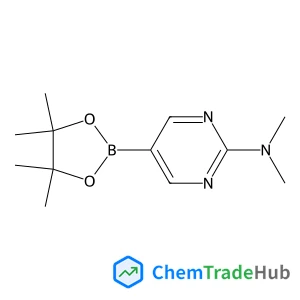
N,N-Dimethyl-5-(4,4,5,5-tetramethyl-1,3,2-dioxaborolan-2-yl)-2-pyrimidinamine
CAS Number:
1032759-30-0
Molecular Formula:
C12H20BN3O2

Recommended Suppliers




Disclaimer
This page provides academic journal information for reference and research purposes only. We are not affiliated with any journal publishers and do not handle publication submissions. For publication-related inquiries, please contact the respective journal publishers directly.
If you notice any inaccuracies in the information displayed, please contact us at support@chemtradehub.com. We will promptly review and address your concerns.