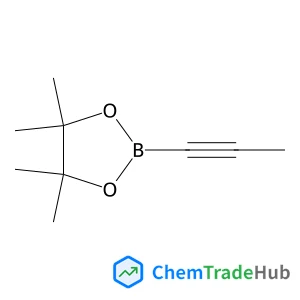
4,4,5,5-Tetramethyl-2-(1-propyn-1-YL)-1,3,2-dioxaborolane
CAS Number:
347389-75-7
Molecular Formula:
C9H15BO2
The first page of this article is displayed as the abstract.
Noriyoshi Kon, Nobuhiko Iki, Sotaro Miyano
DOI: 10.1039/B210198J
Yuji Yamazaki, Yukiko Nambu, Masashi Ohmae, Manabu Sugai, Shunsaku Kimura
DOI: 10.1039/C8OB01955J
Gabriela Islas-Gonzalez, Michèle Bois-Choussy, Jieping Zhu
DOI: 10.1039/B208905J
Richard A. van Delden, Nagatoshi Koumura, Annemarie Schoevaars, Auke Meetsma, Ben L. Feringa
DOI: 10.1039/B209378B
Yingkun Shi, Hongqing Xiao, Xiu-Hua Xu, Yangen Huang
DOI: 10.1039/C8OB02457J
Richard A. J. O'Hair, Ana K. Vrkic
DOI: 10.1039/B209848B
K. V. Belyaeva, L. P. Nikitina, A. V. Afonin, A. V. Vashchenko, V. M. Muzalevskiy, V. G. Nenajdenko, B. A. Trofimov
DOI: 10.1039/C8OB02379D
DOI: 10.1039/B208827B
Alicia Megia-Fernandez, Bethany Mills, Chesney Michels, Sunay V. Chankeshwara, Nikola Krstajić, Chris Haslett, Kevin Dhaliwal, Mark Bradley
DOI: 10.1039/C8OB01790E
Xuan Zhang, Chun-Hua Liu, Li-Hong Liu, Lin Guo, Chao-Jie Wang, Yun-Bao Jiang
DOI: 10.1039/B210106H
2-Methylbenzene-1,4-diamine dihydrochloride (CAS: 615-45-2) should be stored in ...
(1S,4S)-2,5-Diazabicyclo[2.2.1]heptane dihydrobromide is generally considered sa...
(6-Chloropyridazin-3-YL)methanamine finds applications in the pharmaceutical ind...
2-Fluoro-3-methylphenol is primarily used in the synthesis of pharmaceuticals, p...
When handling 3-Methoxy-4-nitrobenzonitrile, it is important to wear appropriate...
When handling 1,3-Oxazolo[4,5-b]pyridine-2(3H)-thione (CAS: 211949-57-4), it is ...
4-Ethynylbenzamide (CAS: 90347-86-7) falls under various regulatory guidelines i...
3-(2-Ethylphenyl)-2-thioxo-4-imidazolidinone is primarily used as an intermediat...
(2-Fluoro-6-methoxyphenyl)acetic acid, also known as 4-fluoro-3-methoxybenzoic a...
Market trends for 2-[4-(Hydroxymethyl)phenoxy]ethanol (CAS: 102196-18-9) indicat...

Organic & Biomolecular Chemistry (OBC) publishes original and high impact research and reviews in organic chemistry. We welcome research that shows new or significantly improved protocols or methodologies in total synthesis, synthetic methodology or physical and theoretical organic chemistry as well as research that shows a significant advance in the organic chemistry or molecular design aspects of chemical biology, catalysis, supramolecular and macromolecular chemistry, theoretical chemistry, mechanism-oriented physical organic chemistry, medicinal chemistry or natural products. Articles published in the journal should report new work which makes a highly-significant impact in the field. Routine and incremental work is generally not suitable for publication in the journal. More details about key areas of our scope are below. In all cases authors should include in their article clear rationale for why their research has been carried out.
![(1R,6R)-6-({[(2-Methyl-2-propanyl)oxy]carbonyl}amino)-3-cyclohexene-1-carboxylic acid structure](https://static.chemtradehub.com/structs/865/865689-24-3-5fef.webp "(1R,6R)-6-({[(2-Methyl-2-propanyl)oxy]carbonyl}amino)-3-cyclohexene-1-carboxylic acid structure")