


Facile preparation of physically crosslinked hydrogel based on the glassy state with high strength
Literature Information
Publication Date
2024-01-04
DOI
10.1039/D3NJ05118H
Impact Factor
3.591
Authors
Qiurui Lin, Tao Rao, Xinyu Ma, Pan Du, Yuhan Liu, Die Luo, Xianru He
View Original
Abstract
Hydrogels are promising materials, but because of their weak mechanical performance, further applications are limited. To enhance the strength of hydrogels, physical cross-linking was introduced by the use of hydrophobic unit diacetone acrylamide (DAAM) to form cross-linking points. The homopolymer of DAAM exhibited a high glass transition temperature above 80 °C, which was confirmed by DSC. The existence of the glassy and hydrophobic phases in the hydrogel was confirmed by XRD test results. The mechanical properties of the hydrogel were satisfactory, with a maximum tensile strength of 1.96 MPa, rapid recovery ability, satisfactory elasticity, and recyclability. A conductive hydrogel was prepared by introducing sodium ions, and it was used for human motion monitoring and is expected to be a promising material for flexible strain sensors.
Recommended Journals

Russian Chemical Reviews

European Journal of Wood and Wood Products

Helvetica Chimica Acta

Nature

Journal of Organometallic Chemistry

Israel Journal of Chemistry

Journal of Physics and Chemistry of Solids

Proceedings of the National Academy of Sciences of the United States of America

Journal of Catalysis

Science Progress
Related Literature
Synthesis of novel cylindrical bottlebrush polypseudorotaxane via inclusion complexation of high density poly(ε-caprolactone) bottlebrush polymer and α-cyclodextrins
Qiang Fu, Jing. M. Ren, Greg. G. Qiao
2011-11-11
Paper
DOI: 10.1039/C1PY00362C
Influence of polymer conformations on the aggregation behaviour of alternating dialkylsilylene-[4,4′-divinyl(cyanostilbene)] copolymers
Chih-Hsien Chen, Shern-Long Lee, Tsong-Shin Lim, Chun-hsien Chen, Tien-Yau Luh
2011-10-03
Paper
DOI: 10.1039/C1PY00259G
Temperature-sensitive nanogels: poly(N-vinylcaprolactam) versus poly(N-isopropylacrylamide)
Jose Ramos, Ainara Imaz, Jacqueline Forcada
2011-12-16
Minireview
DOI: 10.1039/C2PY00485B
Terminal functional glycopolymersvia a combination of catalytic chain transfer polymerisation (CCTP) followed by three consecutive click reactions
Qiang Zhang, Stacy Slavin, Mathew W. Jones, Alice J. Haddleton, David M. Haddleton
2012-02-03
Paper
DOI: 10.1039/C2PY20013A
Bioactive and electroactive response of flexible polythiophene:polyester nanomembranes for tissue engineering
Luis J. del Valle
2012-02-01
Paper
DOI: 10.1039/C2PY00584K
Aqueous RAFT/MADIXpolymerisation of N-vinyl pyrrolidone at ambient temperature
Aymeric Guinaudeau, Stéphane Mazières, D. James Wilson, Mathias Destarac
2011-10-14
Communication
DOI: 10.1039/C1PY00373A
Two-dimensional copolymers with D–A type side chains for organic thin-film transistors: Synthesis and properties
Dugang Chen, Yan Zhao, Cheng Zhong, Gui Yu, Yunqi Liu, Jingui Qin
2011-10-07
Paper
DOI: 10.1039/C1PY00331C
You might also like
Compound Q&A
What industries use 4-(4-tert-Butylphenyl)-1H-pyrazol-3-amine (CAS: 1015845-73-4)?
4-(4-tert-Butylphenyl)-1H-pyrazol-3-amine finds applications in various industri...
1015845-73-44-(4-tert-Butylpheny...
Compound Q&A
What industries use H3TATAB (CAS: 63557-10-8)?
H3TATAB is used in the pharmaceutical industry for the synthesis of certain orga...
63557-10-8H3TATAB
Compound Q&A
What are the main uses of 1-Ethyl-3-fluorobenzene (CAS: 696-39-9)?
1-Ethyl-3-fluorobenzene (CAS: 696-39-9) is primarily used as a precursor in the ...
696-39-91-Ethyl-3-fluorobenz...
Compound Q&A
What are the main uses of 1-(tert-Butoxycarbonyl)-4-(4-methoxyphenyl)pyrrolidine-3-carboxylic acid (CAS: 851484-94-1)?
1-(tert-Butoxycarbonyl)-4-(4-methoxyphenyl)pyrrolidine-3-carboxylic acid is prim...
851484-94-11-(tert-Butoxycarbon...
Compound Q&A
What are the physical and chemical properties of 1-Cyclobutyl-4-piperidinone (CAS: 359880-05-0)?
1-Cyclobutyl-4-piperidinone (CAS: 359880-05-0) is a colorless or white crystalli...
359880-05-01-Cyclobutyl-4-piper...
Compound Q&A
What is Pyridine-2,6-dicarboxylic acid mono-tert-butyl ester (CAS: 575433-76-0)?
Pyridine-2,6-dicarboxylic acid mono-tert-butyl ester (CAS: 575433-76-0) is a che...
575433-76-0Pyridine-2,6-dicarbo...
Compound Q&A
What is the market or research trend for 2,3-Difluorophenylalanine (CAS: 236754-62-4)?
The market for 2,3-Difluorophenylalanine (CAS: 236754-62-4) is growing with incr...
236754-62-42,3-Difluorophenylal...
Compound Q&A
How is (2-Hydroxy-1-naphthyl)boronic acid (CAS: 898257-48-2) typically synthesized?
(2-Hydroxy-1-naphthyl)boronic acid can be synthesized through the reduction of 2...
898257-48-2(2-Hydroxy-1-naphthy...
Compound Q&A
What are the physical and chemical properties of tert-Butyl (5-bromo-6-methyl-3-(4,4,5,5-tetramethyl-1,3,2-dioxaborolan-2-yl)pyridin-2-yl)carbamate (CAS: 1315351-28-0)?
This compound is a crystalline solid with a molecular weight of approximately 52...
1315351-28-0tert-Butyl (5-bromo-...
Compound Q&A
Are there alternatives to 5,7-Dihydroxy-4-oxo-2-(3,4,5-trihydroxyphenyl)-4H-chromen-3-yl beta-D-glucopyranoside (CAS: 19833-12-6) in synthesis?
While 5,7-Dihydroxy-4-oxo-2-(3,4,5-trihydroxyphenyl)-4H-chromen-3-yl beta-D-gluc...
19833-12-65,7-Dihydroxy-4-oxo-...
Source Journal
New Journal of Chemistry

CiteScore:
5.3
Self-citation Rate:
3.7%
Articles per Year:
2153
NJC (New Journal of Chemistry) is a broad-based primary journal encompassing all branches of chemistry and its sub-disciplines. It contains full research articles, communications, perspectives and focus articles. This well-established journal, owned by the Centre National de la Recherche Scientifique (CNRS) of France, has been co-published with the Royal Society of Chemistry since January 1998. NJC is the forum for the publication of high-quality, original and significant work that opens new directions in chemistry or other scientific disciplines. In addition to having a significant chemical component, work published in NJC must demonstrate that it will have an impact on areas of research other than that of the reported work.
Recommended Compounds
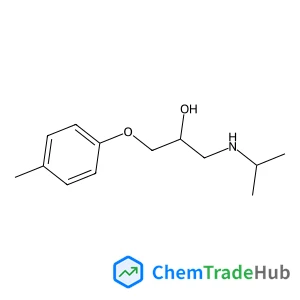
1-(4-Methylphenoxy)-3-(propan-2-ylamino)propan-2-ol
CAS Number:
5790-46-5
Molecular Formula:
C13H21NO2
Recommended Suppliers





Disclaimer
This page provides academic journal information for reference and research purposes only. We are not affiliated with any journal publishers and do not handle publication submissions. For publication-related inquiries, please contact the respective journal publishers directly.
If you notice any inaccuracies in the information displayed, please contact us at support@chemtradehub.com. We will promptly review and address your concerns.