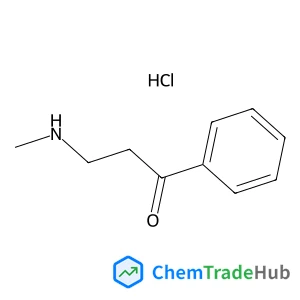
3-(Methylamino)-1-phenyl-1-propanone hydrochloride (1:1)
CAS Number:
2538-50-3
Molecular Formula:
C10H14ClNO
Ziying Huang, Guijuan Jiang, Yun Song, Jingjing Chen, Wenjing Lin, Guangying Yu, Xuemin Duan, Yanshi Xiong, Jintao Wang, Xiangwen Liao, Lianghong Liu
Multi drug-resistant Gram-positive pathogens have become one of the most serious problems facing humankind today. To address this challenge, there is an urgent need to develop new antimicrobial agents that are different from conventional antibiotics. Here, a Ru-based compound bearing benzonitrile, [Ru(dtb)2(BZIL)2](PF6)2 (RuBZ), was synthesized and evaluated. In vitro antibacterial studies demonstrated that RuBZ could efficiently inhibit S. aureus in vitro, showing higher potency than most existing clinical antibiotics, with a minimum inhibitory concentration value of 0.78 μg mL−1. Importantly, RuBZ can effectively inhibit S. aureus from forming a biofilm and releasing hemolytic toxin. What is more, RuBZ exhibited synergistic effects when combined with four clinical antibiotics. Mechanism studies suggest that RuBZ kills bacteria by disrupting their cell membrane. In addition, RuBZ has low hemolytic toxicity and shows good anti-infective potency in two animal infection models. Above all, our study presented here indicates that the Ru-based compound containing a benzonitrile group shows good potential for use as a new anti-infective agent.
Xifeng Chen, Bidou Wang, Guangxing Liu, Yuguo Tang, Peng Miao
DOI: 10.1039/C6AN00762G
Chen Zhou, Yingmei Chen, Pengxiang Shang, Yuwu Chi
DOI: 10.1039/C6AN00664G
C. Y. Shi, C. H. Deng
DOI: 10.1039/C6AN00220J
Lingfeng Xu, Ling Ni, Lihe Sun, Fang Zeng, Shuizhu Wu
DOI: 10.1039/C9AN01582E
Hamid Abdollahi, Paul J. Gemperline
DOI: 10.1039/C8AN00615F
Manman Lin, Bin Xu, Huilu Yao, Aiguo Shen, Jiming Hu
DOI: 10.1039/C5AN02315G
Marcos Bouza, Jaime Orejas, Silvia López-Vidal, Jorge Pisonero, Nerea Bordel, Rosario Pereiro, Alfredo Sanz-Medel
DOI: 10.1039/C5AN01938A
Lidija Malic, Jamal Daoud, Matthias Geissler, Alex Boutin, Ljuboje Lukic, Mojra Janta, Abdelrahman Elmanzalawy, Teodor Veres
DOI: 10.1039/C9AN01316D
Wen Chen, Mei Yang, Na Luo, Fenglin Wang, Ru-Qin Yu, Jian-Hui Jiang
DOI: 10.1039/C9AN01778J
When handling 4-(2-Furylmethyl)thiomorpholine 1,1-dioxide (CAS: 79206-94-3), it ...
When handling 4-Chloro-N-[2-(4-morpholinyl)ethyl]benzamide (CAS: 71320-77-9), it...
Waste containing this compound (CAS: 62921-74-8) should be handled according to ...
Waste containing (S)-Methyl 2-amino-3-cyclohexylpropanoate should be collected i...
This compound can be synthesized using a multi-step process involving the conjug...
There are several alternatives to (2E)-3-(3,4-Dichlorophenyl)acrylic acid in syn...
Ethyl 6-(2-nitrophenyl)imidazo[2,1-b][1,3]thiazole-3-carboxylate (CAS: 925437-84...
Waste containing 2-(1,3-Thiazol-2-yl)ethanamine (CAS: 18453-07-1) should be coll...
Methyl 5-iodo-2-methylbenzoate can be synthesized through the iodination of meth...
5-Chloro[1,2,4]triazolo[1,5-a]pyridine is commonly synthesized via the condensat...

NJC (New Journal of Chemistry) is a broad-based primary journal encompassing all branches of chemistry and its sub-disciplines. It contains full research articles, communications, perspectives and focus articles. This well-established journal, owned by the Centre National de la Recherche Scientifique (CNRS) of France, has been co-published with the Royal Society of Chemistry since January 1998. NJC is the forum for the publication of high-quality, original and significant work that opens new directions in chemistry or other scientific disciplines. In addition to having a significant chemical component, work published in NJC must demonstrate that it will have an impact on areas of research other than that of the reported work.