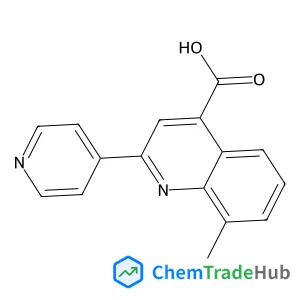
8-Methyl-2-pyridin-4-ylquinoline-4-carboxylic acid
CAS Number:
107027-42-9
Molecular Formula:
C16H12N2O2
C. Y. Shi, C. H. Deng
In this review, various inorganic materials were summarized for the analysis of small molecules by laser desorption/ionization mass spectrometry (LDI-MS). Due to its tremendous advantages, such as simplicity, high speed, high throughput, small analyte volumes and tolerance towards salts, LDI-MS has been widely used in various analytes. During the ionization process, a suitable agent is required to assist the ionization, such as an appropriate matrix for matrix assisted laser desorption/ionization mass spectrometry (MALDI-MS). However, it is normally difficult to analyze small molecules with the MALDI technique because conventional organic matrices may produce matrix-related peaks in the low molecular-weight region, which limits the detection of small molecules (m/z < 700 Da). Therefore, more and more inorganic materials, including carbon-based materials, silicon-based materials and metal-based materials, have been developed to assist the ionization of small molecules. These inorganic materials can transfer energy and improve the ionization efficiency of analytes. In addition, functionalized inorganic materials can act as both an adsorbent and an agent in the enrichment and ionization of small molecules. In this review, we mainly focus on present advances in inorganic materials for the LDI-MS analysis of small molecules in the last five years, which contains the synthetic protocols of novel inorganic materials and the detailed results achieved by inorganic materials. On the other hand, this review also summarizes the application of inorganic materials as adsorbents in the selective enrichment of small molecules, which provides a new field for the application of inorganic materials.

Russian Journal of Coordination Chemistry

Journal of Saudi Chemical Society

Russian Journal of Bioorganic Chemistry

Russian Journal of Organic Chemistry

New Journal of Chemistry

Russian Journal of General Chemistry

Current Opinion in Colloid & Interface Science

Saudi Pharmaceutical Journal

Journal of Peptide Science

Acta Materialia
DOI: 10.1039/C7SE00298J
Siquan Xu, Chunyu Yin, Donghui Pan, Feng Hu, Yuanfeng Wu, Yanan Miao, Lijing Gao, Guomin Xiao
DOI: 10.1039/C8SE00499D
Norberto Manfredi, Matteo Monai, Tiziano Montini, Matteo Salamone, Riccardo Ruffo, Paolo Fornasiero, Alessandro Abbotto
DOI: 10.1039/C7SE00075H
Sen Gao, Maoxia Yang, Shaomin Li, Ji Xia, Jun Mei, Hao Liu
DOI: 10.1039/C8SE00498F
Prerna Gangotri, Pooran Koli
DOI: 10.1039/C7SE00083A
Waste containing 6-Chloro-5-(2'-hydroxy-3'-methoxy-4-biphenylyl)-3-(3-methoxyphe...
(3alpha,5alpha)-3-Hydroxypregnane-11,20-dione is primarily used in the pharmaceu...
The market for 4-Amino-6-chloro-2-pyridinecarboxylic acid (CAS: 546141-56-4) is ...
Alternatives to (2-Benzoylethyl)trimethylammonium chloride (CAS: 24472-88-6) in ...
N-[4-Nitro-3-(trifluoromethyl)phenyl]acetamide (CAS: 393-12-4) is generally safe...
Alternative reagents such as other phosphates or similar functional groups can b...
There are alternatives to N,N'-Bis(3-aminopropyl)-1,3-propanediamine (CAS: 4605-...
When handling Aluminium trihexadecanoate, it is important to use appropriate per...
(1,1-Dioxido-3-oxo-1,2-benzothiazol-2(3H)-yl)acetic acid is a chemical compound ...
Several alternatives to 5,5-dimethyloxolan-2-one (CAS: 3123-97-5) can be used in...

Analyst publishes analytical and bioanalytical research that reports premier fundamental discoveries and inventions, and the applications of those discoveries, unconfined by traditional discipline barriers.