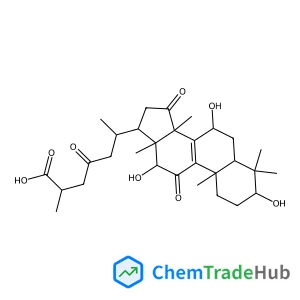
(3beta,7beta,12beta)-3,7,12-Trihydroxy-11,15,23-trioxolanost-8-en-26-oic acid
CAS Number:
98665-22-6
Molecular Formula:
C30H44O8
Xuejun Zhang, Dujuan Mo, Zhongxian Song, Wei Liu, Haiyang Li, Nana Guan, Mengru Zhang, Ruihua Guo, Zhenzhen Huang
Gaseous SO2 acidification Ce-based catalysts were prepared and used for the selective reduction of NO with NH3. S–Ce was obtained by direct anaerobic sulfation of CeO2, while H–S–Ce was obtained by reduction of CeO2 and then anaerobic sulfation. Both S–Ce and H–S–Ce exhibited excellent SCR activity, and the S–Ce catalyst displayed the best catalytic performance. The activity of CeO2 was below 30% in the whole temperature range, while the activity of S–Ce reached 90% at 250 °C and remained 100% at 300–450 °C. Anaerobic sulfation could enhance the redox and surface acidity of the S–Ce catalyst. The acid sites favored NH3 adsorption, while the H–S–Ce catalyst exhibited considerable surface acidity, but the redox performance was weakened by stable sulfate. The reaction mechanism showed that a huge number of NH3 species adsorbed on S–Ce catalysts were consumed by NO gas. The present nitrate species and NO2 were removed. The SCR reaction followed E–R and L–H mechanisms for S–Ce. A large number of NH3 species on H–S–Ce were cleared by NO, and NO could hardly adsorb on its surface. The SCR reaction followed the E–R mechanism.
Sergio Posada-Pérez, David Santos-Carballal, Umberto Terranova, Alberto Roldan, Francesc Illas
DOI: 10.1039/C8CP03430C
Matteo Ambrosetti, Giacomo Ruggeri, Chiara Cappelli, Andrea Pucci
DOI: 10.1039/C8CP04450C
Jose M. Ortiz-Roldan, Gustavo Esteban-Manzanares, Sofía Calero, A. Rabdel Ruiz-Salvador, Said Hamad
DOI: 10.1039/C8CP02591F
Fan W. Zeng, Dajie Zhang, James B. Spicer
DOI: 10.1039/C8CP04997A
Victor M. Freixas, Sebastian Fernandez-Alberti, Sergei Tretiak, Dmitrii Shalashilin
DOI: 10.1039/C8CP02321B
P. Jasik, J. Kozicki, T. Kilich, J. E. Sienkiewicz, N. E. Henriksen
DOI: 10.1039/C8CP02551G
Huan Zong, Xinxin Wang, Jun Quan, Chunhua Tian, Mengtao Sun
DOI: 10.1039/C8CP03442G
Christian Meltzer, Hui Yu, Wolfgang Peukert, Björn Braunschweig
DOI: 10.1039/C8CP02391C
Jiajun Wang, Baozeng Zhou, Fang Wang, Yinping Miao, Junqing Wei, Baojun Zhang, Kailiang Zhang
DOI: 10.1039/C8CP04337J
When handling 4-(2-Furylmethyl)thiomorpholine 1,1-dioxide (CAS: 79206-94-3), it ...
When handling 4-Chloro-N-[2-(4-morpholinyl)ethyl]benzamide (CAS: 71320-77-9), it...
Waste containing this compound (CAS: 62921-74-8) should be handled according to ...
Waste containing (S)-Methyl 2-amino-3-cyclohexylpropanoate should be collected i...
This compound can be synthesized using a multi-step process involving the conjug...
There are several alternatives to (2E)-3-(3,4-Dichlorophenyl)acrylic acid in syn...
Ethyl 6-(2-nitrophenyl)imidazo[2,1-b][1,3]thiazole-3-carboxylate (CAS: 925437-84...
Waste containing 2-(1,3-Thiazol-2-yl)ethanamine (CAS: 18453-07-1) should be coll...
Methyl 5-iodo-2-methylbenzoate can be synthesized through the iodination of meth...
5-Chloro[1,2,4]triazolo[1,5-a]pyridine is commonly synthesized via the condensat...

NJC (New Journal of Chemistry) is a broad-based primary journal encompassing all branches of chemistry and its sub-disciplines. It contains full research articles, communications, perspectives and focus articles. This well-established journal, owned by the Centre National de la Recherche Scientifique (CNRS) of France, has been co-published with the Royal Society of Chemistry since January 1998. NJC is the forum for the publication of high-quality, original and significant work that opens new directions in chemistry or other scientific disciplines. In addition to having a significant chemical component, work published in NJC must demonstrate that it will have an impact on areas of research other than that of the reported work.