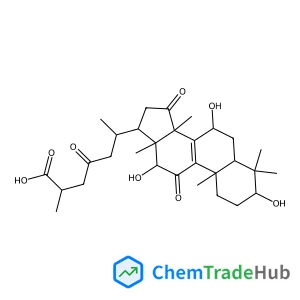
(3beta,7beta,12beta)-3,7,12-Trihydroxy-11,15,23-trioxolanost-8-en-26-oic acid
CAS Number:
98665-22-6
Molecular Formula:
C30H44O8
P. Jasik, J. Kozicki, T. Kilich, J. E. Sienkiewicz, N. E. Henriksen
Adiabatic potential energy curves of the 31Σ+, 33Σ+, 21Π and 23Π states correlating for large internuclear distance with the K(4s) + Li(2p) atomic asymptote were calculated. Very good agreement between the calculated and the experimental curve of the 21Π state allowed for a reliable description of the dissociation process through a small (∼20 cm−1 for J = 0) potential energy barrier. The barrier supports several rovibrational quasi-bound states and explicit time evolution of these states via the time-dependent nuclear Schrödinger equation, showed that the state populations decay exponentially in time. We were able to precisely describe the time-dependent dissociation process of several rovibrational levels and found that our calculated spectrum match very well with the assigned experimental spectrum. Moreover, our approach is able to predict the positions of previously unassigned lines, particularly in the case of their low intensity.
Qi Kang, Dazhong Shen, Yunqing Wang
DOI: 10.1039/C9AN01694E
Yuanyuan Wang, Zhaopeng Yu, Zhen Zhang, Shusheng Zhang
DOI: 10.1039/C6AN00160B
Rongxing Luo, Yinhui Li, Qifeng Zhou, Jing Zheng, Dandan Ma, Pinting Tang, Sheng Yang, Zhihe Qing
DOI: 10.1039/C6AN00467A
Chun Mei Li, Lei Zhan, Lin Ling Zheng, Yuan Fang Li
DOI: 10.1039/C6AN00489J
Dustin Harris, Jyothir Ganesh Ummadi, Andrew R. Thurber, Yvan Allau, Circe Verba, Frederick Colwell, Marta E. Torres, Dipankar Koley
DOI: 10.1039/C6AN00007J
Zoë J. Ayres, Mark E. Newton, Julie V. Macpherson
DOI: 10.1039/C6AN00340K
Yusuke Niwa, Tatsumi Mizuta, Kenji Sueyoshi, Tatsuro Endo, Hideaki Hisamoto
DOI: 10.1039/C9AN01769K
Won-Nyoung Lee, Hyun Jin Yoo, Kim Huyen Nguyen, Changyoon Baek, Junhong Min
DOI: 10.1039/C9AN00896A
Claire V. Crowther, Viola Sanderlin, Mark A. Hayes, Gillian H. Gile
DOI: 10.1039/C9AN01186B
M. Taguchi, N. Schwalb, Y. Rong, N. Garland, M. Tan, H. Yamaguchi, J. C. Claussen, E. S. McLamore
DOI: 10.1039/C6AN00069J
When handling 4-(2-Furylmethyl)thiomorpholine 1,1-dioxide (CAS: 79206-94-3), it ...
When handling 4-Chloro-N-[2-(4-morpholinyl)ethyl]benzamide (CAS: 71320-77-9), it...
Waste containing this compound (CAS: 62921-74-8) should be handled according to ...
Waste containing (S)-Methyl 2-amino-3-cyclohexylpropanoate should be collected i...
This compound can be synthesized using a multi-step process involving the conjug...
There are several alternatives to (2E)-3-(3,4-Dichlorophenyl)acrylic acid in syn...
Ethyl 6-(2-nitrophenyl)imidazo[2,1-b][1,3]thiazole-3-carboxylate (CAS: 925437-84...
Waste containing 2-(1,3-Thiazol-2-yl)ethanamine (CAS: 18453-07-1) should be coll...
Methyl 5-iodo-2-methylbenzoate can be synthesized through the iodination of meth...
5-Chloro[1,2,4]triazolo[1,5-a]pyridine is commonly synthesized via the condensat...

Physical Chemistry Chemical Physics (PCCP) is an international journal co-owned by 19 physical chemistry and physics societies from around the world. This journal publishes original, cutting-edge research in physical chemistry, chemical physics and biophysical chemistry. To be suitable for publication in PCCP, articles must include significant innovation and/or insight into physical chemistry; this is the most important criterion that reviewers and Editors will judge against when evaluating submissions. The journal has a broad scope and welcomes contributions spanning experiment, theory, computation and data science. Topical coverage includes spectroscopy, dynamics, kinetics, statistical mechanics, thermodynamics, electrochemistry, catalysis, surface science, quantum mechanics, quantum computing and machine learning. Interdisciplinary research areas such as polymers and soft matter, materials, nanoscience, energy, surfaces/interfaces, and biophysical chemistry are welcomed if they demonstrate significant innovation and/or insight into physical chemistry. Joined experimental/theoretical studies are particularly appreciated when complementary and based on up-to-date approaches.