













Research progress of anticancer drugs targeting CDK12
Literature Information
Publication Date
2023-05-23
DOI
10.1039/D3MD00004D
Impact Factor
0
Authors
Zhijia Yan, Yongli Du, Haibin Zhang, Yong Zheng, Huiting Lv, Ning Dong, Fang He
View Original
Abstract
Cyclin-dependent kinase 12 (CDK12) is a transcription-associated CDK that plays key roles in transcription, translation, mRNA splicing, the cell cycle, and DNA damage repair. Research has identified that high expression of CDK12 in organs such as the breast, stomach, and uterus can lead to HER2-positive breast cancer, gastric cancer and cervical cancer. Inhibiting high expression of CDK12 suppresses tumor growth and proliferation, suggesting that it is both a biomarker for cancer and a potential target for cancer therapy. CDK12 inhibitors can competitively bind the CDK12 hydrophobic pocket with ATP to avoid CDK12 phosphorylation, blocking subsequent signaling pathways. The development of CDK12 inhibitors is challenging due to the high homology of CDK12 with other CDKs. This review summarizes the research progress of CDK12 inhibitors, their mechanism of action and the structure–activity relationship, providing new insights into the design of CDK12 selective inhibitors.
Related Literature
Designing the topology of ion nano-channels in the mesophases of amphiphilic wedge-shaped molecules
J. J. Hernandz Rueda, X. Zhu, V. M. Nekipelov, M. Moeller
2015-10-26
Communication
DOI: 10.1039/C5CP05618G
Computational prediction of the electronic structure and optical properties of graphene-like β-CuN3
Xu Zhang, Xudong Zhao, Yu Jing, Dihua Wu, Zhen Zhou
2015-11-06
Paper
DOI: 10.1039/C5CP06208J
Programmable diode/resistor-like behavior of nanostructured vanadium pentoxide xerogel thin film
Zhenni Wan, Robert B. Darling, M. P. Anantram
2015-10-26
Communication
DOI: 10.1039/C5CP04755B
Enhancement of spin polarization induced by Coulomb on-site repulsion between localized pz electrons in graphene embedded with line defects
Zhigang Wang, Rui-Qin Zhang, Zejun Ding, Michel A. Van Hove
2015-10-28
Paper
DOI: 10.1039/C5CP03764F
Facile synthesis of highly conductive sulfur-doped reduced graphene oxide sheets
Jitao Li, Gangyi Zhu, Junfeng Lu, Yueyue Wang, Zengliang Shi, Chunxiang Xu
2015-11-20
Paper
DOI: 10.1039/C5CP05475C
Intermediate length scale organisation in tin borophosphate glasses: new insights from high field correlation NMR
G. Tricot, A. Saitoh, H. Takebe
2015-07-07
Paper
DOI: 10.1039/C5CP02095F
Structure–barrier property relationship of biodegradable poly(butylene succinate) and poly[(butylene succinate)-co-(butylene adipate)] nanocomposites: influence of the rigid amorphous fraction
J. Soulestin, M. Sclavons
2015-10-13
Paper
DOI: 10.1039/C5CP04969E
Classical group theory adapted to the mechanism of Pt3Ni nanoparticle growth: the role of W(CO)6 as the “shape-controlling” agent
M. Radtke, A. Ignaszak
2015-11-16
Communication
DOI: 10.1039/C5CP05060J
Correction: Size and shape dependent photoluminescence and excited state decay rates of diamondoids
Robert Richter, David Wolter, Tobias Zimmermann, Lasse Landt, Andre Knecht, Christoph Heidrich, Andrea Merli, Otto Dopfer, Philipp Reiß, Arno Ehresmann, Jens Petersen, Jeremy E. Dahl, Robert M. K. Carlson, Christoph Bostedt, Thomas Möller, Roland Mitric, Torbjörn Rander
2015-11-24
Correction
DOI: 10.1039/C5CP90213D
The R- and S-diastereoisomeric effects on the guanidinohydantoin-induced mutations in DNA
N. R. Jena, Vivek Gaur, P. C. Mishra
2015-06-15
Paper
DOI: 10.1039/C5CP02636A
You might also like
Compound Q&A
How should waste containing 6-Chloro-5-(2'-hydroxy-3'-methoxy-4-biphenylyl)-3-(3-methoxyphenyl)-1H-pyrrolo[3,2-d]pyrimidine-2,4(3H,5H)-dione (CAS: 1346607-05-3) be handled?
Waste containing 6-Chloro-5-(2'-hydroxy-3'-methoxy-4-biphenylyl)-3-(3-methoxyphe...
1346607-05-36-Chloro-5-(2'-hydro...
Compound Q&A
What are the main uses of (3alpha,5alpha)-3-Hydroxypregnane-11,20-dione (CAS: 23930-19-0)?
(3alpha,5alpha)-3-Hydroxypregnane-11,20-dione is primarily used in the pharmaceu...
23930-19-0(3alpha,5alpha)-3-Hy...
Compound Q&A
What is the market or research trend for 4-Amino-6-chloro-2-pyridinecarboxylic acid (CAS: 546141-56-4)?
The market for 4-Amino-6-chloro-2-pyridinecarboxylic acid (CAS: 546141-56-4) is ...
546141-56-44-Amino-6-chloro-2-p...
Compound Q&A
Are there alternatives to (2-Benzoylethyl)trimethylammonium chloride (CAS: 24472-88-6) in synthesis?
Alternatives to (2-Benzoylethyl)trimethylammonium chloride (CAS: 24472-88-6) in ...
24472-88-6(2-Benzoylethyl)trim...
Compound Q&A
Is N-[4-Nitro-3-(trifluoromethyl)phenyl]acetamide (CAS: 393-12-4) safe?
N-[4-Nitro-3-(trifluoromethyl)phenyl]acetamide (CAS: 393-12-4) is generally safe...
393-12-4N-[4-Nitro-3-(triflu...
Compound Q&A
Are there alternatives to [(4R,5R,6S)-5-hydroxy-10-imino-3,7-dioxa-1,9-diazatricyclo[6.4.0.02,6]dodeca-8,11-dien-4-yl]methyl dihydrogen phosphate (CAS: 39679-56-6) in synthesis?
Alternative reagents such as other phosphates or similar functional groups can b...
39679-56-6[(4R,5R,6S)-5-hydrox...
Compound Q&A
Are there alternatives to N,N'-Bis(3-aminopropyl)-1,3-propanediamine (CAS: 4605-14-5) in synthesis?
There are alternatives to N,N'-Bis(3-aminopropyl)-1,3-propanediamine (CAS: 4605-...
4605-14-5N,N'-Bis(3-aminoprop...
Compound Q&A
What precautions should be taken when handling Aluminium trihexadecanoate (CAS: 555-35-1)?
When handling Aluminium trihexadecanoate, it is important to use appropriate per...
555-35-1Aluminium trihexadec...
Compound Q&A
What is (1,1-Dioxido-3-oxo-1,2-benzothiazol-2(3H)-yl)acetic acid (CAS: 52188-11-1)?
(1,1-Dioxido-3-oxo-1,2-benzothiazol-2(3H)-yl)acetic acid is a chemical compound ...
52188-11-1(1,1-Dioxido-3-oxo-1...
Compound Q&A
Are there alternatives to 5,5-dimethyloxolan-2-one (CAS: 3123-97-5) in synthesis?
Several alternatives to 5,5-dimethyloxolan-2-one (CAS: 3123-97-5) can be used in...
3123-97-55,5-dimethyloxolan-2...
Source Journal
Recommended Compounds
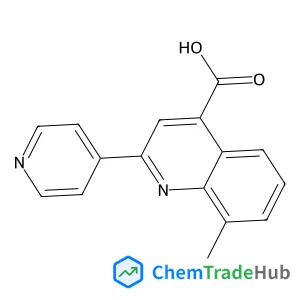
8-Methyl-2-pyridin-4-ylquinoline-4-carboxylic acid
CAS Number:
107027-42-9
Molecular Formula:
C16H12N2O2
Recommended Suppliers




Disclaimer
This page provides academic journal information for reference and research purposes only. We are not affiliated with any journal publishers and do not handle publication submissions. For publication-related inquiries, please contact the respective journal publishers directly.
If you notice any inaccuracies in the information displayed, please contact us at support@chemtradehub.com. We will promptly review and address your concerns.