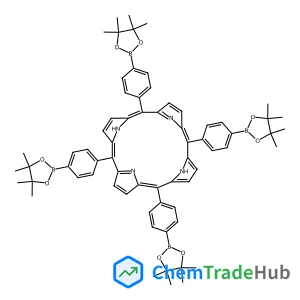
5,10,15,20-tetrakis(4-boronic acid pinacol ester phenyl) porphyrin
CAS Number:
1332748-00-1
Molecular Formula:
C68H74B4N4O8
Shaowei Chen, Forrest Nichols, Shamraiz Hussain Talib, Nasima Arshad, Anham Zafar, Arshad Mahmood, Shahid Zaman, Naveed Kausar Janjua
Dual metal atoms embedded into carbon are emerging electrocatalysts due to synergistic interaction. Herein, copper and iron dual-atoms embedded in a nitrogen-doped carbon support with abundant metal–nitrogen moieties are fabricated via zinc imidazole framework pyrolysis. Hollow nitrogen-doped carbon (HNC) containing Cu/Fe–Nx moieties (Cu : Fe/HNC) shows excellent oxygen reduction activity with a half-wave potential of 0.84 V in alkaline media. Furthermore, the Cu : Fe/HNC exhibits remarkable stability and strong anti-poisoning ability due to the synergistic interaction of the Cu/Fe–Nx moieties in the HNC architecture. Density functional theory calculations revealed the optimum adsorption and desorption of oxygen intermediates due to the synergistic interaction of Cu–Nx and Fe–Nx sites, resulting in improved oxygen reduction performance. This work provides a facile synthesis of dual metal atom catalysts for developing low-cost, nonprecious metal-based ORR electrocatalysts.
Ross Anderson, Martin Fowles, Tim Hyde, Richard Smith, Sergey Nikitenko, Wim Bras
DOI: 10.1039/C2CP43307A
Kelsey M. Hallinen, Stephanie Tristram-Nagle, John F. Nagle
DOI: 10.1039/C2CP42595E
Roel Menting, Dennis K. P. Ng, Beate Röder
DOI: 10.1039/C2CP42416A
DOI: 10.1039/C2CP42413D
Megumi Shintani, Yushi Matsuo, Shun Sakuraba
DOI: 10.1039/C2CP41984J
Fanbin Meng, Wei Yan, Dunyou Wang
DOI: 10.1039/C2CP41917C
Fabio Finocchi, Pascale Geysermans, Antonin Bourgeois
DOI: 10.1039/C2CP41835E
Abril C. Castro, Thomas Johnson, Jesus M. Ugalde, Yan-bo Wu, José M. Mercero, Thomas Heine, Kelling J. Donald
DOI: 10.1039/C2CP40839B
Sang Hyuk Im, Meejae Kang, Jin Hyuck Heo, Sang Il Seok, Sang-Wook Kim, Iván Mora-Seró, Juan Bisquert
DOI: 10.1039/C2CP43223D
Ian P. Silverwood, Neil G. Hamilton, Andrew R. McFarlane, Josef Kapitán, Lutz Hecht, Elizabeth L. Norris, R. Mark Ormerod, Christopher D. Frost, Stewart F. Parker, David Lennon
DOI: 10.1039/C2CP42745A
When handling 4-Methyl-6-(trifluoromethyl)quinoline (CAS: 40716-16-3), safety go...
4-(3,5-Difluorophenyl)aniline is an aromatic organic compound with the CAS numbe...
5-{[4-(Trifluoromethyl)phenyl]sulfanyl}-1,2,3-thiadiazole-4-carboxylic acid can ...
The market for 4-Benzylaniline hydrochloride (CAS: 6317-57-3) is steadily growin...
[3-(Diethylsulfamoyl)phenyl]boronic acid is generally considered safe when handl...
3-Bromo-2,5-dimethoxyaniline is mainly used in the pharmaceutical and chemical i...
N-Methyl-1-(5-methyl-1H-indol-3-yl)methanamine (CAS: 915922-67-7) is subject to ...
This compound is primarily used in the pharmaceutical industry for the synthesis...
2-Methyl-2-propanyl [(1S,3R)-3-aminocyclohexyl]carbamate (CAS: 1298101-47-9) sho...
Ethyl 2-bromo-4,4,4-trifluorobutanoate (CAS: 367-33-9) is utilized in the pharma...
![(4aR,5S,6R,8aS)-5-[2-(3-Furyl)ethyl]-8a-(hydroxymethyl)-5,6-dimethyl-3,4,4a,5,6,7,8,8a-octahydro-1-naphthalenecarboxylic acid structure](https://static.chemtradehub.com/structs/184/18411-75-1-d4cd.webp "(4aR,5S,6R,8aS)-5-[2-(3-Furyl)ethyl]-8a-(hydroxymethyl)-5,6-dimethyl-3,4,4a,5,6,7,8,8a-octahydro-1-naphthalenecarboxylic acid structure")