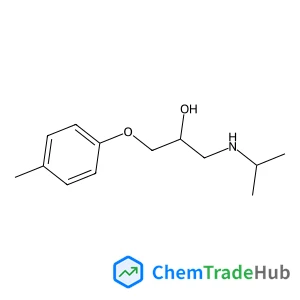
1-(4-Methylphenoxy)-3-(propan-2-ylamino)propan-2-ol
CAS Number:
5790-46-5
Molecular Formula:
C13H21NO2
Gi Byoung Hwang, Joe Stent, Sacha Noimark, Ki Joon Heo, Alexander J. MacRobert, Enrico Salvadori, Charlotte K. Williams, Sebastian D. Pike, Milo S. P. Shaffer, Elaine Allan, Ivan P. Parkin
In this study, a white light-activated bactericidal coating consisting of acrylic latex, zinc oxide nanoparticles (ZnO NPs) and crystal violet (CV) was produced through a two-step dipping process. CV molecules and ZnO NPs were incorporated into an acrylic latex coating deposited onto a glass substrate. After the incorporation, the colour of the coating surface changed to purple from colourless and XPS sputtering analysis showed the existence of ZnO NPs within the coating. In a bactericidal test, the CV dyed samples showed an intrinsic bactericidal activity (0.7–0.88 log reduction in viable bacteria number) against S. aureus whereas it was not observed on E. coli in the dark. Upon white light irradiation (light intensity: 512 lux), the bactericidal activity of the CV-dyed sample was significantly enhanced. Compared to the control, the CV-dyed samples showed 1.16–2.51 log reduction against both bacterial strains in white light. In terms of the testing against S. aureus in white light, ZnO NPs addition into the CV-dyed sample showed enhanced bactericidal activity. The bactericidal activity of the CV-dyed sample with ZnO NPs was 1.34 log higher than the CV-dyed sample. Based on data obtained from TR-EPR spectroscopy, it is speculated that the addition of ZnO NPs into the dye induces an alternative photoredox pathway, resulting in more generation of reactive oxygen species lethal to bacterial cells. It is expected that this technique could be used to transform a wide range of surfaces into bactericidal surfaces and contribute to maintaining low pathogen levels on hospital surfaces related to healthcare-associated infection.
Jieli Wu, Linzhu Zhou, Chengyu Jin, Chunlai Tu, Bangshang Zhu, Qi Zhu, Deyue Yan
DOI: 10.1039/C1PY00333J
Akihiro Nomura, Kohji Ohno, Takeshi Fukuda
DOI: 10.1039/C1PY00215E
Vincent Darcos, Sarah Antoniacomi, Cédric Paniagua, Jean Coudane
DOI: 10.1039/C1PY00414J
Pınar Tatar Güner, Annamária Mikó, Florian F. Schweinberger
DOI: 10.1039/C1PY00463H
Sunirmal Pal, Amit Das, Sankar Maiti, Priyadarsi De
DOI: 10.1039/C1PY00419K
Qinrong Wang, Jun Yu, Yunsong Yan, Shaoqiang Xu, Fangfang Wang, Qingnan Li, Jinzhi Wang, Xin Zhang, Daojun Liu
DOI: 10.1039/C2PY20070H
Mahadeo R. Halhalli, Carla S. A. Aureliano, Eric Schillinger, Claudia Sulitzky, M. Magdalena Titirici, Börje Sellergren
DOI: 10.1039/C2PY00544A
Chinessa T. Adkins, Julia N. Dobish, Clifford S. Brown, Brian Mayrsohn, Sharon K. Hamilton, Felicia Udoji, Kelly Radford, Thomas E. Yankeelov, John C. Gore, Eva Harth
DOI: 10.1039/C1PY00474C
Zhengwei You, Eric M. Jeffries, Yadong Wang
DOI: 10.1039/C1PY00400J
4-(4-tert-Butylphenyl)-1H-pyrazol-3-amine finds applications in various industri...
H3TATAB is used in the pharmaceutical industry for the synthesis of certain orga...
1-Ethyl-3-fluorobenzene (CAS: 696-39-9) is primarily used as a precursor in the ...
1-(tert-Butoxycarbonyl)-4-(4-methoxyphenyl)pyrrolidine-3-carboxylic acid is prim...
1-Cyclobutyl-4-piperidinone (CAS: 359880-05-0) is a colorless or white crystalli...
Pyridine-2,6-dicarboxylic acid mono-tert-butyl ester (CAS: 575433-76-0) is a che...
The market for 2,3-Difluorophenylalanine (CAS: 236754-62-4) is growing with incr...
(2-Hydroxy-1-naphthyl)boronic acid can be synthesized through the reduction of 2...
This compound is a crystalline solid with a molecular weight of approximately 52...
While 5,7-Dihydroxy-4-oxo-2-(3,4,5-trihydroxyphenyl)-4H-chromen-3-yl beta-D-gluc...
![Ethyl 2-[(3-bromo-4-pyridinyl)sulfanyl]-2-methylpropanoate structure](https://static.chemtradehub.com/structs/135/1352794-86-5-a8aa.webp "Ethyl 2-[(3-bromo-4-pyridinyl)sulfanyl]-2-methylpropanoate structure")