














Physical, thermal, mechanical, and nutritional properties of bitter apple (Citrullus colocynthis L.)
Literature Information
Publication Date
2023-04-13
DOI
10.1039/D3FB00005B
Impact Factor
0
Authors
Rinku Grover, Raveena Kargwal, Punit Singh, R. Pandiselvam
View Original
Abstract
The physical, mechanical, thermal, and nutritional properties of bitter apple and their significance in processing, machine designing, and product development are discussed in the present study. Physical parameters of average length, width, and thickness of small, medium, and large fruit were 47.53, 59.08, and 70.63 mm; 46.62, 58.25, and 70.77 mm; and 46.00, 58.25, and 70.49 mm, respectively. The true and bulk density and porosity of bitter apple were measured as 1005 kg m−3, 465 kg m−3, and 53.69%, respectively. In this study, specific heat, thermal conductivity, and thermal diffusivity of bitter apple were found to be 3.866 ± 0.053 kJ per kg per °K, 0.58 ± 0.010 W per m °C, and 0.147 ± 0.001 × (10−7) m2 s−1, respectively. The fruit was a good source of protein (8–9%), fat (6.5–7.5%), crude fiber (7–8%), carbohydrates (58%), and energy (339.69 kcal/100 g), respectively. The results found in this study could be useful in the design and development of processing machinery for the commercial production of bitter apples. Despite having significant nutritional and medicinal value, the bitter apple is an underutilized fruit. By understanding the physical and mechanical properties of bitter apple and the development of processing machinery and post-harvest handling equipment accordingly, we can improve efficiency, reduce waste, and promote sustainability. Additionally, knowledge of the nutritional and thermal properties of bitter apples would provide for preserving the nutrients of bitter apple that may require special processing techniques.
Related Literature
Fragmentation of a dioxolanyl radical via nonstatistical reaction dynamics: characterization of the vinyloxy radical by ns time-resolved laser flash photolysis
Götz Bucher, Mukul Lal, Anup Rana, Michael Schmittel
2018-07-18
Paper
DOI: 10.1039/C8CP03311K
Dynamic tailoring of electromagnetic behaviors of graphene plasmonic oligomers by local chemical potential
Junbo Ren, Wangqing Wang, Weibin Qiu, Pingping Qiu, Zeyu Wang, Zhili Lin, Jia-Xian Wang
2018-05-22
Paper
DOI: 10.1039/C8CP01281D
Mechanism of enhanced triplet decay of thionucleobase by glycosylation and rate-modulating strategies
Shuming Bai, Mario Barbatti
2018-05-29
Paper
DOI: 10.1039/C8CP02306A
Revealing at the molecular level the role of the surfactant in the enhancement of the thermal properties of the gold nanofluid system used for concentrating solar power
Elisa I. Martín, Antonio Sánchez-Coronilla, Javier Navas, Roberto Gómez-Villarejo, Paloma Martínez-Merino, Rodrigo Alcántara, Concha Fernández-Lorenzo
2017-12-18
Paper
DOI: 10.1039/C7CP05384C
Abnormal separation of the silicon–oxygen bond in the liquid layering transition of silicon dioxide in a nanoslit
Zhichao Wang, Tao Li, Yunrui Duan, Weikang Wu, Zhenyang Zhao, Yao Liu, Hui Li
2018-01-02
Paper
DOI: 10.1039/C7CP06843C
Dynamics of water in conical solvation shells around a benzene solute under different thermodynamic conditions
Ashu Choudhary
2018-06-21
Paper
DOI: 10.1039/C7CP08109J
Revisiting the catalytic mechanism of Mo–Cu carbon monoxide dehydrogenase using QM/MM and DFT calculations
Kai Xu, Hajime Hirao
2018-05-10
Paper
DOI: 10.1039/C8CP00858B
Multifunctional nanostructured Co-doped ZnO: Co spatial distribution and correlated magnetic properties
Rafael T. da Silva, Alexandre Mesquita, Thalita Chiaramonte, Xavier Gratens, Valmir A. Chitta, Gul Rahman, Antonio C. Doriguetto, Maria I. B. Bernardi, Hugo B. de Carvalho
2018-07-09
Paper
DOI: 10.1039/C8CP02870B
Effect of PCL end-groups on the self-assembly process of Pluronic in aqueous media
Natalie Gjerde, Kaizheng Zhu, Bo Nyström, Kenneth D. Knudsen
2018-01-04
Paper
DOI: 10.1039/C7CP07240F
Theoretical investigation on the interaction between RhIII octaethylporphyrin and a graphite basal surface: a comparison study of DFT, DFT-D, and AFM
Kohei Tada, Yasushi Maeda, Hiroyuki Ozaki, Shingo Tanaka, Shin-ichi Yamazaki
2018-07-19
Paper
DOI: 10.1039/C8CP02923G
You might also like
Compound Q&A
What industries use (1R,3S)-1,3-Cyclopentanediol (CAS: 16326-97-9)?
(1R,3S)-1,3-Cyclopentanediol finds applications in various industries. In the ph...
16326-97-9(1R,3S)-1,3-Cyclopen...
Compound Q&A
What precautions should be taken when handling N'-[4-(Dimethylamino)phenyl]-N,N-dimethyl-1,4-benzenediamine (CAS: 637-31-0)?
When handling N'-[4-(Dimethylamino)phenyl]-N,N-dimethyl-1,4-benzenediamine, it i...
637-31-0N'-[4-(Dimethylamino...
Compound Q&A
Are there alternatives to 5-(2,4-Difluorophenyl)-2-methoxypyrimidine (CAS: 1352318-16-1) in synthesis?
There are several alternatives to 5-(2,4-Difluorophenyl)-2-methoxypyrimidine in ...
1352318-16-15-(2,4-Difluoropheny...
Compound Q&A
What regulatory guidelines apply to 1-(3-Methoxyphenoxy)propan-2-ol (CAS: 382141-68-6)?
1-(3-Methoxyphenoxy)propan-2-ol (CAS: 382141-68-6) must comply with the Globally...
382141-68-61-(3-Methoxyphenoxy)...
Compound Q&A
Is Tetrodotoxin Citrate (CAS: 18660-81-6) safe?
Tetrodotoxin Citrate is extremely dangerous and should be handled with extreme c...
18660-81-6Tetrodotoxin Citrate
Compound Q&A
What are the main uses of 2-Methyl-2-propanyl [(1R,3S)-3-hydroxycyclopentyl]carbamate (CAS: 225641-84-9)?
2-Methyl-2-propanyl [(1R,3S)-3-hydroxycyclopentyl]carbamate (CAS: 225641-84-9) i...
225641-84-92-Methyl-2-propanyl ...
Compound Q&A
How should waste containing 4-(2-Hydroxyhexafluoroisopropyl)Benzoic Acid (CAS: 16261-80-6) be handled?
Waste containing 4-(2-Hydroxyhexafluoroisopropyl)Benzoic Acid (CAS: 16261-80-6) ...
16261-80-64-(2-Hydroxyhexafluo...
Compound Q&A
How is 2-Methyl-2-proanyl {(2S)-1-[(benzyloxy)amino]-3-hydroxy-3-methyl-1-oxo-2-butanyl}carbamate (CAS: 102507-19-7) typically synthesized?
2-Methyl-2-proanyl {(2S)-1-[(benzyloxy)amino]-3-hydroxy-3-methyl-1-oxo-2-butanyl...
102507-19-72-Methyl-2-propanyl ...
Compound Q&A
What is Benzeneethanamine, α-ethyl-, hydrochloride (1:1) (CAS: 20735-15-3)?
Benzeneethanamine, α-ethyl-, hydrochloride (1:1) is an organic compound with the...
20735-15-3Benzeneethanamine, α...
Compound Q&A
Are there alternatives to 3-{(E)-[4-(Dimethylamino)phenyl]diazenyl}benzoic acid (CAS: 20691-84-3) in synthesis?
In the synthesis of compounds similar to 3-{(E)-[4-(Dimethylamino)phenyl]diazeny...
20691-84-33-{(E)-[4-(Dimethyla...
Source Journal
Recommended Compounds
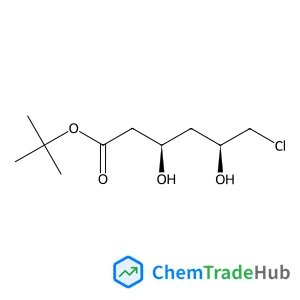
2-Methyl-2-propanyl (3R,5S)-6-chloro-3,5-dihydroxyhexanoate
CAS Number:
154026-93-4
Molecular Formula:
C10H19ClO4

Recommended Suppliers




Disclaimer
This page provides academic journal information for reference and research purposes only. We are not affiliated with any journal publishers and do not handle publication submissions. For publication-related inquiries, please contact the respective journal publishers directly.
If you notice any inaccuracies in the information displayed, please contact us at support@chemtradehub.com. We will promptly review and address your concerns.