













Abnormal inhibiting effect of H2O on Pd/SiO2 and Na–Pd/SiO2 catalysts for HCHO oxidation
Literature Information
Publication Date
2023-09-21
DOI
10.1039/D3CY00796K
Impact Factor
6.119
Authors
Xiaofeng Liu, Changbin Zhang, Yuming Zheng
View Original
Abstract
Active hydroxyl groups (OH) are very important in HCHO oxidation, due to the fact that OH is the main active species in the degradation of formate and dioxymethylene (DOM) groups, especially for noble metal supported catalysts with alkali metal addition. Interestingly, in this study we found that sodium (Na) can also promote HCHO oxidation activity of Pd/SiO2 catalysts without activated surface OH. Though Na addition could effectively improve the dispersion of Pd and the oxygen activation capacity of the catalyst, no effect on H2O activation to form surface OH was found. Notably, different from Pd/TiO2 or Pt/TiO2 catalysts with TiO2 as support, H2O caused the deactivation of Pd/SiO2 and even Na–Pd/SiO2 catalysts. Investigation of the catalysts showed that the aggregation of Pd particles, reduction of effective interface and accumulation of intermediate products were the main factors leading to the deactivation of the catalysts. However, the addition of Na could improve the regeneration ability of the Pd/SiO2 catalyst.
Related Literature
Manipulation of the stereochemical outcome and product distribution in the Henry reaction using CO2 pressure
Andrew J. Parratt, Dave J. Adams, Anthony A. Clifford, Christopher M. Rayner
2004-10-08
Communication
DOI: 10.1039/B409451D
SSZ-60: a new large-pore zeolite related to ZSM-23
Allen Burton, Saleh Elomari
2004-10-04
Communication
DOI: 10.1039/B410010G
Catalyst surface characterization in microfabricated reactors using pulse chemisorption
Martin A. Schmidt, Klavs F. Jensen
2004-10-04
Communication
DOI: 10.1039/B410078F
Synthesis and Bergman cyclization of a β-extended porphyrenediyne
John D. Spence, Eric D. Cline, Domingo M. LLagostera, Patrick S. O'Toole
2003-12-09
Communication
DOI: 10.1039/B312001E
Short and stereoselective synthesis of C-glycosylated glycine derivatives from glycals by radical addition and reduction
Thomas Sommermann, Boo Geun Kim, Karl Peters, Eva-Maria Peters, Torsten Linker
2004-10-05
Communication
DOI: 10.1039/B410120K
Oxygenation of thiolates to S-bonded sulfinate in an iron(iii) complex related to nitrile hydratase
Erwan Galardon, Michel Giorgi, Isabelle Artaud
2003-12-16
Communication
DOI: 10.1039/B312318A
[Li(thf)3cyclo-(P4tBu4CH)] – synthesis, molecular structure and dynamic behaviour
Robert Wolf, Evamarie Hey-Hawkins
2004-10-05
Communication
DOI: 10.1039/B410617B
Synthesis of long Poly(dG)·Poly(dC) DNA using enzymatic reaction
Shin-ichi Tanaka, Masateru Taniguchi, Susumu Uchiyama, Kiichi Fukui, Tomoji Kawai
2004-09-21
Communication
DOI: 10.1039/B410753E
11-Aminoundecanoic acid: a versatile unit for the generation of low molecular weight gelators for water and organic solvents
Anthony D'Aléo, Jean-Luc Pozzo, Frédéric Fages, Marc Schmutz, Gudrun Mieden-Gundert, Fritz Vögtle, Vesna Caplar, Mladen Zinic
2003-11-18
Communication
DOI: 10.1039/B307846A
Contrasting coordination behaviour of 22-membered chalcogenaaza (Se, Te) macrocylces towards Pd(ii) and Pt(ii): Isolation and structural characterization of the first metallamacrocyle with a C–Pt–Se linkage
Snigdha Panda, Harkesh B. Singh, Ray J. Butcher
2004-01-08
Communication
DOI: 10.1039/B312358H
You might also like
Compound Q&A
What precautions should be taken when handling 2-Chloro-1,2-bis(4-methylphenyl)ethanone (CAS: 71193-32-3)?
When handling 2-Chloro-1,2-bis(4-methylphenyl)ethanone (CAS: 71193-32-3), it is ...
71193-32-32-Chloro-1,2-bis(4-m...
Compound Q&A
What industries use 4-Ethoxy-3-(5-methyl-4-oxo-7-propyl-1,4-dihydroimidazo[5,1-f][1,2,4]triazin-2-yl)benzenesulfonyl chloride (CAS: 224789-26-8)?
4-Ethoxy-3-(5-methyl-4-oxo-7-propyl-1,4-dihydroimidazo[5,1-f][1,2,4]triazin-2-yl...
224789-26-84-Ethoxy-3-(5-methyl...
Compound Q&A
How should Methyl 3-Oxo-4-Androsten-17-Carboxylate (CAS: 2681-55-2) be stored?
Methyl 3-Oxo-4-Androsten-17-Carboxylate (CAS: 2681-55-2) should be stored in a c...
2681-55-2Methyl 3-Oxo-4-Andro...
Compound Q&A
What are the main uses of (R)-3-Amino-4-(3-hexylphenylamino)-4-oxobutylphosphonic acid (CAS: 909725-61-7)?
(R)-3-Amino-4-(3-hexylphenylamino)-4-oxobutylphosphonic acid is primarily used i...
909725-61-7(R)-3-Amino-4-(3-hex...
Compound Q&A
What regulatory guidelines apply to 2-Methyl-2-propanyl 3-amino-3-carbamoyl-1-azetidinecarboxylate (CAS: 1254120-14-3)?
2-Methyl-2-propanyl 3-amino-3-carbamoyl-1-azetidinecarboxylate (CAS: 1254120-14-...
1254120-14-32-Methyl-2-propanyl ...
Compound Q&A
Are there alternatives to (E)-4-(tert-Butoxy)-4-oxobut-2-enoic acid (CAS: 135355-96-3) in synthesis?
There are alternative reagents that can be used in synthesis instead of (E)-4-(t...
135355-96-3(E)-4-(tert-Butoxy)-...
Compound Q&A
What are the physical and chemical properties of [2-(3-Chlorophenyl)-1,3-thiazol-4-yl]methanol (CAS: 121202-20-8)?
[2-(3-Chlorophenyl)-1,3-thiazol-4-yl]methanol (CAS: 121202-20-8) is a crystallin...
121202-20-8[2-(3-Chlorophenyl)-...
Compound Q&A
What is the market or research trend for Methyl (2S)-[(4S)-2,2-dimethyl-1,3-dioxolan-4-yl]{[(4-methylphenyl)sulfonyl]oxy}acetate (CAS: 166249-17-8)?
The market and research trends for Methyl (2S)-[(4S)-2,2-dimethyl-1,3-dioxolan-4...
166249-17-8Methyl (2S)-[(4S)-2,...
Compound Q&A
What is the market or research trend for 1-Bromo-2-isocyanatoethane (CAS: 42865-19-0)?
The market for 1-Bromo-2-isocyanatoethane (CAS: 42865-19-0) is driven by its use...
42865-19-01-Bromo-2-isocyanato...
Compound Q&A
What are the main uses of 4-Nitro-D-phenylalanine hydrochloride (CAS: 147065-06-3)?
4-Nitro-D-phenylalanine hydrochloride (CAS: 147065-06-3) is primarily used in re...
147065-06-34-Nitro-D-phenylalan...
Source Journal
Catalysis Science & Technology
CiteScore:
5.91
Self-citation Rate:
4.5%
Articles per Year:
600
Catalysis Science & Technology is committed to publishing research reporting high-quality, cutting-edge developments across the catalysis community at large. The journal places equal focus on publications from the heterogeneous, homogeneous, thermo-, electro-, photo-, organo- and biocatalysis communities. Works published in the journal feature a balanced mix of fundamental, technology-oriented, experimental, computational, digital and data-driven original research, thus appealing to catalysis practitioners in both academic and industrial environments. Original research articles published in the journal must demonstrate new catalytic discoveries and/or methodological advances that represent a significant advance on previously published work, from the molecular to the process scales. We welcome rigorous research in a wide range of timely or emerging applications related to the environment, health, energy and materials. Catalysis Science & Technology publishes Communications, Articles, Reviews and Perspectives. More details regarding manuscript types may be found in the Information for Authors section.
Recommended Compounds
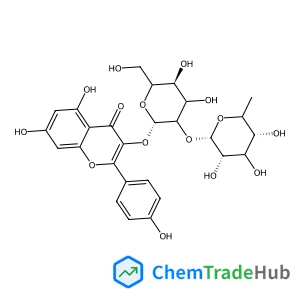
5,7-Dihydroxy-2-(4-hydroxyphenyl)-4-oxo-4H-chromen-3-yl 2-O-(6-deoxy-alpha-L-mannopyranosyl)-beta-D-glucopyranoside
CAS Number:
32602-81-6
Molecular Formula:
C27H30O15
Recommended Suppliers




Disclaimer
This page provides academic journal information for reference and research purposes only. We are not affiliated with any journal publishers and do not handle publication submissions. For publication-related inquiries, please contact the respective journal publishers directly.
If you notice any inaccuracies in the information displayed, please contact us at support@chemtradehub.com. We will promptly review and address your concerns.