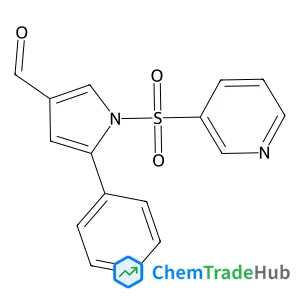
5-Phenyl-1-(pyridin-3-ylsulfonyl)-1H-pyrrole-3-carbaldehyde
CAS Number:
881676-90-0
Molecular Formula:
C16H12N2O3S
Zhoujie Zhang, Mengping Huang, Na Shu, Hanyu Luo, Qiyan Cao, Bingbing Fan, Yu Han, Yong Wu
A series of novel [Ir(tpy)(btp)Cl]+ complexes (Ir1–Ir4) have been reported to show excellent performance as photosensitizers. The introduction of electron-withdrawing groups increases visible light absorption and the lifetime of triplet states. To improve the photophysical properties, we theoretically design Ir5–Ir9 with electron-withdrawing groups (Cl, F, COOH, CN and NO2). Surprisingly, our findings indicate that the photosensitizer performance does not strictly increase with the electron-withdrawing ability of the substituents. In this work, the geometric and electronic structures, transition features, and photophysical properties of Ir1–Ir9 are investigated. The natural transition orbital (NTO) analysis indicates that the T1 and T2 states play a role in the photochemical pathways. Ultraviolet-visible (UV-vis) absorption spectra and charge-transfer spectra (CTS) have been investigated to show that the introduction of electron-withdrawing groups not only improves the visible light absorbing ability, but also changes the nature of electron excitation, providing a future molecular design strategy for similar series of photosensitizers. The rates of (reverse) intersystem crossing and the Huang–Rhys factors are evaluated to interpret the experimental results within the framework of Marcus theory. For complexes Ir1–Ir7, the introduction of electron-withdrawing groups leads to a lower efficiency of reverse intersystem crossing and a strong non-radiative process T2 → T1, resulting in a long triplet lifetime and excellent performance as a photosensitizer. Furthermore, some newly designed complexes (Ir7–Ir9) show great potential as thermally activated delayed fluorescence emitters, contrary to our initial expectations.
DOI: 10.1039/C6CP05557E
Asmita Gupta, Manju Bansal
DOI: 10.1039/C6CP04617G
Myriam Barrejón, María J. Gómez-Escalonilla, José Luis G. Fierro, Pilar Prieto, José R. Carrillo, Gonzalo Abellán, M, Mercedes Gabás, Juan T. López-Navarrete, Fernando Langa
DOI: 10.1039/C6CP05285A
D. Akhmetzyanov, H. Y. V. Ching, V. Denysenkov, L. C. Tabares, T. F. Prisner, S. Un
DOI: 10.1039/C6CP05239H
Andrew G. Stack, Jose M. Borreguero, Timothy R. Prisk, Eugene Mamontov, Hsiu-Wen Wang, Lukas Vlcek, David J. Wesolowski
DOI: 10.1039/C6CP05836A
Changsheng Ding, Toshiyuki Nohira, Rika Hagiwara
DOI: 10.1039/C6CP05944A
Argyrios Karatrantos, Qiong Cai
DOI: 10.1039/C6CP04611H
Maciej Ptak, Mirosław Mączka, Anna Gągor, Adam Sieradzki, Bartosz Bondzior, Przemysław Dereń, S. Pawlus
DOI: 10.1039/C6CP05151K
When considering alternatives to 1-(4-Chlorophenyl)-N-hydroxymethanimine (CAS: 3...
This compound should be stored in a cool, dry place away from direct sunlight. I...
3-(4-Bromophenyl)-5-(2-fluorophenyl)-1,2,4-oxadiazole is synthesized through a m...
5-Chloro-2-(4-chlorophenyl)-4-methyl-6-[3-(1-piperidinyl)propoxy]pyrimidine (CAS...
2-Chloro-4-(difluoromethoxy)pyridine is used in the pharmaceutical industry for ...
3-Chloro-6-methylpyridazine (CAS: 1121-79-5) is classified under the Globally Ha...
Several alternatives can be used in the synthesis of Methyl 4,5-dimethyl-2-nitro...
Alternatives to (2E,2'E)-3,3'-(1,4-Phenylene)bisacrylaldehyde include other acry...
3-Amino-5-chloropyridin-2-ol hydrochloride is an organic compound with the CAS n...
When handling 6,7-Difluoro-2,3-dihydro-4H-chromen-4-one, it is essential to wear...

Physical Chemistry Chemical Physics (PCCP) is an international journal co-owned by 19 physical chemistry and physics societies from around the world. This journal publishes original, cutting-edge research in physical chemistry, chemical physics and biophysical chemistry. To be suitable for publication in PCCP, articles must include significant innovation and/or insight into physical chemistry; this is the most important criterion that reviewers and Editors will judge against when evaluating submissions. The journal has a broad scope and welcomes contributions spanning experiment, theory, computation and data science. Topical coverage includes spectroscopy, dynamics, kinetics, statistical mechanics, thermodynamics, electrochemistry, catalysis, surface science, quantum mechanics, quantum computing and machine learning. Interdisciplinary research areas such as polymers and soft matter, materials, nanoscience, energy, surfaces/interfaces, and biophysical chemistry are welcomed if they demonstrate significant innovation and/or insight into physical chemistry. Joined experimental/theoretical studies are particularly appreciated when complementary and based on up-to-date approaches.