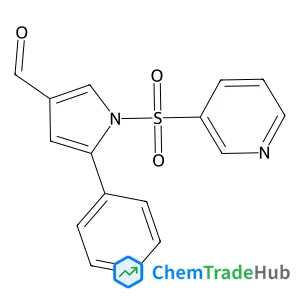
5-Phenyl-1-(pyridin-3-ylsulfonyl)-1H-pyrrole-3-carbaldehyde
CAS Number:
881676-90-0
Molecular Formula:
C16H12N2O3S
Argyrios Karatrantos, Qiong Cai
Na ion batteries (NIBs) are considered as a promising low cost and sustainable energy storage technology. To better design nanoporous carbons as anode materials for NIBs, molecular dynamics simulations have been employed to study the behavior of Na+ ions (as well as PF6− ions) confined within carbon nanopores, in the presence of non-aqueous (organic) solvent. The effects of pore size and surface charge density were quantified by calculating ionic density profiles and concentration within the pores. Carbon slit pores of widths 0.72–10 nm were considered. The carbon surfaces were charged with densities of 0 (neutral pores), −0.8e nm−2, −1.2e nm−2, and −2e nm−2. Organic solutions of Na+ and PF6− at 1 M concentrations were considered under operating conditions of sodium ion batteries. As the surface charge density increases, more Na+ ions enter the pores. In all pores, when the surface is highly charged the Na+ ions move toward the negatively charged graphene surfaces because of counterion condensation effects. In some instances, our results reveal the formation of multiple layers of adsorbed Na+ inside the pores. Both the nanopore width and surface charge alter the density profiles of ions and solvent inside the pores.
Harry Ramanantoanina, Goutam Kuri, Matthias Martin, Johannes Bertsch
DOI: 10.1039/C9CP01021A
Nicolas Schaeffer, German Pérez-Sánchez, Helena Passos, José R. B. Gomes, Nicolas Papaiconomou, João A. P. Coutinho
DOI: 10.1039/C8CP07750A
David Fuks, Yaniv Gelbstein
DOI: 10.1039/C9CP00764D
DOI: 10.1039/C8CP06780E
Juan P. Aranguren-Abrate, Claude Dedonder-Lardeux, Christophe Jouvet
DOI: 10.1039/C8CP07162D
Kamila Akhmetova, Haiyan Fan
DOI: 10.1039/C8CP04789H
Jin-Hyoung Kim, So-Yoen Kim, Ho-Jin Son, Sang Ook Kang
DOI: 10.1039/C8CP07759B
Jamal Shaibo, Rui Yang, Zhe Wang, He-Ming Huang, Jue Xiong, Xin Guo
DOI: 10.1039/C9CP00596J
Shuchang Wu, Yangming Lin, Bingwei Zhong, Guodong Wen, Hongyang Liu, Dang Sheng Su
DOI: 10.1039/C8CP06175K
Yu-Min Chen, Chih-Yuan Lin, Shiojenn Tseng
DOI: 10.1039/C9CP00266A
When considering alternatives to 1-(4-Chlorophenyl)-N-hydroxymethanimine (CAS: 3...
This compound should be stored in a cool, dry place away from direct sunlight. I...
3-(4-Bromophenyl)-5-(2-fluorophenyl)-1,2,4-oxadiazole is synthesized through a m...
5-Chloro-2-(4-chlorophenyl)-4-methyl-6-[3-(1-piperidinyl)propoxy]pyrimidine (CAS...
2-Chloro-4-(difluoromethoxy)pyridine is used in the pharmaceutical industry for ...
3-Chloro-6-methylpyridazine (CAS: 1121-79-5) is classified under the Globally Ha...
Several alternatives can be used in the synthesis of Methyl 4,5-dimethyl-2-nitro...
Alternatives to (2E,2'E)-3,3'-(1,4-Phenylene)bisacrylaldehyde include other acry...
3-Amino-5-chloropyridin-2-ol hydrochloride is an organic compound with the CAS n...
When handling 6,7-Difluoro-2,3-dihydro-4H-chromen-4-one, it is essential to wear...

Physical Chemistry Chemical Physics (PCCP) is an international journal co-owned by 19 physical chemistry and physics societies from around the world. This journal publishes original, cutting-edge research in physical chemistry, chemical physics and biophysical chemistry. To be suitable for publication in PCCP, articles must include significant innovation and/or insight into physical chemistry; this is the most important criterion that reviewers and Editors will judge against when evaluating submissions. The journal has a broad scope and welcomes contributions spanning experiment, theory, computation and data science. Topical coverage includes spectroscopy, dynamics, kinetics, statistical mechanics, thermodynamics, electrochemistry, catalysis, surface science, quantum mechanics, quantum computing and machine learning. Interdisciplinary research areas such as polymers and soft matter, materials, nanoscience, energy, surfaces/interfaces, and biophysical chemistry are welcomed if they demonstrate significant innovation and/or insight into physical chemistry. Joined experimental/theoretical studies are particularly appreciated when complementary and based on up-to-date approaches.