












A magnetically reusable Ce-MOF/GO/Fe3O4 composite for effective photocatalytic degradation of chlortetracycline
Literature Information
Publication Date
2023-12-26
DOI
10.1039/D3CP04499H
Impact Factor
3.676
Authors
Derek Hao, Liping Lu, Qi Wang
View Original
Abstract
Herein, we report a novel 1/GO/Fe3O4 photocatalyst, comprising Ce(BTB)(H2O) (MOF-1, H3BTB = 1,3,5-benzenetrisbenzoic acid), graphene oxide (GO), and iron oxide (Fe3O4) for photocatalytic degradation of chlortetracycline (CTC). This design enables the effective transfer of electrons from the MOF to GO, thereby reducing the photoelectron–hole recombination rate. Therefore, the optimized 1/GO/Fe3O4 photocatalyst with H2O2 shows the highest photocatalytic activity toward CTC. The kinetic constant is 5.4 times that in the system of MOF-1 and hydrogen peroxide, which usually acted as efficient electron acceptors to improve the photocatalytic performance of MOFs. More importantly, light absorption is extended from the ultraviolet to the visible region. Furthermore, 1/GO/Fe3O4 can be quickly recycled under an applied magnetic field and displays outstanding stability and reusability. According to the radical trapping experiments and electron paramagnetic resonance results, hydroxyl radicals, superoxide radicals, and holes all contribute to excellent photocatalytic activity. The possible catalytic mechanism of 1/GO/Fe3O4 is tentatively proposed. This work aims to explore the synergistic effect between metal–organic frameworks (MOFs) and GO, and provide a theoretical basis for MOF-based composites to remove antibiotic contaminants in the environment.
Recommended Journals
Related Literature
Optimization of amorphous silicon double junction solar cells for an efficient photoelectrochemical water splitting device based on a bismuth vanadate photoanode
Lihao Han, Paula Perez Rodriguez, Bernard Dam, Miro Zeman, Arno H. M. Smets
2014-01-02
Paper
DOI: 10.1039/C3CP55035D
Insights into mechanical compression and the enhancement in performance by Mg(OH)2 coating in flexible dye sensitized solar cells
T. A. Nirmal Peiris, K. G. Upul Wijayantha, Jorge García-Cañadas
2013-12-02
Paper
DOI: 10.1039/C3CP53260G
Dual fluorescence of excited state intra-molecular proton transfer of HBFO: mechanistic understanding, substituent and solvent effects
Wenjing Yang, Xuebo Chen
2014-01-07
Paper
DOI: 10.1039/C3CP54462A
Single bubble perturbation in cavitation proximity of solid glass: hot spot versus distance
Helmuth Möhwald, Kenneth Suslick
2013-08-21
Paper
DOI: 10.1039/C3CP52850B
Determination of volatility of ionic liquids at the nanoscale by means of ultra-fast scanning calorimetry
Mathias Ahrenberg, Marcel Brinckmann, Jürn W. P. Schmelzer, Martin Beck, Christin Schmidt
2013-11-15
Paper
DOI: 10.1039/C3CP54325K
A new insight into the 5-carboxycytosine and 5-formylcytosine under typical bisulfite conditions: a deamination mechanism study
Wenliang Wang, Daodao Hu, Jian Lü
2013-12-16
Paper
DOI: 10.1039/C3CP54266A
A XANES study of LiVPO4F: a factor analysis approach
Yan Qin, Yang Ren, Steve M. Heald, Chengjun Sun, Dehua Zhou, Bryant J. Polzin, Steve E. Trask, Khalil Amine, Yinjin Wei, Gang Chen, Ira Bloom, Zonghai Chen
2014-01-10
Paper
DOI: 10.1039/C3CP54588A
The benzoic acid–water complex: a potential atmospheric nucleation precursor studied using microwave spectroscopy and ab initio calculations
Elijah G. Schnitzler, Wolfgang Jäger
2013-11-28
Paper
DOI: 10.1039/C3CP54486A
You might also like
Compound Q&A
What is the market or research trend for N-(4-Methoxybenzyl)-2-pyridinamine (CAS: 52818-63-0)?
N-(4-Methoxybenzyl)-2-pyridinamine (CAS: 52818-63-0) is increasingly being used ...
52818-63-0N-(4-Methoxybenzyl)-...
Compound Q&A
What precautions should be taken when handling Ethyl 4-(2-chlorophenyl)-1,3-thiazole-2-carboxylate (CAS: 1050507-06-6)?
When handling Ethyl 4-(2-chlorophenyl)-1,3-thiazole-2-carboxylate, appropriate p...
1050507-06-6Ethyl 4-(2-chlorophe...
Compound Q&A
What regulatory guidelines apply to diethyldiselane (CAS: 628-39-7)?
Diethyldiselane (CAS: 628-39-7) is classified under the Globally Harmonized Syst...
628-39-7Diethyldiselane
Compound Q&A
What is the market or research trend for oxocopper (CAS: 12053-18-8)?
The market for oxocopper (CAS: 12053-18-8) is primarily driven by its use in cat...
12053-18-8oxocopper; oxo-(oxoc...
Compound Q&A
What is the market or research trend for 5-{[(2-Methyl-2-propanyl)oxy]carbonyl}-5-azaspiro[2.4]heptane-7-carboxylic acid?
The market for 5-{[(2-Methyl-2-propanyl)oxy]carbonyl}-5-azaspiro[2.4]heptane-7-c...
1268519-54-55-{[(2-Methyl-2-prop...
Compound Q&A
What is 2-(1-Pyrrolidinyl)-4-pyridinamine (CAS: 35981-63-6)?
2-(1-Pyrrolidinyl)-4-pyridinamine is a chemical compound with the CAS number 359...
35981-63-62-(1-Pyrrolidinyl)-4...
Compound Q&A
What are the physical and chemical properties of 2-(3-Pyridinyl)-1-azabicyclo[2.2.2]octane (CAS: 91556-75-1)?
2-(3-Pyridinyl)-1-azabicyclo[2.2.2]octane (CAS: 91556-75-1) is a crystalline sol...
91556-75-12-(3-Pyridinyl)-1-az...
Compound Q&A
How is (S)-Alpha-allyl-proline hydrochloride (CAS: 129704-91-2) typically synthesized?
(S)-Alpha-allyl-proline hydrochloride is usually synthesized via a Wittig reacti...
129704-91-2(S)-Alpha-allyl-prol...
Compound Q&A
What is 3-Methyl-1,2-oxazole-5-carboxylic acid (CAS: 4857-42-5)?
3-Methyl-1,2-oxazole-5-carboxylic acid (CAS: 4857-42-5) is an organic compound w...
4857-42-53-Methyl-1,2-oxazole...
Compound Q&A
How is Lys-SMCC-DM1 (CAS: 1281816-04-3) typically synthesized?
Lys-SMCC-DM1 is synthesized via a multi-step process involving the coupling of S...
1281816-04-3Lys-SMCC-DM1
Source Journal
Physical Chemistry Chemical Physics

CiteScore:
5.5
Self-citation Rate:
10.3%
Articles per Year:
3036
Physical Chemistry Chemical Physics (PCCP) is an international journal co-owned by 19 physical chemistry and physics societies from around the world. This journal publishes original, cutting-edge research in physical chemistry, chemical physics and biophysical chemistry. To be suitable for publication in PCCP, articles must include significant innovation and/or insight into physical chemistry; this is the most important criterion that reviewers and Editors will judge against when evaluating submissions. The journal has a broad scope and welcomes contributions spanning experiment, theory, computation and data science. Topical coverage includes spectroscopy, dynamics, kinetics, statistical mechanics, thermodynamics, electrochemistry, catalysis, surface science, quantum mechanics, quantum computing and machine learning. Interdisciplinary research areas such as polymers and soft matter, materials, nanoscience, energy, surfaces/interfaces, and biophysical chemistry are welcomed if they demonstrate significant innovation and/or insight into physical chemistry. Joined experimental/theoretical studies are particularly appreciated when complementary and based on up-to-date approaches.
Recommended Compounds
![5'-Fluoro-[2,3'-biindolinylidene]-2',3-dione structure](https://static.chemtradehub.com/structs/251/251903-00-1-9cb1.webp "5'-Fluoro-[2,3'-biindolinylidene]-2',3-dione structure")

![1-[6-(1H-Imidazol-1-yl)-3-pyridinyl]methanamine structure](https://static.chemtradehub.com/structs/914/914637-08-4-8825.webp "1-[6-(1H-Imidazol-1-yl)-3-pyridinyl]methanamine structure")
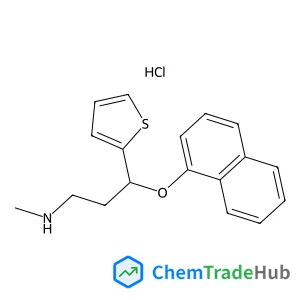
N-Methyl-3-(1-naphthyloxy)-3-(2-thienyl)-1-propanamine hydrochloride (1:1)
CAS Number:
1188266-11-6
Molecular Formula:
C18H20ClNOS
Recommended Suppliers



Disclaimer
This page provides academic journal information for reference and research purposes only. We are not affiliated with any journal publishers and do not handle publication submissions. For publication-related inquiries, please contact the respective journal publishers directly.
If you notice any inaccuracies in the information displayed, please contact us at support@chemtradehub.com. We will promptly review and address your concerns.