












Styrylpyrimidine chromophores with bulky electron-donating substituents: experimental and theoretical investigation
Literature Information
Publication Date
2023-11-15
DOI
10.1039/D3CP03705C
Impact Factor
3.676
Authors
Maxime Hodée, Julien Massue, Sylvain Achelle, Arnaud Fihey, Gilles Ulrich, Françoise Robin-le Guen, Claudine Katan
View Original
Abstract
Styrylpyrimidines with bulky 9,9-dimethylacridan, phenoxazine and phenothiazine electron-donating fragments were designed. Thermally activated delayed fluorescence (TADF) properties were expected for these structures. These chromophores exhibit peculiar emission properties. For 9,9-dimethylacridan and phenoxazine derivatives, a single emission highly sensitive to the polarity is observed in solution whereas for phenothiazine derivative a dual emission is observed in solution and is attributed to the coexistence of quasi-axial (Qax) and quasi-equatorial (Qeq) conformers. This study intends to understand through theoretical and experimental works, why the studied chromophores do not exhibit TADF properties, contrary to what was expected. The absence of phosphorescence both at room temperature and 77 K tends to indicate the impossibility to harvest triplet states in these systems. Wave-function based calculations show that for both conformers of the three chromophores the S1–T1 splitting is significantly larger than 0.2 eV. The second triplet state T2 of Qeq conformers is found very close in energy to the singlet S1 state, but S1 and T2 states possess similar charge transfer characters. This prevents efficient spin–orbit coupling between the states, which is consistent with the absence of TADF.
Related Literature
Elucidation of the conformational dynamics of multi-body systems by construction of Markov state models
Fu Kit Sheong
2016-06-02
Perspective
DOI: 10.1039/C6CP02545E
Study of entropic characteristics of strongly correlated systems using VO2 as a model case
Asaya Fujita, Yoshiaki Kinemuchi, Wataru Yamaguchi
2016-10-18
Paper
DOI: 10.1039/C6CP06200H
Controlled fabrication of mesoporous TiO2 hierarchical structures as scattering layers to enhance the power conversion efficiency of dye-sensitized solar cells
Dae-Kue Hwang, Shi-Joon Sung
2016-09-21
Paper
DOI: 10.1039/C6CP05999F
Exploring short intramolecular interactions in alkylaromatic substrates
Alberto Baggioli, Carlo A. Cavallotti, Antonino Famulari
2016-10-06
Paper
DOI: 10.1039/C6CP03323G
Unlocking the observation of different proton populations in fluorinated polymers by solid-state 1H and 19F double resonance NMR spectroscopy
P. Goossens, F. Saïdi, J. A. Martens
2016-09-16
Paper
DOI: 10.1039/C6CP04139F
Enhancing cycling durability of Li-ion batteries with hierarchical structured silicon–graphene hybrid anodes
Melanie J. Loveridge, Michael J. Lain, Qianye Huang, Chaoying Wan, Alexander J. Roberts, George S. Pappas, Rohit Bhagat
2016-10-21
Paper
DOI: 10.1039/C6CP06788C
Exchange potentials for semi-classical electrons
Judith Herzfeld, Solen Ekesan
2016-10-20
Paper
DOI: 10.1039/C6CP06100A
You might also like
Compound Q&A
Are there alternatives to 1-(4-Chlorophenyl)-N-hydroxymethanimine (CAS: 3848-36-0) in synthesis?
When considering alternatives to 1-(4-Chlorophenyl)-N-hydroxymethanimine (CAS: 3...
3848-36-01-(4-Chlorophenyl)-N...
Compound Q&A
How should (1R,9S,10S,12S,14E,16S,19R,20R,21S,22R)-3,9,21-Trihydroxy-5,10,12,14,16,20,22-heptamethyl-23,24-dioxatetracyclo[17.3.1.1~6,9~.0~2,7~]tetracosa-2,5,7,14-tetraen-4-one (CAS: 183202-73-5) be stored?
This compound should be stored in a cool, dry place away from direct sunlight. I...
183202-73-5(1R,9S,10S,12S,14E,1...
Compound Q&A
How is 3-(4-Bromophenyl)-5-(2-fluorophenyl)-1,2,4-oxadiazole (CAS: 419553-16-5) typically synthesized?
3-(4-Bromophenyl)-5-(2-fluorophenyl)-1,2,4-oxadiazole is synthesized through a m...
419553-16-53-(4-Bromophenyl)-5-...
Compound Q&A
How is 5-Chloro-2-(4-chlorophenyl)-4-methyl-6-[3-(1-piperidinyl)propoxy]pyrimidine (CAS: 1639220-19-1) typically synthesized?
5-Chloro-2-(4-chlorophenyl)-4-methyl-6-[3-(1-piperidinyl)propoxy]pyrimidine (CAS...
1639220-19-15-Chloro-2-(4-chloro...
Compound Q&A
What industries use 2-Chloro-4-(difluoromethoxy)pyridine (CAS: 1206978-15-5)?
2-Chloro-4-(difluoromethoxy)pyridine is used in the pharmaceutical industry for ...
1206978-15-52-Chloro-4-(difluoro...
Compound Q&A
What regulatory guidelines apply to 3-Chloro-6-methylpyridazine (CAS: 1121-79-5)?
3-Chloro-6-methylpyridazine (CAS: 1121-79-5) is classified under the Globally Ha...
1121-79-53-Chloro-6-methylpyr...
Compound Q&A
Are there alternatives to Methyl 4,5-dimethyl-2-nitrobenzoate in synthesis?
Several alternatives can be used in the synthesis of Methyl 4,5-dimethyl-2-nitro...
90922-74-0Methyl 4,5-dimethyl-...
Compound Q&A
Are there alternatives to (2E,2'E)-3,3'-(1,4-Phenylene)bisacrylaldehyde in synthesis?
Alternatives to (2E,2'E)-3,3'-(1,4-Phenylene)bisacrylaldehyde include other acry...
63405-68-5(2E,2'E)-3,3'-(1,4-P...
Compound Q&A
What is 3-Amino-5-chloropyridin-2-ol hydrochloride (CAS: 1261906-29-9)?
3-Amino-5-chloropyridin-2-ol hydrochloride is an organic compound with the CAS n...
1261906-29-93-Amino-5-chloropyri...
Compound Q&A
What precautions should be taken when handling 6,7-Difluoro-2,3-dihydro-4H-chromen-4-one (CAS: 1092349-93-3)?
When handling 6,7-Difluoro-2,3-dihydro-4H-chromen-4-one, it is essential to wear...
1092349-93-36,7-Difluoro-2,3-dih...
Source Journal
Physical Chemistry Chemical Physics

CiteScore:
5.5
Self-citation Rate:
10.3%
Articles per Year:
3036
Physical Chemistry Chemical Physics (PCCP) is an international journal co-owned by 19 physical chemistry and physics societies from around the world. This journal publishes original, cutting-edge research in physical chemistry, chemical physics and biophysical chemistry. To be suitable for publication in PCCP, articles must include significant innovation and/or insight into physical chemistry; this is the most important criterion that reviewers and Editors will judge against when evaluating submissions. The journal has a broad scope and welcomes contributions spanning experiment, theory, computation and data science. Topical coverage includes spectroscopy, dynamics, kinetics, statistical mechanics, thermodynamics, electrochemistry, catalysis, surface science, quantum mechanics, quantum computing and machine learning. Interdisciplinary research areas such as polymers and soft matter, materials, nanoscience, energy, surfaces/interfaces, and biophysical chemistry are welcomed if they demonstrate significant innovation and/or insight into physical chemistry. Joined experimental/theoretical studies are particularly appreciated when complementary and based on up-to-date approaches.
Recommended Compounds
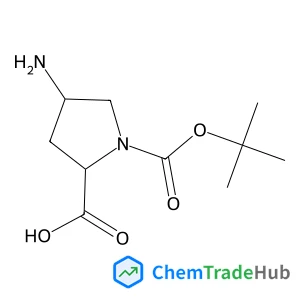
(2R,4R)-1-Boc-4-Aminopyrrolidine-2-carboxylic acid
CAS Number:
132622-98-1
Molecular Formula:
C10H18N2O4
Recommended Suppliers






Disclaimer
This page provides academic journal information for reference and research purposes only. We are not affiliated with any journal publishers and do not handle publication submissions. For publication-related inquiries, please contact the respective journal publishers directly.
If you notice any inaccuracies in the information displayed, please contact us at support@chemtradehub.com. We will promptly review and address your concerns.