



Electric-field frictional effects in confined zwitterionic molecules
Literature Information
Publication Date
2023-07-06
DOI
10.1039/D3CP00914A
Impact Factor
3.676
Authors
Melisa M. Gianetti, Roberto Guerra, Andrea Vanossi, Michael Urbakh, Nicola Manini
View Original
Abstract
We theoretically explore the effect of a transverse electric field on the frictional response of a bi-layer of packed zwitterionic molecules. The dipole-moment reorientation promoted by the electric field can lead to either stick-slip or smooth sliding dynamics, with average shear stress values varying over a wide range. A structure–property relation is revealed by investigating the array of molecules and their mutual orientation and interlocking. Moreover, the thermal friction enhancement previously observed in these molecules is shown to be suppressed by the electric field, recovering the expected thermolubricity at large-enough fields. The same holds for other basic tribological quantities, such as the external load, which can influence friction in opposite ways depending on the strength of the applied electric field. Our findings open a route for the reversible control of friction forces via electric polarization of the sliding surface.
Recommended Journals

Molecular Pharmacology

Israel Journal of Chemistry

Proceedings of the National Academy of Sciences of the United States of America

Planta Medica

Kinetics and Catalysis

Science Progress

Pure and Applied Chemistry

Journal of Physics and Chemistry of Solids

Journal of Organometallic Chemistry

Journal of Medicinal Chemistry
Related Literature
Ullmann coupling mediated assembly of an electrically driven altitudinal molecular rotor
Colin J. Murphy, Zachary C. Smith, Alex Pronschinski, Emily A. Lewis, Melissa L. Liriano, Chloe Wong, Christopher J. Ivimey, Mitchell Duffy, Wojciech Musial, Andrew J. Therrien, Samuel W. Thomas III, E. Charles H. Sykes
2015-11-03
Paper
DOI: 10.1039/C5CP05294G
How can carbon favor planar multi-coordination in boron-based clusters? Global structures of CBxEy2− (E = Al, Ga, x + y = 4)
Zhong-hua Cui, Jing-jing Sui, Yi-hong Ding
2015-10-30
Paper
DOI: 10.1039/C5CP04776E
Influence of additives on the structure of surfactant-free microemulsions
J. Marcus, D. Touraud, S. Prévost, O. Diat, T. Zemb, W. Kunz
2015-11-18
Paper
DOI: 10.1039/C5CP06364G
Excited-state dynamics of guanosine in aqueous solution revealed by time-resolved photoelectron spectroscopy: experiment and theory
Franziska Buchner, Berit Heggen, Hans-Hermann Ritze, Walter Thiel, Andrea Lübcke
2015-11-09
Paper
DOI: 10.1039/C5CP04394H
Phase transition behaviors of the supported DPPC bilayer investigated by sum frequency generation (SFG) vibrational spectroscopy and atomic force microscopy (AFM)
Heng-Liang Wu, Yujin Tong, Qiling Peng, Na Li, Shen Ye
2015-10-02
Paper
DOI: 10.1039/C5CP04960A
Synthesis of branched Pd nanocrystals with tunable structures, their growth mechanism, and enhanced electrocatalytic properties
Xueli Guo, Yiwei Tan
2015-10-26
Paper
DOI: 10.1039/C5CP05531H
Conversion of light-energy into molecular strain in the photocycle of the photoactive yellow protein
Ana P. Gamiz-Hernandez, Ville R. I. Kaila
2015-12-18
Paper
DOI: 10.1039/C5CP05244K
Theoretical study on the dehydrogenation reaction of dihydrogen bonded phenol–borane-trimethylamine in the excited state
Yonggang Yang, Yufang Liu, Dapeng Yang, Hui Li, Kai Jiang, Jinfeng Sun
2015-08-12
Paper
DOI: 10.1039/C5CP02530C
Synthesis of hollow cobalt oxide nanopowders by a salt-assisted spray pyrolysis process applying nanoscale Kirkendall diffusion and their electrochemical properties
Hyeon Seok Ju, Jung Sang Cho, Jong Hwa Kim, Yun Ju Choi, Yun Chan Kang
2015-11-05
Paper
DOI: 10.1039/C5CP06206C
Two equivalent methyl internal rotations in 2,5-dimethylthiophene investigated by microwave spectroscopy
Vinh Van, Wolfgang Stahl, Ha Vinh Lam Nguyen
2015-09-29
Communication
DOI: 10.1039/C5CP03513A
You might also like
Compound Q&A
What are the main uses of 1H-Indazole-6-carbonitrile (CAS: 141290-59-7)?
1H-Indazole-6-carbonitrile finds applications in pharmaceuticals, where it serve...
141290-59-71H-Indazole-6-carbon...
Compound Q&A
How should waste containing Dioctyl (2E)-2-butenedioate (CAS: 2997-85-5) be handled?
Waste containing Dioctyl (2E)-2-butenedioate (CAS: 2997-85-5) should be collecte...
2997-85-5Dioctyl (2E)-2-buten...
Compound Q&A
What industries use Sodium [(1,2-benzoxazol-3-ylmethyl)sulfonyl]azanide (CAS: 68291-98-5)?
Sodium [(1,2-benzoxazol-3-ylmethyl)sulfonyl]azanide is primarily used in pharmac...
68291-98-5Sodium [(1,2-benzoxa...
Compound Q&A
Are there alternatives to Dimethyl 4-(4,4,5,5-tetramethyl-1,3,2-dioxaborolan-2-yl)-2,6-pyridinedicarboxylate (CAS: 741709-66-0) in synthesis?
Dimethyl 4-(4,4,5,5-tetramethyl-1,3,2-dioxaborolan-2-yl)-2,6-pyridinedicarboxyla...
741709-66-0Dimethyl 4-(4,4,5,5-...
Compound Q&A
How should waste containing 2-Fluoro-6-hydrazinopyridine (CAS: 80714-39-2) be handled?
Waste containing 2-Fluoro-6-hydrazinopyridine (CAS: 80714-39-2) should be manage...
80714-39-22-Fluoro-6-hydrazino...
Compound Q&A
What is 6-Formyl-2-pyridinecarboxylic acid (CAS: 499214-11-8)?
6-Formyl-2-pyridinecarboxylic acid is an organic compound with the molecular for...
499214-11-86-Formyl-2-pyridinec...
Compound Q&A
What is the market or research trend for 3-(3,4-dimethoxyphenyl)-2,5-dimethyl-N-(2-morpholin-4-ylethyl)pyrazolo[1,5-a]pyrimidin-7-amine (CAS: 900874-91-1)?
Research trends for this compound indicate a focus on its potential applications...
900874-91-13-(3,4-dimethoxyphen...
Compound Q&A
How is 9H-Tribenzo[b,d,f]azepine (CAS: 29875-73-8) typically synthesized?
9H-Tribenzo[b,d,f]azepine is typically synthesized via a multi-step process invo...
29875-73-89H-Tribenzo[b,d,f]az...
Compound Q&A
How is 1-Cyclopropyl-7-ethoxy-6-fluoro-8-methoxy-4-oxo-1,4-dihydro-3-quinolinecarboxylic acid (CAS: 1797982-51-4) typically synthesized?
1-Cyclopropyl-7-ethoxy-6-fluoro-8-methoxy-4-oxo-1,4-dihydro-3-quinolinecarboxyli...
1797982-51-41-Cyclopropyl-7-etho...
Compound Q&A
How should waste containing Methyl 3-oxo-1,2,3,4-tetrahydro-6-quinoxalinecarboxylate (CAS: 671820-52-3) be handled?
Waste containing Methyl 3-oxo-1,2,3,4-tetrahydro-6-quinoxalinecarboxylate (CAS: ...
671820-52-3Methyl 3-oxo-1,2,3,4...
Source Journal
Physical Chemistry Chemical Physics

CiteScore:
5.5
Self-citation Rate:
10.3%
Articles per Year:
3036
Physical Chemistry Chemical Physics (PCCP) is an international journal co-owned by 19 physical chemistry and physics societies from around the world. This journal publishes original, cutting-edge research in physical chemistry, chemical physics and biophysical chemistry. To be suitable for publication in PCCP, articles must include significant innovation and/or insight into physical chemistry; this is the most important criterion that reviewers and Editors will judge against when evaluating submissions. The journal has a broad scope and welcomes contributions spanning experiment, theory, computation and data science. Topical coverage includes spectroscopy, dynamics, kinetics, statistical mechanics, thermodynamics, electrochemistry, catalysis, surface science, quantum mechanics, quantum computing and machine learning. Interdisciplinary research areas such as polymers and soft matter, materials, nanoscience, energy, surfaces/interfaces, and biophysical chemistry are welcomed if they demonstrate significant innovation and/or insight into physical chemistry. Joined experimental/theoretical studies are particularly appreciated when complementary and based on up-to-date approaches.
Recommended Compounds

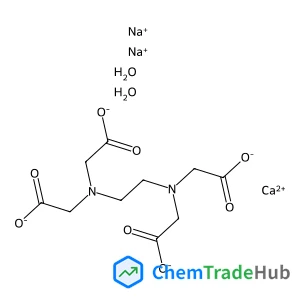
EthylenediaminetetraaceticacidcalciumDisodiumsalthydrate
CAS Number:
23411-34-9
Molecular Formula:
C10H16CaN2Na2O10
Recommended Suppliers




Disclaimer
This page provides academic journal information for reference and research purposes only. We are not affiliated with any journal publishers and do not handle publication submissions. For publication-related inquiries, please contact the respective journal publishers directly.
If you notice any inaccuracies in the information displayed, please contact us at support@chemtradehub.com. We will promptly review and address your concerns.