


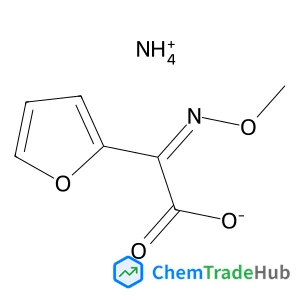
Ammonium (Z)-2-(furan-2-yl)-2-(methoxyimino)acetate
CAS Number:
97148-39-5
Molecular Formula:
C7H10N2O4
Eddy Lontchi, Marcos M. Mason, Monica Vasiliu, David A. Dixon
Structures for the mono-, di-, and tri-bridge isomers of M2O5 as well as those for the MO2 and MO3 fragments for M = V, Nb, Ta, and Pa were optimized at the density functional theory (DFT) level. Single point CCSD(T) calculations extrapolated to the complete basis set (CBS) limit at the DFT geometries were used to predict the energetics. The lowest energy dimer isomer was the di-bridge for M = V and Nb and the tri-bridge for M = Ta and Pa. The di-bridge isomers were predicted to be composed of MO2+ and MO3− fragments, whereas the mono- and tri-bridge are two MO2+ fragments linked by an O2−. The heats of formation of M2O5 dimers, as well as MO2 and MO3 neutral and ionic species were predicted using the Feller–Peterson–Dixon (FPD) approach. The heats of formation of the MF5 species were calculated to provide additional benchmarks. Dimerization energies to form the M2O5 dimers are predicted to become more negative going down group 5 and range from −29 to −45 kcal mol−1. The ionization energies (IEs) for VO2 and TaO2 are essentially the same at 8.75 eV whereas the IEs for NbO2 and PaO2 are 8.10 and 6.25 eV, respectively. The predicted adiabatic electron affinities (AEAs) range from 3.75 eV to 4.45 eV for the MO3 species and vertical detachment energies from 4.21 to 4.59 eV for MO3−. The calculated MO bond dissociation energies increase from 143 kcal mol−1 for M = V to ∼170 kcal mol−1 for M = Nb and Ta to ∼200 kcal mol−1 for M = Pa. The M–O bond dissociation energies are all similar ranging from 97 to 107 kcal mol−1. Natural bond analysis provided insights into the types of chemical bonds in terms of their ionic character. Pa2O5 is predicted to behave like an actinyl species dominated by the interactions of approximately linear PaO2+ groups.

Russian Journal of Organic Chemistry

Russian Journal of Applied Chemistry

Russian Journal of Bioorganic Chemistry

Russian Journal of General Chemistry

Journal of Saudi Chemical Society

Journal of Natural Medicines

Current Opinion in Colloid & Interface Science

Organic Process Research & Development

Saudi Pharmaceutical Journal

Drug Discovery Today
Claas H. Hövelmann, Jan Streuff, Lydia Brelot, Kilian Muñiz
DOI: 10.1039/B719479J
Debao Xiao, Longtian Kang, Zhongliang Wang, Shuxiao Zhang, Ying Ma, Hongbing Fu, Jiannian Yao
DOI: 10.1039/B803959C
Laura C. Pavelka, Simon J. Holder, Kim M. Baines
DOI: 10.1039/B801762J
DOI: 10.1039/B801786G
Alan M. Kenwright, Ilya Kuprov, Elena De Luca, David Parker, Shashi U. Pandya, P. Kanthi Senanayake, David G. Smith
DOI: 10.1039/B802838A
Masami Sakamoto, Hiroya Kawanishi, Takashi Mino, Tsutomu Fujita
DOI: 10.1039/B801524D
Navaratnarajah Kuganathan, Jennifer C. Green
DOI: 10.1039/B804636K
W. Matthew Leevy, Timothy N. Lambert, James R. Johnson, Joshua Morris, Bradley D. Smith
DOI: 10.1039/B803590C
Waste containing (6-Bromo-2-naphthyl)oxy](dimethyl)(2-methyl-2-propanyl)silane (...
7-Fluoro-4-isoquinolinecarboxylic acid can be synthesized via a multi-step proce...
2,3,5,6-Tetrabromothieno[3,2-b]thiophene is a crystalline compound with a high m...
1-[4-(Benzylamino)-7,8-dihydro-5H-pyrano[4,3-d]pyrimidin-2-yl]-2-methyl-1H-indol...
The market for imidazo[5,1-d]-1,2,3,5-tetrazine-8-carboxylic acid, 3,4-dihydro-3...
3-(Triisopropylsilyl)propiolaldehyde is a synthetic organic compound with the CA...
6-Nitro-2H-1,4-benzoxazin-3(4H)-one (CAS: 81721-87-1) is subject to various regu...
Waste containing (3-Fluorophenyl)(4-{[(2-methyl-2-propanyl)oxy]carbonyl}-1-piper...
N,N'-4,4'-Biphenyldiyldiisonicotinamide is a white crystalline solid with a mole...
6-Bromo-8-fluoro-2-quinazolinol is primarily used in the pharmaceutical industry...

Physical Chemistry Chemical Physics (PCCP) is an international journal co-owned by 19 physical chemistry and physics societies from around the world. This journal publishes original, cutting-edge research in physical chemistry, chemical physics and biophysical chemistry. To be suitable for publication in PCCP, articles must include significant innovation and/or insight into physical chemistry; this is the most important criterion that reviewers and Editors will judge against when evaluating submissions. The journal has a broad scope and welcomes contributions spanning experiment, theory, computation and data science. Topical coverage includes spectroscopy, dynamics, kinetics, statistical mechanics, thermodynamics, electrochemistry, catalysis, surface science, quantum mechanics, quantum computing and machine learning. Interdisciplinary research areas such as polymers and soft matter, materials, nanoscience, energy, surfaces/interfaces, and biophysical chemistry are welcomed if they demonstrate significant innovation and/or insight into physical chemistry. Joined experimental/theoretical studies are particularly appreciated when complementary and based on up-to-date approaches.

![(1S)-1,5-Anhydro-1-[3-(1-benzothiophen-2-ylmethyl)-4-fluorophenyl]-D-glucitol structure](https://static.chemtradehub.com/structs/761/761423-87-4-dbeb.webp "(1S)-1,5-Anhydro-1-[3-(1-benzothiophen-2-ylmethyl)-4-fluorophenyl]-D-glucitol structure")



