












Lone-pair-induced formation of intrinsic one-dimensional SbSX (X = Cl, Br, I) helix chain materials
Literature Information
Publication Date
2023-10-27
DOI
10.1039/D3CP00061C
Impact Factor
3.676
Authors
Cong Hu
View Original
Abstract
Intrinsic one-dimensional (1D) helix chain materials are extremely rare in inorganic chemistry due to their novel structural features and complex syntheses. Herein, we report a class of inborn 1D helix chains, namely 1D SbSX (X = Cl, Br, I), that can exist stably. Through ab initio calculations, we demonstrate that the formation of this helical feature is facilitated by the lone pairs in antimony atoms. Owing to the different chemical bonds induced by the lone pairs, a phase transition between different helix chain phases can occur by applying extra elongation strain. More importantly, 1D SbSX helix chains possess superior flexibility. Under large elongation strains, the elastic energy is stored via bond angle redistributions, while the average bond lengths can remain invariant. Our work not only enriches the family of intrinsic 1D helical materials, but also provides a novel avenue for the diversification of low-dimensional phase change and flexible materials.
Related Literature
A single-atom catalyst of cobalt supported on a defective two-dimensional boron nitride material as a promising electrocatalyst for the oxygen reduction reaction: a DFT study
Rongxing He, Wei Shen, Ming Li, Tao Zhang
2019-03-02
Paper
DOI: 10.1039/C9CP00452A
Towards capturing cellular complexity: combining encapsulation and macromolecular crowding in a reverse micelle
Philipp Honegger, Othmar Steinhauser
2019-03-25
Paper
DOI: 10.1039/C9CP00053D
On the involvement of d-electrons in superatomic shells: the group 3 and 4 transition metals
J. T. A. Gilmour, N. Gaston
2019-03-25
Paper
DOI: 10.1039/C9CP00323A
The effect of Fe vacancies and Cu adhesion on the magnetic properties of Fe3GeTe2
Jia Liu, Anping Wang, Kaisong Pu, Shaozheng Zhang, Terence Musho, Liang Chen
2019-03-12
Paper
DOI: 10.1039/C9CP00151D
The complete conformational panorama of formanilide–water complexes: the role of water as a conformational switch
Pablo Pinacho, Susana Blanco, Juan Carlos López
2019-01-03
Paper
DOI: 10.1039/C8CP06959J
The electric field modulation of electronic properties in a type-II phosphorene/PbI2 van der Waals heterojunction
Fei Wang, Wenli Zhang, Xiuwen Zhang
2019-03-14
Paper
DOI: 10.1039/C9CP00733D
Dimers of polycyclic aromatic hydrocarbons: the missing pieces in the soot formation process
X. Mercier, O. Carrivain, A. Faccinetto, E. Therssen
2019-03-22
Paper
DOI: 10.1039/C9CP00394K
Depletion driven self-assembly of block copolymer solutions by homopolymers
Tao Yang, Zhen Lei, Shuang Yang, Er-Qiang Chen
2019-01-03
Paper
DOI: 10.1039/C8CP06679E
DFT calculations of the synergistic effect of λ-MnO2/graphene composites for electrochemical adsorption of lithium ions
Huixin Zhang, Xiao Du, Shengqi Ding, Qiang Wang, Lutong Chang, Xuli Ma, Xiaogang Hao, Changjun Pen
2019-03-25
Paper
DOI: 10.1039/C9CP00714H
Theoretical description of the thermomolecular orientation of anisotropic colloids
2018-12-19
Paper
DOI: 10.1039/C8CP06780E
You might also like
Compound Q&A
Are there alternatives to 1-(4-Chlorophenyl)-N-hydroxymethanimine (CAS: 3848-36-0) in synthesis?
When considering alternatives to 1-(4-Chlorophenyl)-N-hydroxymethanimine (CAS: 3...
3848-36-01-(4-Chlorophenyl)-N...
Compound Q&A
How should (1R,9S,10S,12S,14E,16S,19R,20R,21S,22R)-3,9,21-Trihydroxy-5,10,12,14,16,20,22-heptamethyl-23,24-dioxatetracyclo[17.3.1.1~6,9~.0~2,7~]tetracosa-2,5,7,14-tetraen-4-one (CAS: 183202-73-5) be stored?
This compound should be stored in a cool, dry place away from direct sunlight. I...
183202-73-5(1R,9S,10S,12S,14E,1...
Compound Q&A
How is 3-(4-Bromophenyl)-5-(2-fluorophenyl)-1,2,4-oxadiazole (CAS: 419553-16-5) typically synthesized?
3-(4-Bromophenyl)-5-(2-fluorophenyl)-1,2,4-oxadiazole is synthesized through a m...
419553-16-53-(4-Bromophenyl)-5-...
Compound Q&A
How is 5-Chloro-2-(4-chlorophenyl)-4-methyl-6-[3-(1-piperidinyl)propoxy]pyrimidine (CAS: 1639220-19-1) typically synthesized?
5-Chloro-2-(4-chlorophenyl)-4-methyl-6-[3-(1-piperidinyl)propoxy]pyrimidine (CAS...
1639220-19-15-Chloro-2-(4-chloro...
Compound Q&A
What industries use 2-Chloro-4-(difluoromethoxy)pyridine (CAS: 1206978-15-5)?
2-Chloro-4-(difluoromethoxy)pyridine is used in the pharmaceutical industry for ...
1206978-15-52-Chloro-4-(difluoro...
Compound Q&A
What regulatory guidelines apply to 3-Chloro-6-methylpyridazine (CAS: 1121-79-5)?
3-Chloro-6-methylpyridazine (CAS: 1121-79-5) is classified under the Globally Ha...
1121-79-53-Chloro-6-methylpyr...
Compound Q&A
Are there alternatives to Methyl 4,5-dimethyl-2-nitrobenzoate in synthesis?
Several alternatives can be used in the synthesis of Methyl 4,5-dimethyl-2-nitro...
90922-74-0Methyl 4,5-dimethyl-...
Compound Q&A
Are there alternatives to (2E,2'E)-3,3'-(1,4-Phenylene)bisacrylaldehyde in synthesis?
Alternatives to (2E,2'E)-3,3'-(1,4-Phenylene)bisacrylaldehyde include other acry...
63405-68-5(2E,2'E)-3,3'-(1,4-P...
Compound Q&A
What is 3-Amino-5-chloropyridin-2-ol hydrochloride (CAS: 1261906-29-9)?
3-Amino-5-chloropyridin-2-ol hydrochloride is an organic compound with the CAS n...
1261906-29-93-Amino-5-chloropyri...
Compound Q&A
What precautions should be taken when handling 6,7-Difluoro-2,3-dihydro-4H-chromen-4-one (CAS: 1092349-93-3)?
When handling 6,7-Difluoro-2,3-dihydro-4H-chromen-4-one, it is essential to wear...
1092349-93-36,7-Difluoro-2,3-dih...
Source Journal
Physical Chemistry Chemical Physics

CiteScore:
5.5
Self-citation Rate:
10.3%
Articles per Year:
3036
Physical Chemistry Chemical Physics (PCCP) is an international journal co-owned by 19 physical chemistry and physics societies from around the world. This journal publishes original, cutting-edge research in physical chemistry, chemical physics and biophysical chemistry. To be suitable for publication in PCCP, articles must include significant innovation and/or insight into physical chemistry; this is the most important criterion that reviewers and Editors will judge against when evaluating submissions. The journal has a broad scope and welcomes contributions spanning experiment, theory, computation and data science. Topical coverage includes spectroscopy, dynamics, kinetics, statistical mechanics, thermodynamics, electrochemistry, catalysis, surface science, quantum mechanics, quantum computing and machine learning. Interdisciplinary research areas such as polymers and soft matter, materials, nanoscience, energy, surfaces/interfaces, and biophysical chemistry are welcomed if they demonstrate significant innovation and/or insight into physical chemistry. Joined experimental/theoretical studies are particularly appreciated when complementary and based on up-to-date approaches.
Recommended Compounds
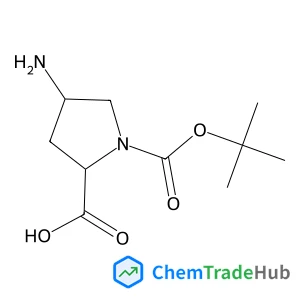
(2R,4R)-1-Boc-4-Aminopyrrolidine-2-carboxylic acid
CAS Number:
132622-98-1
Molecular Formula:
C10H18N2O4
Recommended Suppliers





Disclaimer
This page provides academic journal information for reference and research purposes only. We are not affiliated with any journal publishers and do not handle publication submissions. For publication-related inquiries, please contact the respective journal publishers directly.
If you notice any inaccuracies in the information displayed, please contact us at support@chemtradehub.com. We will promptly review and address your concerns.