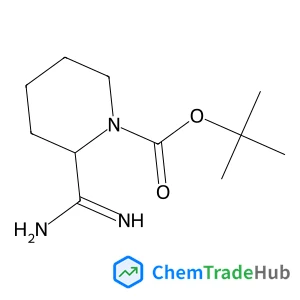
2-Methyl-2-propanyl 2-carbamimidoyl-1-piperidinecarboxylate
CAS Number:
1258640-98-0
Molecular Formula:
C11H21N3O2
Franziska Rüttger, Dietmar Stalke, Michael John
A new NMR method for structural verification and 11B resonance assignment in (car)borane clusters is presented, based on the measurement of 11B residual quadrupolar couplings (RQCs) in a stretched polystyrene (PS) gel. The method was applied to ortho-carborane (B10C2H12), a derivative thereof with reduced symmetry, meta-carborane and decaborane (B10H14).
Andrew J. Kukor, Mason A. Guy, Joel M. Hawkins, Jason E. Hein
DOI: 10.1039/D1RE00284H
Zhewei Liu, Zhoufeng Bian, Zhigang Wang, Bo Jiang
DOI: 10.1039/D1RE00401H
Qingteng Zhou, Kaijie Ni, Francesca M. Kerton
DOI: 10.1039/D1RE00111F
Lixia Liu, Chengming Wang
DOI: 10.1039/D1RE00188D
Eugenio Gómez
DOI: 10.1039/D1RE00293G
Vinodh Rajendra, Yang Chen, Michael A. Brook
DOI: 10.1039/B9PY00220K
N-(4-Methoxybenzyl)-2-pyridinamine (CAS: 52818-63-0) is increasingly being used ...
When handling Ethyl 4-(2-chlorophenyl)-1,3-thiazole-2-carboxylate, appropriate p...
Diethyldiselane (CAS: 628-39-7) is classified under the Globally Harmonized Syst...
The market for oxocopper (CAS: 12053-18-8) is primarily driven by its use in cat...
The market for 5-{[(2-Methyl-2-propanyl)oxy]carbonyl}-5-azaspiro[2.4]heptane-7-c...
2-(1-Pyrrolidinyl)-4-pyridinamine is a chemical compound with the CAS number 359...
2-(3-Pyridinyl)-1-azabicyclo[2.2.2]octane (CAS: 91556-75-1) is a crystalline sol...
(S)-Alpha-allyl-proline hydrochloride is usually synthesized via a Wittig reacti...
3-Methyl-1,2-oxazole-5-carboxylic acid (CAS: 4857-42-5) is an organic compound w...
Lys-SMCC-DM1 is synthesized via a multi-step process involving the coupling of S...

ChemComm publishes urgent research which is of outstanding significance and interest to experts in the field, while also appealing to the journal’s broad chemistry readership. Our communication format is ideally suited to short, urgent studies that are of such importance that they require accelerated publication. Our scope covers all topics in chemistry, and research at the interface of chemistry and other disciplines (such as materials science, nanoscience, physics, engineering and biology) where there is a significant novelty in the chemistry aspects. Major topic areas covered include: Analytical Chemistry Catalysis Chemical Biology and medicinal chemistry Computational Chemistry and Machine Learning Energy and sustainable chemistry Environmental Chemistry Green Chemistry Inorganic Chemistry Materials Chemistry Nanoscience Organic Chemistry Physical Chemistry Polymer Chemistry Supramolecular Chemistry
![1-[6-(1H-Imidazol-1-yl)-3-pyridinyl]methanamine structure](https://static.chemtradehub.com/structs/914/914637-08-4-8825.webp "1-[6-(1H-Imidazol-1-yl)-3-pyridinyl]methanamine structure")