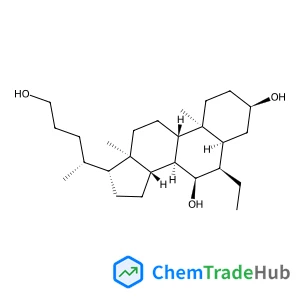
(3alpha,5beta,6alpha,7alpha)-6-Ethylcholane-3,7,24-triol
CAS Number:
1537866-49-1
Molecular Formula:
C26H46O3
Qingteng Zhou, Kaijie Ni, Francesca M. Kerton
A non-covalent supramolecular enzyme system, which is formed by non-covalent interactions of an enzyme with substrate analogs, shows better enzyme catalytic activity than the enzyme itself. A non-covalent supramolecular laccase-dye substrate analog system (SL-DSA) was designed to confirm the enzyme catalyzing mechanism. A range of spectral and electrochemical methods showed that the non-covalent interaction is important in the catalytic degradation reaction of 13 dyes. The decolorization rate was 10–54% higher than with laccase (LAC) alone. Thus, the SL-DSA has better catalytic activity than LAC itself in the three-step degradation reaction of dyes. The enzymatic mechanism of SL-DSA identified may act to supplement the mechanism of the enzyme binding directly with the substrate.
Marina Buswell, Ian Fleming
DOI: 10.1039/B210445H
Ian Fleming, Matthew G. Russell
DOI: 10.1039/B210442C
Cyril Aymonier, Ulf Schlotterbeck, Lydie Antonietti, Philipp Zacharias, Ralf Thomann, Joerg C. Tiller, Stefan Mecking
DOI: 10.1039/B208575E
Yong Zhou, Shu-Hong Yu, Arne Thomas, Bao-Hang Han
DOI: 10.1039/B210590J
Emily Chung, Dan Bizzotto, Michael O. Wolf
DOI: 10.1039/B208912B
Yasutaka Tanaka, Yoshinobu Murakami, Riemi Kiko
DOI: 10.1039/B209281F
Mercedes Álvaro, Pedro Atienzar, José L. Bourdelande, Hermenegildo García
DOI: 10.1039/B209225P
Kozo Toyota, Akitake Nakamura, Masaaki Yoshifuji
DOI: 10.1039/B209666H
Jörgen Ohlsson, Anders Sundin, Ulf J. Nilsson
DOI: 10.1039/B210649C
Serena Biella, Michele Rossi
DOI: 10.1039/B210506C
N-(4-Methoxybenzyl)-2-pyridinamine (CAS: 52818-63-0) is increasingly being used ...
When handling Ethyl 4-(2-chlorophenyl)-1,3-thiazole-2-carboxylate, appropriate p...
Diethyldiselane (CAS: 628-39-7) is classified under the Globally Harmonized Syst...
The market for oxocopper (CAS: 12053-18-8) is primarily driven by its use in cat...
The market for 5-{[(2-Methyl-2-propanyl)oxy]carbonyl}-5-azaspiro[2.4]heptane-7-c...
2-(1-Pyrrolidinyl)-4-pyridinamine is a chemical compound with the CAS number 359...
2-(3-Pyridinyl)-1-azabicyclo[2.2.2]octane (CAS: 91556-75-1) is a crystalline sol...
(S)-Alpha-allyl-proline hydrochloride is usually synthesized via a Wittig reacti...
3-Methyl-1,2-oxazole-5-carboxylic acid (CAS: 4857-42-5) is an organic compound w...
Lys-SMCC-DM1 is synthesized via a multi-step process involving the coupling of S...

Reaction Chemistry & Engineering is an interdisciplinary journal reporting cutting-edge research focused on enhancing the understanding and efficiency of reactions. Reaction engineering leverages the interface where fundamental molecular chemistry meets chemical engineering and technology. Challenges in chemistry can be overcome by the application of new technologies, while engineers may find improved solutions for process development from the latest developments in reaction chemistry. Reaction Chemistry & Engineering is a unique forum for researchers whose interests span the broad areas of chemical engineering and chemical sciences to come together in solving problems of importance to wider society. All papers should be written to be approachable by readers across the engineering and chemical sciences. Papers that consider multiple scales, from the laboratory up to and including plant scale, are particularly encouraged.
![N-{[(2-Methyl-2-propanyl)oxy]carbonyl}-L-methionylglycine structure](https://static.chemtradehub.com/structs/234/23446-03-9-e1e5.webp "N-{[(2-Methyl-2-propanyl)oxy]carbonyl}-L-methionylglycine structure")