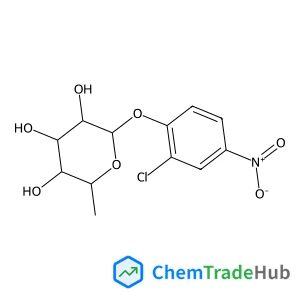
2-Chloro-4-nitrophenyl 6-deoxy-alpha-L-galactopyranoside
CAS Number:
157843-41-9
Molecular Formula:
C12H14ClNO7
Peng Xuan Zheng, Song Lin Ou, Lei Yu Qu, Ying Zhang, Shi Qing Jiang, Xiang Li, Jun Xiong Wan, Min Zhang, Xin Bao
We have utilized reversible covalent bonding to expand the accessible states of a molecular switch. Introducing a hydroxyl group onto the donor moiety of a donor–acceptor Stenhouse adduct (DASA) imparts an acidity response by forming an oxazolidine ring through intramolecular nucleophilic addition. Furthermore, we observed distinct color changes under cryogenic conditions, extending the thermal responsiveness beyond the cyclization equilibrium observed at elevated temperatures. These unique responses present promising prospects for diverse applications compared to traditional photoinduced binary isomerization.
Ulrich Sternberg, Stephan L. Grage, Raiker Witter
DOI: 10.1039/B908236K
Giuseppe Brancato, Nadia Rega
DOI: 10.1039/C003005H
Damien M. Murphy, Ian A. Fallis, Emma Carter, David J. Willock, James Landon, Sabine Van Doorslaer, Evi Vinck
DOI: 10.1039/B907807J
Usman Ali Rana, Paul M. Bayley, R. Vijayaraghavan, Douglas R. MacFarlane, Maria Forsyth
DOI: 10.1039/C0CP00156B
Akira Miyoshi, Jun-ichi Yoshida, Naoya Shiki, Mitsuo Koshi
DOI: 10.1039/B905787K
Jorge A. Boscoboinik, Florencia C. Calaza, Zeesham Habeeb, Dennis W. Bennett, Dario J. Stacchiola, Martin A. Purino, Wilfred T. Tysoe
DOI: 10.1039/C003239E
Katarzyna A. Kacprzak
DOI: 10.1039/B822765A
Maria Waechtler, Martin Sellin, Annegret Stark, Dilek Akcakayiran, Gerhard Findenegg, Anna Gruenberg, Hergen Breitzke, Gerd Buntkowsky
DOI: 10.1039/B926836G
Christian Merten, Marc Amkreutz, Andreas Hartwig
DOI: 10.1039/C004009F
Núria González-García, Matthias Olzmann
DOI: 10.1039/C0CP00284D
When handling 2-Chloro-1,2-bis(4-methylphenyl)ethanone (CAS: 71193-32-3), it is ...
4-Ethoxy-3-(5-methyl-4-oxo-7-propyl-1,4-dihydroimidazo[5,1-f][1,2,4]triazin-2-yl...
Methyl 3-Oxo-4-Androsten-17-Carboxylate (CAS: 2681-55-2) should be stored in a c...
(R)-3-Amino-4-(3-hexylphenylamino)-4-oxobutylphosphonic acid is primarily used i...
2-Methyl-2-propanyl 3-amino-3-carbamoyl-1-azetidinecarboxylate (CAS: 1254120-14-...
There are alternative reagents that can be used in synthesis instead of (E)-4-(t...
[2-(3-Chlorophenyl)-1,3-thiazol-4-yl]methanol (CAS: 121202-20-8) is a crystallin...
The market and research trends for Methyl (2S)-[(4S)-2,2-dimethyl-1,3-dioxolan-4...
The market for 1-Bromo-2-isocyanatoethane (CAS: 42865-19-0) is driven by its use...
4-Nitro-D-phenylalanine hydrochloride (CAS: 147065-06-3) is primarily used in re...

ChemComm publishes urgent research which is of outstanding significance and interest to experts in the field, while also appealing to the journal’s broad chemistry readership. Our communication format is ideally suited to short, urgent studies that are of such importance that they require accelerated publication. Our scope covers all topics in chemistry, and research at the interface of chemistry and other disciplines (such as materials science, nanoscience, physics, engineering and biology) where there is a significant novelty in the chemistry aspects. Major topic areas covered include: Analytical Chemistry Catalysis Chemical Biology and medicinal chemistry Computational Chemistry and Machine Learning Energy and sustainable chemistry Environmental Chemistry Green Chemistry Inorganic Chemistry Materials Chemistry Nanoscience Organic Chemistry Physical Chemistry Polymer Chemistry Supramolecular Chemistry