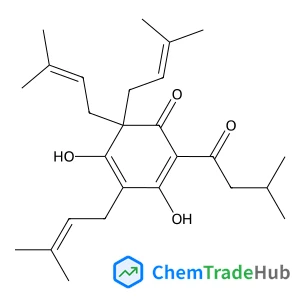
3,5-Dihydroxy-4-(3-methylbutanoyl)-2,6,6-tris(3-methyl-2-buten-1-yl)-2,4-cyclohexadien-1-one
CAS Number:
468-28-0
Molecular Formula:
C26H38O4
Ulrich Sternberg, Stephan L. Grage, Raiker Witter
A semi-empirical method for the prediction of chemical shifts, based on bond polarization theory, has recently been introduced for 13C. Here, we extended this approach to calculate the 19F chemical shift tensors of fluorine bound to aromatic rings and in aliphatic CF3groups. For the necessary parametrization, ab initio chemical shift calculations were performed at the MP2 level for a set of fluorinated molecules including tryptophan. The bond polarization parameters obtained were used to calculate the 19F chemical shift tensors for several crystalline molecules, and to reference the calculated values on a chemical shift scale relative to CFCl3. As a first biophysical application, we examined the distribution of conformations of a 19F-labeled tryptophan side chain in the membrane-bound ion channel peptide, gramicidin A. The fluorine chemical shift tensors were calculated from snapshots of a molecular dynamics simulation employing the 19F-parametrized bond polarization theory. In this MD simulation, published 2H quadrupolar and 15N–1H dipolar couplings of the indole ring were used as orientational constraints to determine the conformational distribution of the 5F-Trp13 side chain. These conformations were then used to interpret the spectra of 19F-labeled gramicidin A in fluid and gel phase lipid bilayers.
Marcio Fernando Cobo, Kateřina Maliňáková, Detlef Reichert, Kay Saalwächter, Eduardo Ribeiro deAzevedo
DOI: 10.1039/B907674C
Christopher Adam Hixson, James P. Benigni, David J. Earl
DOI: 10.1039/B905254B
O. G. Poluektov, S. V. Paschenko, L. M. Utschig
DOI: 10.1039/B906521K
Ulrich Sternberg, Stephan L. Grage, Raiker Witter
DOI: 10.1039/B908236K
Anan Tongraar
DOI: 10.1039/C0CP00136H
Alan Wong, Andy P. Howes, Ben Parkinson, Tiit Anupõld, Ago Samoson, Diane Holland, Ray Dupree
DOI: 10.1039/B906501F
Sean Garrett-Roe, Peter Hamm
DOI: 10.1039/C004579A
Alexander Schnegg, Jan Behrends, Klaus Lips, Robert Bittl, Karsten Holldack
DOI: 10.1039/B905745E
R. Azouani, S. Tieng, K. Chhor, J.-F. Bocquet, P. Eloy, E. M. Gaigneaux, K. Klementiev, A. V. Kanaev
DOI: 10.1039/B923548E
Anna Åkesson, Kristian Moss Bendtsen, Manja A. Beherens, Jan Skov Pedersen, Viveka Alfredsson, Marité Cárdenas Gómez
DOI: 10.1039/C0CP00172D
When handling 2-Chloro-1,2-bis(4-methylphenyl)ethanone (CAS: 71193-32-3), it is ...
4-Ethoxy-3-(5-methyl-4-oxo-7-propyl-1,4-dihydroimidazo[5,1-f][1,2,4]triazin-2-yl...
Methyl 3-Oxo-4-Androsten-17-Carboxylate (CAS: 2681-55-2) should be stored in a c...
(R)-3-Amino-4-(3-hexylphenylamino)-4-oxobutylphosphonic acid is primarily used i...
2-Methyl-2-propanyl 3-amino-3-carbamoyl-1-azetidinecarboxylate (CAS: 1254120-14-...
There are alternative reagents that can be used in synthesis instead of (E)-4-(t...
[2-(3-Chlorophenyl)-1,3-thiazol-4-yl]methanol (CAS: 121202-20-8) is a crystallin...
The market and research trends for Methyl (2S)-[(4S)-2,2-dimethyl-1,3-dioxolan-4...
The market for 1-Bromo-2-isocyanatoethane (CAS: 42865-19-0) is driven by its use...
4-Nitro-D-phenylalanine hydrochloride (CAS: 147065-06-3) is primarily used in re...

Physical Chemistry Chemical Physics (PCCP) is an international journal co-owned by 19 physical chemistry and physics societies from around the world. This journal publishes original, cutting-edge research in physical chemistry, chemical physics and biophysical chemistry. To be suitable for publication in PCCP, articles must include significant innovation and/or insight into physical chemistry; this is the most important criterion that reviewers and Editors will judge against when evaluating submissions. The journal has a broad scope and welcomes contributions spanning experiment, theory, computation and data science. Topical coverage includes spectroscopy, dynamics, kinetics, statistical mechanics, thermodynamics, electrochemistry, catalysis, surface science, quantum mechanics, quantum computing and machine learning. Interdisciplinary research areas such as polymers and soft matter, materials, nanoscience, energy, surfaces/interfaces, and biophysical chemistry are welcomed if they demonstrate significant innovation and/or insight into physical chemistry. Joined experimental/theoretical studies are particularly appreciated when complementary and based on up-to-date approaches.