












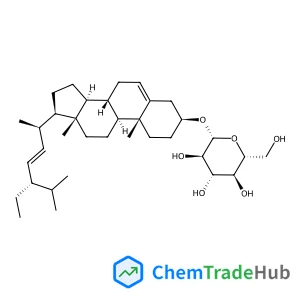
(3beta,22E)-Stigmasta-5,22-dien-3-yl beta-D-glucopyranoside
CAS Number:
19716-26-8
Molecular Formula:
C35H58O6
Usman Ali Rana, Paul M. Bayley, R. Vijayaraghavan, Douglas R. MacFarlane, Maria Forsyth
Mixtures of the plastic crystal material choline dihydrogen phosphate [Choline][DHP] and phosphoric acid, from 4.5 mol% to 18 mol% H3PO4, were investigated and shown to have significantly higher proton conductivity compared to the pure [Choline][DHP]. This was particularly evident from the electrochemical hydrogen reduction reaction and the proton NMR diffusion measurements, in addition to ionic conductivity measured from the impedance spectroscopy. The ionic conductivity was observed to increase by more than an order of magnitude in phase I (i.e. the highest temperature solid phase in [Choline][DHP]) reaching up to 10−2 S cm−1. The multinuclear NMR spectroscopy data suggest that, at least on the timescale of the NMR measurement, the H+ cations and [DHP] anions are equivalent in both phases. The pulsed field gradient NMR diffusion measurements of the 18 mol% acid sample indicate that all three ions are mobile, however the H+ diffusion coefficient is an order of magnitude higher than for the [Choline] cation or the [DHP] anion, and therefore conduction in these materials is dominated by proton conductivity. The thermal stability, as measured by TGA, is unaffected with increasing acid additions and remains high; i.e. no significant mass loss below 200 °C.
Olaf J. Borkiewicz, Karena W. Chapman, Peter J. Chupas
DOI: 10.1039/C3CP50590A
Anna Kubacka, Ana Iglesias-Juez, M. Di Michiel, Mark A. Newton, Marcos Fernández-García
DOI: 10.1039/C3CP44293D
Jonathan Keating, Gopinathan Sankar, Timothy I. Hyde, Shinji Kohara, Koji Ohara
DOI: 10.1039/C3CP50600B
Masatoshi Nakatani, Atsushi Nobuhiro, Nobuhiko Yokoshi, Hajime Ishihara
DOI: 10.1039/C3CP43834A
Sirous Asgari, Doretta Capsoni, Piercarlo Mustarelli
DOI: 10.1039/C3CP51481A
Jaehyun Moon, Jin-Ah Park, Su-Jae Lee, Jeong-Ik Lee, Taehyong Zyung, Eui-Chol Shin, Jong-Sook Lee
DOI: 10.1039/C3CP44684K
D. Fazzi, A. Milani, D. Brida, C. Manzoni, E. Cinquanta, M. Devetta, L. Ravagnan, P. Milani, F. Cataldo, L. Lüer, R. Wannemacher, J. Cabanillas-Gonzalez, M. Negro, S. Stagira, C. Vozzi
DOI: 10.1039/C3CP50508A
Yuma Matsumoto, Mai Tsubamoto, Ryoji Sugimura, Masatoshi Kozaki, Kenshi Kimoto, Munetaka Iwamura, Koichi Nozaki, Naoki Senju, Chiasa Uragami, Yohei Muramatsu, Akinori Konno
DOI: 10.1039/C3CP50182E
George Hasegawa, Mai Sannohe, Yuya Ishihara, Kazuyoshi Kanamori, Kazuki Nakanishi, Takeshi Abe
DOI: 10.1039/C3CP50352F
When handling 2-Chloro-1,2-bis(4-methylphenyl)ethanone (CAS: 71193-32-3), it is ...
4-Ethoxy-3-(5-methyl-4-oxo-7-propyl-1,4-dihydroimidazo[5,1-f][1,2,4]triazin-2-yl...
Methyl 3-Oxo-4-Androsten-17-Carboxylate (CAS: 2681-55-2) should be stored in a c...
(R)-3-Amino-4-(3-hexylphenylamino)-4-oxobutylphosphonic acid is primarily used i...
2-Methyl-2-propanyl 3-amino-3-carbamoyl-1-azetidinecarboxylate (CAS: 1254120-14-...
There are alternative reagents that can be used in synthesis instead of (E)-4-(t...
[2-(3-Chlorophenyl)-1,3-thiazol-4-yl]methanol (CAS: 121202-20-8) is a crystallin...
The market and research trends for Methyl (2S)-[(4S)-2,2-dimethyl-1,3-dioxolan-4...
The market for 1-Bromo-2-isocyanatoethane (CAS: 42865-19-0) is driven by its use...
4-Nitro-D-phenylalanine hydrochloride (CAS: 147065-06-3) is primarily used in re...

Physical Chemistry Chemical Physics (PCCP) is an international journal co-owned by 19 physical chemistry and physics societies from around the world. This journal publishes original, cutting-edge research in physical chemistry, chemical physics and biophysical chemistry. To be suitable for publication in PCCP, articles must include significant innovation and/or insight into physical chemistry; this is the most important criterion that reviewers and Editors will judge against when evaluating submissions. The journal has a broad scope and welcomes contributions spanning experiment, theory, computation and data science. Topical coverage includes spectroscopy, dynamics, kinetics, statistical mechanics, thermodynamics, electrochemistry, catalysis, surface science, quantum mechanics, quantum computing and machine learning. Interdisciplinary research areas such as polymers and soft matter, materials, nanoscience, energy, surfaces/interfaces, and biophysical chemistry are welcomed if they demonstrate significant innovation and/or insight into physical chemistry. Joined experimental/theoretical studies are particularly appreciated when complementary and based on up-to-date approaches.


![(1R)-3-Bromo-1,7,7-trimethylbicyclo[2.2.1]heptan-2-one structure](https://static.chemtradehub.com/structs/102/10293-06-8-dd8a.webp "(1R)-3-Bromo-1,7,7-trimethylbicyclo[2.2.1]heptan-2-one structure")





