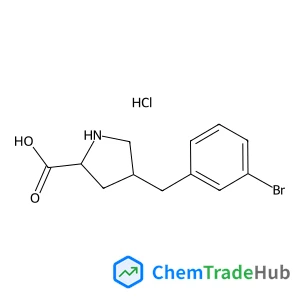
(2S,4R)-4-(3-Bromobenzyl)pyrrolidine-2-carboxylic acid hydrochloride
CAS Number:
1049734-10-2
Molecular Formula:
C12H15BrClNO2
Pol Salles, Pamela Machado, Pengmei Yu, Mariona Coll
Oxides offer unique physical and chemical properties that inspire rapid advances in materials chemistry to design and nanoengineer materials compositions and implement them in devices for a myriad of applications. Chemical deposition methods are gaining attention as a versatile approach to develop complex oxide thin films and nanostructures by properly selecting compatible chemical precursors and designing an accurate cost-effective thermal treatment. Here, upon describing the basics of chemical solution deposition (CSD) and atomic layer deposition (ALD), some examples of the growth of chemically-deposited functional complex oxide films that can have applications in energy and electronics are discussed. To go one step further, the suitability of these techniques is presented to prepare freestanding complex oxides which can notably broaden their applications. Finally, perspectives on the use of chemical methods to prepare future materials are given.
Xin Zhao, Jianyong Feng, Shi Chen, Yizhong Huang, Tze Chien Sum, Zhong Chen
DOI: 10.1039/C6CP06410H
F. Aguilera-Granja, L. C. Balbás, A. Vega
DOI: 10.1039/C6CP06225C
Ruge Quhe, Shenyan Feng, Ming Lei
DOI: 10.1039/C6CP06583J
Daniel A. Jacobs, Yiliang Wu, Heping Shen, Chog Barugkin, Fiona J. Beck, Thomas P. White, Klaus Weber, Kylie R. Catchpole
DOI: 10.1039/C6CP06989D
Giuseppe Cassone, Franz Saija, Ernesto Di Mauro, A. Marco Saitta, Judit E. Šponer
DOI: 10.1039/C6CP07993H
Jianzhong Chen, Jinan Wang, Weiliang Zhu
DOI: 10.1039/C6CP08105C
Martin R. S. McCoustra
DOI: 10.1039/C6CP06928B
Tianli Wu, Mingyu Pi, Xiaodeng Wang, Dingke Zhang, Shijian Chen
DOI: 10.1039/C6CP07294A
DOI: 10.1039/C6CP07834F
2-(2-Chloroacetamido)-3-phenylpropanoic acid (CAS: 7765-11-9) is generally consi...
2-(Benzyloxy)-5-bromobenzoic acid can be handled safely if appropriate precautio...
(4-Methyl-1,2,5-oxadiazol-3-yl)methanamine hydrochloride is a chemical compound ...
2-(5-Hexylthiophen-2-yl)-4,4,5,5-tetramethyl-1,3,2-dioxaborolane (CAS: 917985-54...
While 4-(8-Methyl-9H-1,3-dioxolo[4,5-h][2,3]benzodiazepin-5-yl)benzenamine (CAS:...
The market for tert-butyl 3-hydroxy-4,5,7,8-tetrahydro-2H-pyrazolo[3,4-d]azepine...
Waste containing 3,5-Diamino-1H-pyrazole-4-carbonitrile (CAS: 6844-58-2) should ...
(6-Fluoro-3-pyridinyl)boronic acid can be synthesized through the reaction of 6-...
Dibenzyl carbonimidoylbiscarbamate (CAS: 10065-79-9) finds applications in vario...
The market for (beta,beta,2,3,4,5,6-~2~H_7_)Phenylalanine (CAS: 74228-83-4) is g...

ChemComm publishes urgent research which is of outstanding significance and interest to experts in the field, while also appealing to the journal’s broad chemistry readership. Our communication format is ideally suited to short, urgent studies that are of such importance that they require accelerated publication. Our scope covers all topics in chemistry, and research at the interface of chemistry and other disciplines (such as materials science, nanoscience, physics, engineering and biology) where there is a significant novelty in the chemistry aspects. Major topic areas covered include: Analytical Chemistry Catalysis Chemical Biology and medicinal chemistry Computational Chemistry and Machine Learning Energy and sustainable chemistry Environmental Chemistry Green Chemistry Inorganic Chemistry Materials Chemistry Nanoscience Organic Chemistry Physical Chemistry Polymer Chemistry Supramolecular Chemistry
![2-[(E)-(2-Methoxyphenyl)diazenyl]-3-oxo-N-(2-oxo-2,3-dihydro-1H-benzimidazol-5-yl)butanamide structure](https://static.chemtradehub.com/structs/821/82199-12-0-f1d0.webp "2-[(E)-(2-Methoxyphenyl)diazenyl]-3-oxo-N-(2-oxo-2,3-dihydro-1H-benzimidazol-5-yl)butanamide structure")
![Ethyl ({[(2-methyl-2-propanyl)oxy]carbonyl}amino)(2-pyridinyl)acetate structure](https://static.chemtradehub.com/structs/313/313490-90-3-dd15.webp "Ethyl ({[(2-methyl-2-propanyl)oxy]carbonyl}amino)(2-pyridinyl)acetate structure")