











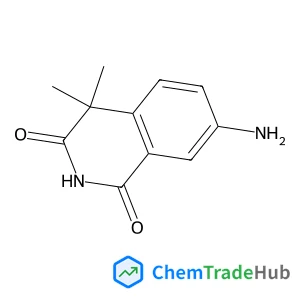
1,3(2H,4H)-Isoquinolinedione, 7-amino-4,4-dimethyl-
CAS Number:
14576-22-8
Molecular Formula:
C11H12N2O2
Yu-Nan Chen, Xu-Yang Shen, Yue Yu, Chen-Yu Xue, Ying-Lin Zhou, Xin-Xiang Zhang
Nucleosides have been found to suffer in-source fragmentation (ISF) in electrospray ionization mass spectrometry, which leads to reduced sensitivity and ambiguous identification. In this work, a combination of theoretical calculations and nuclear magnetic resonance analysis revealed the key role of protonation at N3 near the glycosidic bond during ISF. Therefore, an ultrasensitive liquid chromatography-tandem mass spectrometry system for 5-formylcytosine detection was developed with 300 fold signal enhancement. Also, we established a MS1-only platform for nucleoside profiling and successfully identified sixteen nucleosides in the total RNA of MCF-7 cells. Taking ISF into account, we can realize analysis with higher sensitivity and less ambiguity, not only for nucleosides, but for other molecules with similar protonation and fragmentation behaviors.
L. Wang, G. Arrabito
DOI: 10.1039/C5AN00861A
Xiao-He Xiao, Jia-Bo Wang, Yan-Ling Zhao, Mei-Hua Yang
DOI: 10.1039/C2AN36084E
M. Groessl, S. Graf, R. Knochenmuss
DOI: 10.1039/C5AN00838G
Bailu Xu, Chuanqi Zhao, Weili Wei, Jinsong Ren, Daisuke Miyoshi, Naoki Sugimoto, Xiaogang Qu
DOI: 10.1039/C2AN36174D
Subash Prakash, Seenivasan Rajesh, Sarkkarai Raja Singh, Chandran Karunakaran, Veerapandy Vasu
DOI: 10.1039/C2AN36347J
Lydia M. Young, Rachel A. Mahood, Janet C. Saunders, Ling-Hsien Tu, Sheena E. Radford, Alison E. Ashcroft
DOI: 10.1039/C5AN00865D
Imran I. Patel, Júlio Trevisan, Takahiro Nakamura, Carol J. Hirschmugl, Nigel J. Fullwood, Francis L. Martin
DOI: 10.1039/C2AN36197C
Wayne L. O'Brien, Nicholas D. Boltin, Zhenyu Lu, Brianna M. Cassidy, Raymond G. Belliveau, Emory J. Straub, Stephanie A. DeJong, Stephen L. Morgan, M. L. Myrick
DOI: 10.1039/C5AN01413A
4-Nitrophenyl phosphate disodium salt hexahydrate is primarily used as a substra...
2-(Trifluoromethyl)-1,3-oxazole-4-carboxylic Acid (CAS: 1060816-01-4) is widely ...
2-Fluoro-4-biphenylcarboxylic acid should be stored in a cool, dry place at room...
Prednisolone-21-Carboxylic Acid is primarily used in the pharmaceutical industry...
4-(Hydrazinomethyl)-1,2,3-benzenetriol (CAS: 3614-72-0) should be stored in a co...
4-Amino-1-methyl-1H-pyrazole-5-carboxylic acid hydrochloride (CAS: 92534-70-8) i...
Dehydropachymic acid (CAS: 77012-31-8) is regulated by various agencies. It fall...
The market and research trends for 6-[(2,2-Dimethylpropanoyl)amino]nicotinic aci...
1,10-Phenanthroline-2,9-dicarbaldehyde should be stored in a cool, dry place awa...
5-Carbamoyl-11-oxo-10,11-dihydro-5H-dibenzo[b,f]azepin-10-yl acetate can be synt...

Analyst publishes analytical and bioanalytical research that reports premier fundamental discoveries and inventions, and the applications of those discoveries, unconfined by traditional discipline barriers.
![S-[2,3-Bis(palmitoyloxy)propyl]-N-[(9H-fluoren-9-ylmethoxy)(hydroxy)methylene]cysteine structure](https://static.chemtradehub.com/structs/210/210532-98-2-f6a7.webp "S-[2,3-Bis(palmitoyloxy)propyl]-N-[(9H-fluoren-9-ylmethoxy)(hydroxy)methylene]cysteine structure")







