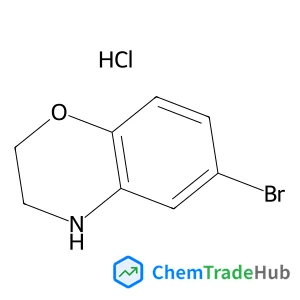
6-Bromo-3,4-dihydro-2H-1,4-benzoxazine hydrochloride (1:1)
CAS Number:
1260803-10-8
Molecular Formula:
C8H9BrClNO
L. Wang, G. Arrabito
We herein aim to report on the fabrication of DNA nano-heterostructures usable as a robust multi-functional analytical system to obtain multiple and complex data in parallel format from a single sample with unprecedented analytical performances. The ability of chemical information contained in the sequences of programmed DNA structures to organize matter made DNA become a unique material in “the nanoworld”. Such carefully designed DNA nanostructures can then be functionalized/templated with different biomolecules/nanomaterials as different as nanoparticles, nanowires, organic molecules, peptides, and proteins with controlled spacing on the nanometer scale (<10 nm). In this way, it is possible to combine the properties of both DNA and nanomaterials for exposing the designed functionality and customizable geometrical hetero-nanostructures. By coupling automated on-chip high yield DNA synthesis with low cost detection methods, DNA-nanotechnology can enable the realization of high-sensitivity, multiplexed bioanalytical assays for many different applications like diagnostics, drug screening, toxicology, immunology and biosensors.
Yasuhiro Kubota, Masato Nakazawa, Junheon Lee, Ryoma Naoi, Motoki Tachikawa, Toshiyasu Inuzuka, Kazumasa Funabiki, Masaki Matsui, Taekyeong Kim
DOI: 10.1039/D1QO01169C
Xue-Jiao Lv, Yong-Chao Ming, Hui-Chun Wu
DOI: 10.1039/D1QO01135A
Adesh Kumar Singh, Jeyakumar Kandasamy
DOI: 10.1039/C8OB01393D
Ramanathan Devenderan
DOI: 10.1039/C8OB00818C
Soumendranath Mukhopadhyay, Subhas Chandra Pan
DOI: 10.1039/C8OB01399C
Graham W. Heberlig, Jesse T. C. Brown, Ryan D. Simard, Monica Wirz, Wei Zhang, Meng Wang, Leah I. Susser, Mark E. Horsman, Christopher N. Boddy
DOI: 10.1039/C8OB01512K
Zhou Sun, Kuirong Xiang, Hua Tao, Liqun Guo, Ying Li
DOI: 10.1039/C8OB01731J
F. Gao, C. Ieritano, K.-T. Chen, G. M. Dias, J. Rousseau, Y. Seimbille
DOI: 10.1039/C8OB01434E
4-Nitrophenyl phosphate disodium salt hexahydrate is primarily used as a substra...
2-(Trifluoromethyl)-1,3-oxazole-4-carboxylic Acid (CAS: 1060816-01-4) is widely ...
2-Fluoro-4-biphenylcarboxylic acid should be stored in a cool, dry place at room...
Prednisolone-21-Carboxylic Acid is primarily used in the pharmaceutical industry...
4-(Hydrazinomethyl)-1,2,3-benzenetriol (CAS: 3614-72-0) should be stored in a co...
4-Amino-1-methyl-1H-pyrazole-5-carboxylic acid hydrochloride (CAS: 92534-70-8) i...
Dehydropachymic acid (CAS: 77012-31-8) is regulated by various agencies. It fall...
The market and research trends for 6-[(2,2-Dimethylpropanoyl)amino]nicotinic aci...
1,10-Phenanthroline-2,9-dicarbaldehyde should be stored in a cool, dry place awa...
5-Carbamoyl-11-oxo-10,11-dihydro-5H-dibenzo[b,f]azepin-10-yl acetate can be synt...

Analyst publishes analytical and bioanalytical research that reports premier fundamental discoveries and inventions, and the applications of those discoveries, unconfined by traditional discipline barriers.
![[(1S,2S,3R,4S,7R,9S,10S,12R,15S)-4,12-Diacetyloxy-15-[(2R,3S)-3-benzamido-3-phenyl-2-(2,2,2-trichloroethoxycarbonyloxy)propanoyl]oxy-1,9-dihydroxy-10,14,17,17-tetramethyl-11-oxo-6-oxatetracyclo[11.3.1.03,10.04,7]heptadec-13-en-2-yl] benzoate structure](https://static.chemtradehub.com/structs/100/100431-55-8-7104.webp "[(1S,2S,3R,4S,7R,9S,10S,12R,15S)-4,12-Diacetyloxy-15-[(2R,3S)-3-benzamido-3-phenyl-2-(2,2,2-trichloroethoxycarbonyloxy)propanoyl]oxy-1,9-dihydroxy-10,14,17,17-tetramethyl-11-oxo-6-oxatetracyclo[11.3.1.03,10.04,7]heptadec-13-en-2-yl] benzoate structure")