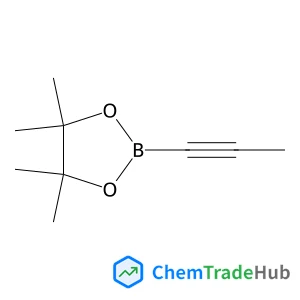
4,4,5,5-Tetramethyl-2-(1-propyn-1-YL)-1,3,2-dioxaborolane
CAS Number:
347389-75-7
Molecular Formula:
C9H15BO2
Liane Meneses, Nicolás F. Gajardo-Parra, Esteban Cea-Klapp, José Matías Garrido, Christoph Held, Ana Rita Duarte, Alexandre Paiva
In this work, the activity of horseradish peroxidase (HRP) in betaine-based natural deep eutectic systems (NADESs) was measured and studied by molecular simulations. Focus was laid on enzymatic activity in the NADESs under thermal stress as well as under the influence of water. Furthermore, the structure of HRP under these different conditions was measured by circular dichroism (CD). As a result, HRP remains enzymatically active in all NADESs upon incubation for 24 h at 37 °C and 60 °C and after 4 h at 80 °C, especially when incubated in a NADES composed of betaine, trehalose, glycerol, and water, in a molar ratio of 2 : 1 : 3 : 5. The CD studies have shown that high activity is obtained in the systems that promoted higher α-helix contents. The molecular simulations showed that using a NADES instead of buffer solvent reduces HRP flexibility, and we found that enzymatic activity correlates with Gibbs energy of solvation of HRP. Finally, hydrophobic hydration interactions govern the stabilization mechanism of the HRP folded state as shown by a drastic enzymatic activity drop upon 5 wt% water addition using a betaine: glycerol NADES as solvent.

Russian Chemical Bulletin

Journal of Natural Medicines

Russian Journal of Coordination Chemistry

Saudi Pharmaceutical Journal

Chemistry Education Research and Practice

Russian Journal of General Chemistry

New Journal of Chemistry

Drug Discovery Today

Organic Process Research & Development

Russian Journal of Applied Chemistry
Harald Solheim, Kenneth Ruud, Marcel Nooijen, Fabrizio Santoro, Xian Zhao, Marcin Kwit, Pawel Skowronek
DOI: 10.1039/C2CP23584F
Andrew S. Powell, Zlatka Stoeva, James S. Lord, Ronald I. Smith, Duncan H. Gregory, Jeremy J. Titman
DOI: 10.1039/C2CP43318D
DOI: 10.1039/C2CP42994B
Jinsoo Kim, Hee-Dae Lim, Hyeokjo Gwon, Kisuk Kang
DOI: 10.1039/C3CP43225D
Christian Schröder
DOI: 10.1039/C2CP23329K
F. Lufrano, V. Baglio, O. Di Blasi, P. Staiti, V. Antonucci, A. S. Aricò
DOI: 10.1039/C2CP23477G
Jin-Sung Park, Sook Ho Kim, Nam-Kyung Lee, Kyoung J. Lee, Seok-Cheol Hong
DOI: 10.1039/C2CP23551J
Chris Medcraft, Don McNaughton, Chris D. Thompson, Dominique R. T. Appadoo, Sigurd Bauerecker, Evan G. Robertson
DOI: 10.1039/C3CP43974G
2-Methylbenzene-1,4-diamine dihydrochloride (CAS: 615-45-2) should be stored in ...
(1S,4S)-2,5-Diazabicyclo[2.2.1]heptane dihydrobromide is generally considered sa...
(6-Chloropyridazin-3-YL)methanamine finds applications in the pharmaceutical ind...
2-Fluoro-3-methylphenol is primarily used in the synthesis of pharmaceuticals, p...
When handling 3-Methoxy-4-nitrobenzonitrile, it is important to wear appropriate...
When handling 1,3-Oxazolo[4,5-b]pyridine-2(3H)-thione (CAS: 211949-57-4), it is ...
4-Ethynylbenzamide (CAS: 90347-86-7) falls under various regulatory guidelines i...
3-(2-Ethylphenyl)-2-thioxo-4-imidazolidinone is primarily used as an intermediat...
(2-Fluoro-6-methoxyphenyl)acetic acid, also known as 4-fluoro-3-methoxybenzoic a...
Market trends for 2-[4-(Hydroxymethyl)phenoxy]ethanol (CAS: 102196-18-9) indicat...
![3-[(3R,4R)-3-[(6-aminopyrimidin-4-yl)-methyl-amino]-4-methyl-1-piperidyl]-3-oxo-propanenitrile structure](https://static.chemtradehub.com/structs/164/1640971-60-3-83a4.webp "3-[(3R,4R)-3-[(6-aminopyrimidin-4-yl)-methyl-amino]-4-methyl-1-piperidyl]-3-oxo-propanenitrile structure")
![Methyl 2-[5-(3-Phenoxyphenyl)-2H-tetrazol-2-yl]acetate structure](https://static.chemtradehub.com/structs/130/1305320-60-8-84b4.webp "Methyl 2-[5-(3-Phenoxyphenyl)-2H-tetrazol-2-yl]acetate structure")