












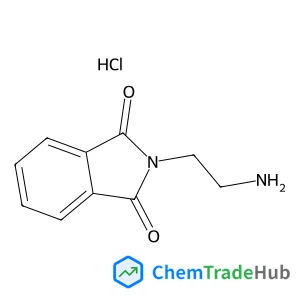
2-(2-Aminoethyl)-1H-isoindole-1,3(2H)-dione hydrochloride (1:1)
CAS Number:
30250-67-0
Molecular Formula:
C10H11ClN2O2
The first page of this article is displayed as the abstract.
DOI: 10.1039/D0CP02470H
João R. Robalo, Denilson Mendes de Oliveira, Petra Imhof, Dor Ben-Amotz, Ana Vila Verde
DOI: 10.1039/D0CP04205F
Jingyu Li, Chi Zhang, Peng-Fei Liu
DOI: 10.1039/D0CP03226C
Alexandra Schindl, Rebecca R. Hawker, Karin S. Schaffarczyk McHale, Kenny T.-C. Liu, Andrew Y. Hsieh, Alyssa Gilbert, Stuart W. Prescott, Ronald S. Haines, Anna K. Croft, Jason B. Harper, Christof M. Jäger
DOI: 10.1039/D0CP04224B
Lei Gao, Hai-Qing Lin
DOI: 10.1039/D0CP04020G
Yang Liu, Hongwei Song, Jun Li
DOI: 10.1039/D0CP04120C
Sushil Sharma, Zimu Wei, Ferdinand C. Grozema, Sanchita Sengupta
DOI: 10.1039/D0CP04579A
Eduardo Martín Rico-Sotomayor, José Enrique Barquera-Lozada
DOI: 10.1039/D0CP03305G
M. Guruprasad Reddy, Nitin P. Lobo, Arun Roy, K. V. Ramanathan, T. Narasimhaswamy
DOI: 10.1039/D0CP03933K
V. H. Shafeeq, G. Unnikrishnan
DOI: 10.1039/D0CP04275G
Waste containing 2-Ethyl-4-Methyl-1H-Imidazole-5-Carbaldehyde (CAS: 88634-80-4) ...
Triethoxy(octyl)silane (CAS: 1385031-14-0) is widely used in the pharmaceuticals...
Several alternatives to 3-iodo-7-nitro-1H-indazole (CAS: 864724-64-1) exist in t...
Yes, there are alternatives to Benzene, bis[(trimethoxysilyl)ethyl] (CAS: 266317...
Isothiazole-3-carbonitrile (CAS: 1452-17-1) is generally considered safe when us...
(3-Chlorophenyl)methanol (CAS: 873-63-2) is considered low to moderately toxic. ...
(2S,3S)-2-Hydroxy-3-({[(2-methyl-2-propanyl)oxy]carbonyl}amino)-3-(2-naphthyl)pr...
Proper handling of methyl 2-(bromomethyl)-5-methoxybenzoate requires the use of ...
6,8-Dibromoimidazo[1,2-a]pyridine-2-carboxylic acid (CAS: 904805-36-3) is an aro...
3-Amino-5-bromo-2-pyridinecarbonitrile is considered safe when handled under pro...

Reaction Chemistry & Engineering is an interdisciplinary journal reporting cutting-edge research focused on enhancing the understanding and efficiency of reactions. Reaction engineering leverages the interface where fundamental molecular chemistry meets chemical engineering and technology. Challenges in chemistry can be overcome by the application of new technologies, while engineers may find improved solutions for process development from the latest developments in reaction chemistry. Reaction Chemistry & Engineering is a unique forum for researchers whose interests span the broad areas of chemical engineering and chemical sciences to come together in solving problems of importance to wider society. All papers should be written to be approachable by readers across the engineering and chemical sciences. Papers that consider multiple scales, from the laboratory up to and including plant scale, are particularly encouraged.
![N-[(9H-Fluoren-9-ylmethoxy)carbonyl]-beta-phenyl-L-phenylalanine structure](https://static.chemtradehub.com/structs/201/201484-50-6-c2fc.webp "N-[(9H-Fluoren-9-ylmethoxy)carbonyl]-beta-phenyl-L-phenylalanine structure")
![Ethyl 3-((6-(4,5-dihydro-1H-benzo[d]azepin-3(2H)-yl)-2-(pyridin-2-yl)pyrimidin-4-yl)amino)propanoate structure](https://static.chemtradehub.com/structs/137/1373423-53-0-496a.webp "Ethyl 3-((6-(4,5-dihydro-1H-benzo[d]azepin-3(2H)-yl)-2-(pyridin-2-yl)pyrimidin-4-yl)amino)propanoate structure")





