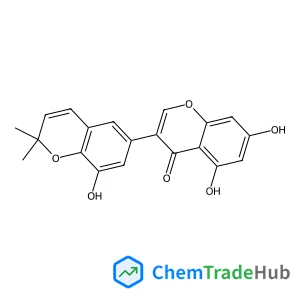
5,7,8'-Trihydroxy-2',2'-dimethyl-2'H,4H-3,6'-bichromen-4-one
CAS Number:
129280-33-7
Molecular Formula:
C20H16O6
Satyam Singh, Rajesh K. Yadav, Tae Wu Kim, Chandani Singh, Pooja Singh, Atul P. Singh, Alok Kumar Singh, Atresh Kumar Singh, Jin-Ook Baeg, Sarvesh Kumar Gupta
We report that generating (formic acid) and regenerating (NADH/NADPH) from CO2 and NAD+/NADP+ using a nitrogen-rich polymeric carbon nitride catalytic–biocatalytic system under solar light (λ > 420 nm) could provide a new approach for storage of clean energy. In situ thermally copolymerized urea along with a 1,4-diaminoanthraquinone (AQ) monomer using a modified carbon nitride (CN) photocatalyst (AQBCN) was undertaken. The artificial AQBCN photocatalyst–biocatalyst system led to formic acid (344.12 μmol) generation and NADH/NADPH regeneration (97.21/95%) in comparison with monomers. Our method could be employed to develop an AQBCN photocatalyst for selective regeneration of NADH/NADPH and CO2 generation.

Journal of Asian Natural Products Research

Critical Reviews in Solid State and Materials Sciences

Cellulose

Bioorganic & Medicinal Chemistry

Atomization and Sprays

Bioorganic & Medicinal Chemistry Letters

Medicinal Chemistry Research

Acta Metallurgica Sinica-English Letters

Heteroatom Chemistry

Chinese Journal of Chemistry
Lin-Tai Da, Mengna Lin
DOI: 10.1039/C9CP04613E
Isabel Peña, Carlos Cabezas
DOI: 10.1039/D0CP04580B
Hassan Ghermezcheshme, Hesam Makki, Mohsen Mohseni, Morteza Ebrahimi
DOI: 10.1039/D0CP04244G
Honghui Zhang, Wenjin Li
DOI: 10.1039/D0CP04162A
Jinjie Gu, Xilong Qu
DOI: 10.1039/D0CP04565A
Prasanta Bandyopadhyay, Soumyadip Ray, Md. Motin Seikh
DOI: 10.1039/C9CP05374C
Wenhui Hu, Fan Yang, Nick Pietraszak, Jing Gu, Jier Huang
DOI: 10.1039/D0CP03995K
Xiaoxiao Lu, Bina Fu, Dong H. Zhang
DOI: 10.1039/D0CP04611F
E. M. Gavilán-Arriazu, Rodrigo E. Giménez, O. A. Pinto
DOI: 10.1039/D0CP03348K
Waste containing 2-Ethyl-4-Methyl-1H-Imidazole-5-Carbaldehyde (CAS: 88634-80-4) ...
Triethoxy(octyl)silane (CAS: 1385031-14-0) is widely used in the pharmaceuticals...
Several alternatives to 3-iodo-7-nitro-1H-indazole (CAS: 864724-64-1) exist in t...
Yes, there are alternatives to Benzene, bis[(trimethoxysilyl)ethyl] (CAS: 266317...
Isothiazole-3-carbonitrile (CAS: 1452-17-1) is generally considered safe when us...
(3-Chlorophenyl)methanol (CAS: 873-63-2) is considered low to moderately toxic. ...
(2S,3S)-2-Hydroxy-3-({[(2-methyl-2-propanyl)oxy]carbonyl}amino)-3-(2-naphthyl)pr...
Proper handling of methyl 2-(bromomethyl)-5-methoxybenzoate requires the use of ...
6,8-Dibromoimidazo[1,2-a]pyridine-2-carboxylic acid (CAS: 904805-36-3) is an aro...
3-Amino-5-bromo-2-pyridinecarbonitrile is considered safe when handled under pro...

Reaction Chemistry & Engineering is an interdisciplinary journal reporting cutting-edge research focused on enhancing the understanding and efficiency of reactions. Reaction engineering leverages the interface where fundamental molecular chemistry meets chemical engineering and technology. Challenges in chemistry can be overcome by the application of new technologies, while engineers may find improved solutions for process development from the latest developments in reaction chemistry. Reaction Chemistry & Engineering is a unique forum for researchers whose interests span the broad areas of chemical engineering and chemical sciences to come together in solving problems of importance to wider society. All papers should be written to be approachable by readers across the engineering and chemical sciences. Papers that consider multiple scales, from the laboratory up to and including plant scale, are particularly encouraged.